Cotton crepe and elastic adhesive bandages solve different problems: one retains a dressing or gives light support, while the other fixes itself and maintains more consistent support during movement. By comparing fixation, stretch, skin contact, application technique and procurement specifications, you can select the safer option and avoid confusing either bandage with padding or a prescribed compression system.
Key takeaways
- Choose cotton crepe for adjustable retention and light support.
- Choose elastic adhesive bandage for sustained fixation on intact skin.
- Wrap smoothly and overlap evenly to prevent pressure points.
- Ask Santiago suppliers for material, width, length and packaging details.
Fixation or compression: what each bandage actually does
Choose cotton crepe bandage for adjustable dressing retention or light support when skin tolerance matters; choose elastic adhesive bandage for sustained fixation during movement when intact skin can tolerate adhesive.
| Option | How it stays in place | Adjustment and removal |
|---|---|---|
| Cotton crepe bandage | Woven, crimped textile; usually needs clips, tape or a tubular retention layer because it can loosen, wrinkle or slip | Easy to reposition and remove, with no direct adhesive exposure |
| Elastic adhesive bandage | Extensible textile with a pressure-sensitive adhesive; normally needs no separate clips | Less likely to migrate, but difficult to reposition once stuck and painful skin injury can occur during removal |
| Cohesive bandage | Adheres mainly to itself, not to skin | Not equivalent to an adhesive skin-contact product |
“Elastic” does not define compression. Pressure depends on tension, limb circumference, bandage width, layers, overlap and limb contour. A narrow wrap, wrinkle or tight edge can create a local pressure peak and a tourniquet effect; thicker or stretchier material is not automatically safer.
Specify the fibre composition and elongation of cotton crepe bandage rather than relying on its name. A product containing synthetic or elastomeric yarns can behave differently from a non-elastic cotton weave.
Neither bandage is the primary dressing for a highly exuding wound. Use a sterile absorbent wound-contact layer when indicated, then select the outer bandage for retention or support.
- Choose cotton crepe when you need repeated adjustment, light support or avoidance of adhesive contact.
- Choose elastic adhesive bandage when movement demands sustained fixation and the skin is intact and robust.
- Stop and remove or loosen the wrap for numbness, tingling, increasing pain, cold digits, pale or blue skin, or worsening swelling.
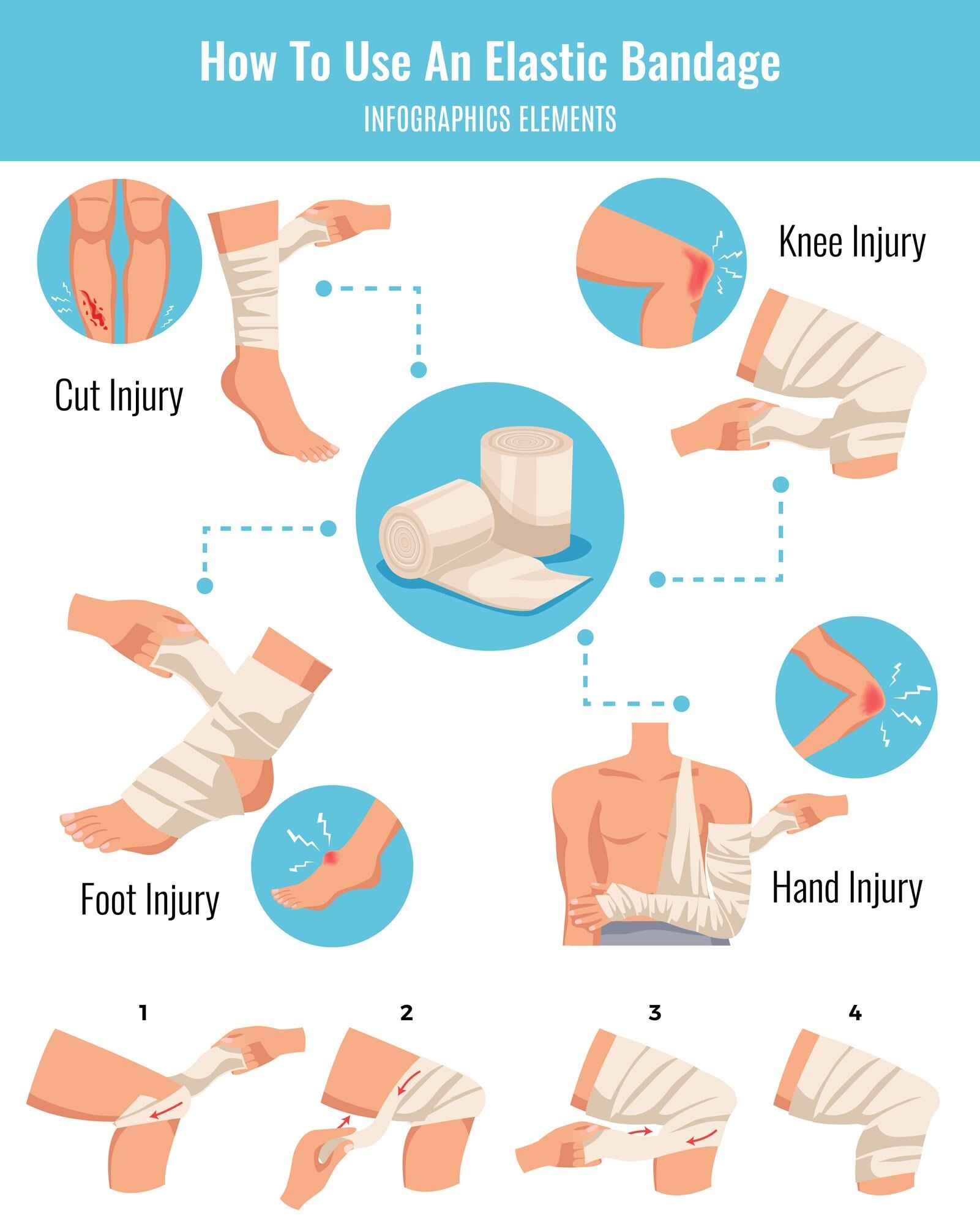
How to wrap either bandage without creating pressure points
1. Start at the far end of the limb and wrap toward the body. Cover the dressing, but leave fingers or toes outside the wrap so you can inspect them and avoid trapping them inside.
2. Overlap each turn by about half the bandage width, unless the manufacturer or clinician specifies another pattern. Use smooth, even tension; do not pull the roll to maximum stretch.
3. Keep the bandage flat. Unfold a wrinkle rather than covering it with another layer, because a fold or narrow edge can create a local pressure point. Reduce tension over joints, and avoid circular turns that bite into the hollow behind a knee, elbow, ankle or wrist.
4. Anchor a cotton crepe bandage with clips, tape or a tubular retention layer. Keep clips away from skin folds and the wound. Do not place elastic adhesive bandage directly over an open wound, sutures, blistered skin, hair-bearing areas when avoidable, or broken skin unless the label specifically permits that contact.
5. After applying either bandage, check that the wrap is flat and secure without causing pain or restricting movement. After applying elastic adhesive bandage, check warmth, colour, sensation and movement below the wrap.
6. Remove or loosen the wrap immediately for numbness, tingling, increasing pain, cold fingers or toes, pale or blue skin, or worsening swelling. Sustained therapeutic compression requires clinical assessment, including an ankle-brachial pressure index before compression is considered for a venous leg ulcer; do not improvise with an adhesive elastic wrap.
Adhesive contact, fragile skin and removal
Elastic adhesive bandage is made to bond to intact skin or an underlying dressing, not directly to a wound. It can pull hair and strip the epidermis, causing pain, irritant dermatitis or allergic contact dermatitis; risk rises with aged, oedematous, steroid-treated or repeatedly dressed skin.
A non-adhesive cotton crepe bandage avoids that contact but needs clips, tape or a tubular retention layer.
Protect fragile skin with a low-trauma interface or dressing border only when the product labelling permits it. Ask whether the adhesive, elastic yarn or packaging contains natural-rubber latex, acrylate, rosin or another sensitiser. “Hypoallergenic” does not prove that a product is latex-free.
Confirm whether the roll is sterile or non-sterile, intended for intact skin or only to secure a sterile dressing; individual wrapping is not proof of sterility.
Remove an adhesive bandage as follows:
- Support the skin with one hand and lift a corner.
- Peel slowly back over itself, not upward, following hair growth.
- Stop if skin tears, bleeds or develops marked redness. Never rip off a tightly bonded strip.
- Do not apply solvent to an open wound.
- Inspect the skin, document any reaction and avoid the same adhesive until its cause is assessed.
For a highly exuding wound, use a sterile absorbent wound-contact layer specified separately; neither bandage replaces that dressing.
Cotton crepe, bandage cloth, soft roll and gamjee roll are not synonyms
Use soft roll or gamjee roll underneath a dressing, splint or cast; use cotton crepe bandage as the outer support or retention layer. Bandage cloth alone does not identify either function.
| Material | What it is | Correct use |
|---|---|---|
| Cotton crepe bandage | Finished woven, crimped support bandage | Dressing retention, light support or mild compression |
| Bandage cloth | General material description | Specify its construction and intended use before ordering |
| Soft roll | Soft padding undercast or under-wrap material | Cushioning and pressure distribution, not prescribed compression |
| Gamjee roll | Absorbent cotton wool enclosed or backed by gauze | Wound absorbency and padding, not outer fixation or compression |
For cotton crepe bandage, specify fibre blend, finished width and length, elongation, mass per unit area, edge construction, and sterile or non-sterile status. A product called cotton crepe can contain synthetic or elastomeric yarns, so the name does not establish its stretch or support.
A tender using bandage cloth must state whether it is woven or knitted, elastic or non-elastic, absorbent or non-absorbent, and intended for fixation, padding or compression. Without those details, a roll can be mistaken for gauze, crepe or adhesive elastic bandage.
Apply soft roll smoothly with enough overlap to leave no exposed gaps and without bulky folds. It cushions prominences but cannot deliver prescribed compression.
Gamjee, also called Gamgee, traditionally contains thick absorbent cotton wool with gauze layers. Specify cotton-wool construction, absorbent mass per area, gauze layers, sterility and wound-contact status, then pair it with the correct outer bandage.
A Santiago buying checklist for the right specification
Before ordering in Santiago, compare the Spanish-language label and exact technical data sheet supplied for the Chilean market, not a catalogue photograph or the generic word “bandage.”
| Option | What it means | When it applies |
|---|---|---|
| Cotton crepe bandage | Adjustable woven support; secure with clips, tape or a tubular layer | Dressing retention or light support |
| Elastic adhesive bandage | Extensible substrate with pressure-sensitive adhesive; self-fixating but harder to reposition | Sustained fixation when intact skin tolerates adhesive |
| Bandage cloth | Material description, not a complete specification | Require construction, elasticity, absorbency and intended use before purchase |
Request these details from the supplier:
- Cotton crepe: fibre composition, finished width and length, elongation, recovery, mass per unit area, edge finish, packaging, and sterile or non-sterile status.
- Elastic adhesive bandage: adhesive type, substrate composition, natural-rubber latex declaration, intended skin contact, roll dimensions, elongation test load, test speed and recovery data.
- Confirm whether the roll adheres to skin, adheres cohesively to itself, or is simply elastic. Do not compare elongation figures tested at different loads or speeds.
- Ask for instructions covering overlap, maximum stretch, removal and contraindications. Confirm whether adhesive contact is limited to intact skin or a sterile dressing; individual wrapping does not prove sterility.
Ask the importer to verify Chilean Institute of Public Health documentation and current device-control requirements for the intended classification. Komal Health Care Pvt Ltd is one supplier a Santiago buyer can evaluate against that file. Choose cotton crepe for adjustable retention or light support; choose elastic adhesive bandage for self-fixation when skin tolerates adhesive.
Escalate high-compression requirements to a clinician-defined system.
Related products
 | Surgical Disposable The range of medical bandage, gauze bandages available with us is known for its woven fast edges, thick fabric, better elasticity and controlled,... View product → |
 | Surgical Disposable Our superior range of medical bandage, gauze bandages AS Elastic Adhesive Bandages is known for its good aesthetic appeal, woven fast edges and thick... View product → |
Frequently asked questions
What is the difference between cotton crepe bandage and elastic adhesive bandage?
Cotton crepe bandage provides adjustable dressing retention and light support without adhesive. Elastic adhesive bandage maintains fixation during movement but requires intact skin that tolerates adhesive.
How do you wrap either bandage without creating pressure points?
Keep the limb in a comfortable position, overlap each turn evenly, avoid wrinkles, and use consistent tension. Check circulation, sensation and skin colour after wrapping.
Is bandage cloth the same as cotton crepe, soft roll or gamjee roll?
No. Bandage cloth describes a fabric category, while cotton crepe is a stretchable woven bandage. Soft roll is padding, and gamjee roll is a padded dressing material; confirm the construction and intended use before buying.
What should you check when buying bandages in Santiago?
Confirm the material, width, roll length, stretch or adhesive specification, sterile status, packaging, lot number, expiry date and Spanish-language labelling where required.
Related products
 | Surgical Disposable The Bandages available with us includes rolled bandages, Cotton Crepe Bandage, Elastic Adhesive Bandage and Soft Bandage Roll. View product → |
 | Rolled Bandages These medical Rolled Bandages, gauze bandages like Rolled Bandages are used for different types of cuts, injuries, wounds etc. View product → |
 | Surgical Disposable These Gamjee Roll are highly absorbent cotton are available in low adherent gauze cover and is applied over dressing to provide low adherent wound... View product → |