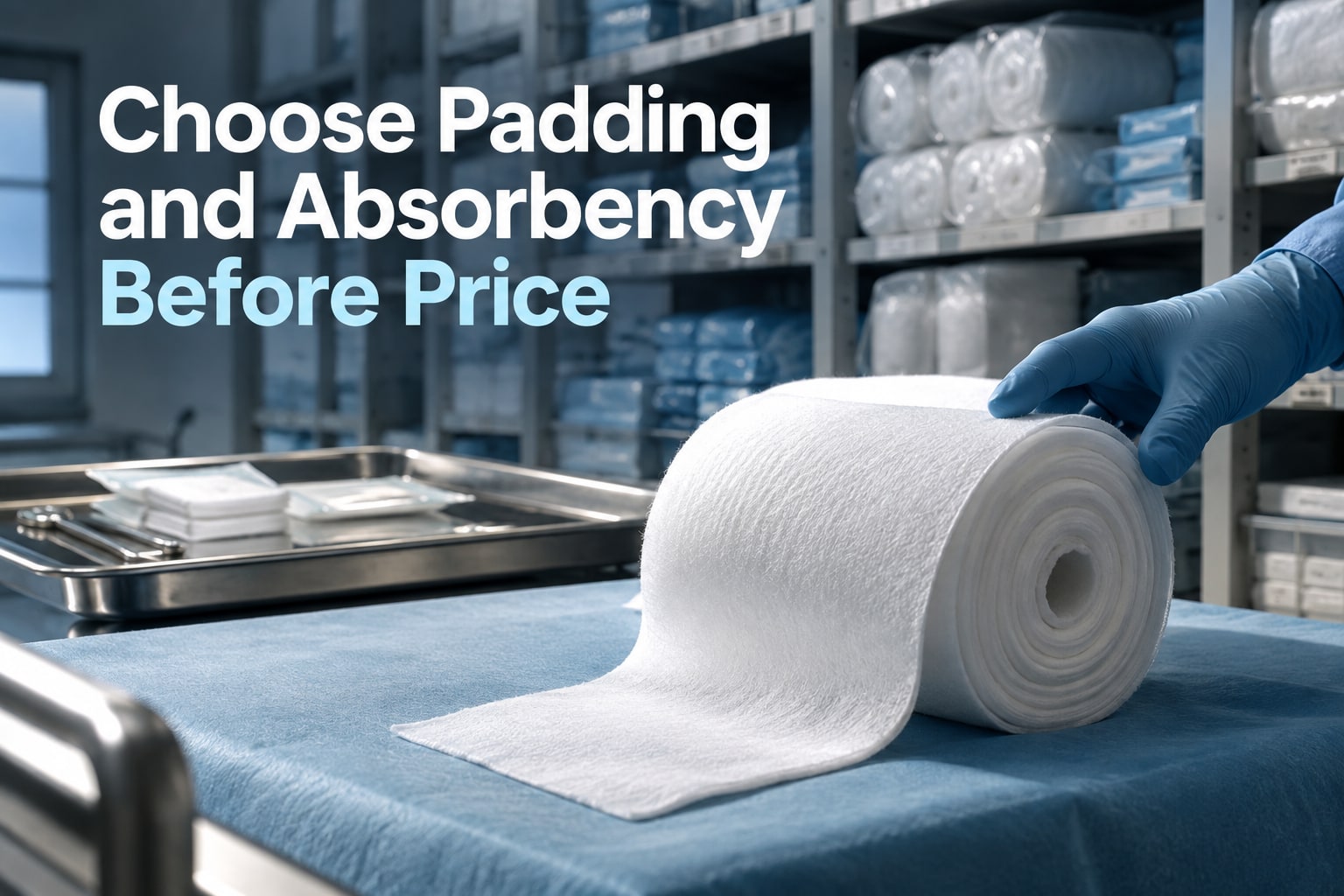
A gamjee roll is not interchangeable with every soft roll, gauze roll or bandage cloth on a hospital shelf. By separating wound-contact requirements from absorbent padding, then checking construction, sterility, packaging and Chilean procurement documents, you can specify a roll that suits the patient, the ward and the receiving process.
Key takeaways
- Confirm the roll’s cotton-wool construction, gauze layers, dimensions and sterile status.
- Match padding and absorbency to the wound dressing, exudate level and fixation method.
- Apply enough tension to secure the dressing without restricting circulation or causing pressure.
- Compare usable cost by coverage, waste, storage needs and documented trial results.
Identify the Roll Before You Specify It
A gamjee roll is an absorbent cotton-wool layer enclosed between gauze layers, giving it bulk absorbency and cushioning for dressing work. It is not automatically a primary wound-contact dressing: place it over a suitable sterile wound dressing unless the product label and hospital protocol permit direct contact.
| Rolled material | Construction and main function | Do not assume |
|---|---|---|
| Gamjee roll | Cotton wool between gauze; absorbs fluid and cushions | It will keep its cushioning after saturation |
| Gauze roll | Woven gauze fabric for swabbing, wrapping, packing or securing | It provides gamjee-level bulk absorbency |
| Soft roll | Padded roll used under plaster, synthetic casts or compression bandages | It is sterile or suitable for an open wound |
| Bandage cloth | Generic rolled fabric description | Absorbency, thickness, weave, sterility or wound-contact suitability |
Specify the construction by name—“gamjee tissue/roll,” “absorbent cotton wool dressing,” “soft roll padding” or “gauze bandage”—rather than ordering only “bandage cloth.” A vague description can deliver the wrong material: gauze may fray, shed lint or adhere to a drying wound; soft roll may compress under a cast and absorb little fluid; saturated gamjee loses its cushioning function.
Separate sterile wound-contact stock from secondary padding stock, and compare wet absorbency, lint, conformability, roll compression and removal during a product trial.
Match Absorbency and Padding to the Clinical Use
Choose the roll after estimating exudate, not by wound diameter alone. A heavily draining wound needs absorbent capacity plus enough padding to protect surrounding skin; a small, dry incision needs neither a bulky roll nor high fluid capacity.
Place gamjee roll over a suitable primary wound dressing unless its labelling and hospital protocol specifically permit direct wound contact.
| Clinical choice | Best fit | Check before use |
|---|---|---|
| Gamjee roll | Moderate drainage, broad wounds, bony prominences and postoperative padding | Saturation, cushioning after wetting, sterile status and removal without disturbing the primary dressing |
| Gauze roll | Light drainage, contouring fingers or limbs, and securing a primary dressing | Fraying, lint, adherence to a drying wound and adequate layer thickness |
| Soft roll | Padding beneath plaster, synthetic casts or compression bandages | Compression under the cast, moisture retention and whether it is nonsterile secondary padding |
For a large or highly exuding wound, increase absorbent layers or select a wider, longer roll rather than wrapping tightly. For toes, fingers, ankles and joints, choose a conformable width that avoids ridges across flexures; for circumferential compression, use a product intended for that pressure system and monitor distal colour, warmth, sensation and capillary refill.
Keep sterile wound-contact stock separate from nonsterile padding. If gauze or cotton could enter an operative field or cavity, specify a radiopaque or otherwise detectable marker and follow the hospital count policy; plain gauze is not automatically visible on X-ray.
Apply, Secure and Replace the Roll Without Excess Pressure
Place the gamjee roll over a suitable primary wound dressing unless the product and hospital protocol authorise direct contact. In emergency care, use the sterile pack for wound coverage and follow bleeding-control protocol; do not push a roll into a deep wound.
- Perform hand hygiene, check the wound and drains, and choose a length that covers the dressing without excessive overlap.
- Lay the roll smoothly over the primary dressing. Avoid folds, ridges and gaps over the incision or wound.
- Wrap with even, gentle tension. Use enough pressure to prevent movement, never enough to leave marks, numbness, tingling, increasing pain, pale or blue digits, or cool skin.
- Secure the end with tape or an approved bandage fastener, not a tight circular strip. Recheck the dressing after movement and during routine observations.
- Replace it immediately when saturated, soiled, loose or displaced, and change it during the scheduled postoperative dressing review using aseptic technique. Lift it away slowly; moisten an adhering layer with the approved solution rather than pulling tissue.
For ward changes, record drainage, wound appearance and the time of replacement. Protect postoperative drains and keep their exit sites visible. A soft roll belongs under a cast or compression bandage unless the protocol specifically permits another use; it is not automatically a sterile wound-contact substitute for gamjee roll.
Set the Purchase Specification and Check Every Delivery
Specify a gamjee tissue/roll by measurable features, not by “bandage cloth” or “hospital size.” State the roll width and length, number of layers, cotton or blended-fibre composition, approximate mass or thickness, edge construction, absorbency, lint limit, sterile or nonsterile status, and individual-packaging format.
| Specification item | Direct wound-contact stock | Secondary padding stock |
|---|---|---|
| Sterility | Sterile, intact sterile barrier | Nonsterile only if protocol permits |
| Construction | Gamjee dressing with defined cover and detectable marker when required | Soft roll padding or gauze roll with defined thickness |
| Use | Over the wound dressing or in an operative field | Over a primary dressing for protection or padding |
| Control | Countable under the hospital’s retained-material policy | Never assume radiographic detectability |
Require Spanish labelling that names intended use, composition, dimensions, sterility, lot number, expiry or shelf-life, storage conditions, and the importer or responsible party. Confirm the product’s current classification and sanitary-control or registration pathway with Chile’s Instituto de Salud Pública; a CE mark or FDA reference does not establish Chilean compliance.
At receiving, reject or quarantine any pack with a broken seal, pinhole, crushed or wet wrapper, missing lot, expired date, or absent sterilisation indicator where one is supplied. Record the supplier, purchase order, lot, quantity and inspection result.
Ask Komal Health Care Pvt Ltd for the same lot-level documents and Spanish-facing labelling details you require from every bidder.
Related products
 | Surgical Disposable These Gamjee Roll are highly absorbent cotton are available in low adherent gauze cover and is applied over dressing to provide low adherent wound... View product → |
 | Dressing We are manufacture of Gamjee Roll. These Gamjee Roll are highly absorbent cotton are available in low adherent gauze cover and is applied over... View product → |
Compare Usable Dressing Cost, Storage and Trial Results
Compare each offer by cost per usable dressing or treated area, not by price per roll. Count cutting waste, extra secondary dressings, disposal, and replacements after leakage or slippage. Record width, length, layer count and compression so a shorter roll does not appear cheaper.
| Format | Usable-cost question | Storage and performance check |
|---|---|---|
| Gamjee roll | How much absorbent area remains after trimming saturated sections? | Measure bulk, cushioning, wet absorbency and roll compression. |
| Gauze roll | How much is lost to fraying, lint, adhesion or repeated layers? | Check weave, shedding, conformability and removal from drying wounds. |
| Soft roll | How much padding is needed per case, and is extra absorbent material required? | Check compression under bandages or casts; do not assume wound-contact suitability. |
Run a controlled trial using the same wound scenarios, dressing sizes and fixation methods. Weigh dry and wet material, record treated area, and document:
- Fluid capacity before strike-through
- Lint or loose fibres
- Conformability around joints and limbs
- Compression after application
- Removal without disrupting the dressing system
Separate sterile, direct wound-contact stock from nonsterile secondary padding. A soft roll or gauze roll can serve over a sterile primary dressing only under the hospital protocol; it is not equivalent to a sterile gamjee dressing.
Include storage volume, shelf-life, packaging damage and stock rotation in the comparison. Reject savings that depend on undocumented sterility, vague “bandage cloth” descriptions, missing lot traceability or absent Chilean regulatory documentation; verify intended use and supplier records with the hospital’s procurement and quality teams.
Frequently asked questions
What should you confirm before specifying a gamjee roll?
Confirm its cotton-wool filling, gauze covering, width, length, absorbency, padding, sterile status, packaging and lot identification. Do not assume a gamjee roll is suitable for direct wound contact.
How do you match gamjee roll absorbency and padding to clinical use?
Use lighter padding for routine support over a suitable primary dressing and greater absorbency or cushioning when exudate, pressure protection or limb contour requires it. Follow the product label and hospital protocol.
How should staff apply and replace a gamjee roll?
Place it over the approved primary dressing, secure it with suitable fixation and use only the tension needed to hold it in place. Check circulation, skin condition, leakage and saturation, then replace it under the dressing plan or sooner when wet or contaminated.
What should a hospital include in its purchase specification?
State the roll’s dimensions, construction, absorbency, padding, sterile or non-sterile status, packaging, lot traceability, expiry information when applicable and delivery inspection criteria. Compare coverage, waste, storage space and trial results rather than unit price alone.
Related products
 | Gauze Roll We produce and supply to our clients, a wide range of Gauze Rollthat are hygienically made so that they are safe to use in various medical... View product → |
 | Rolled Bandages These medical Rolled Bandages, gauze bandages like Rolled Bandages are used for different types of cuts, injuries, wounds etc. View product → |