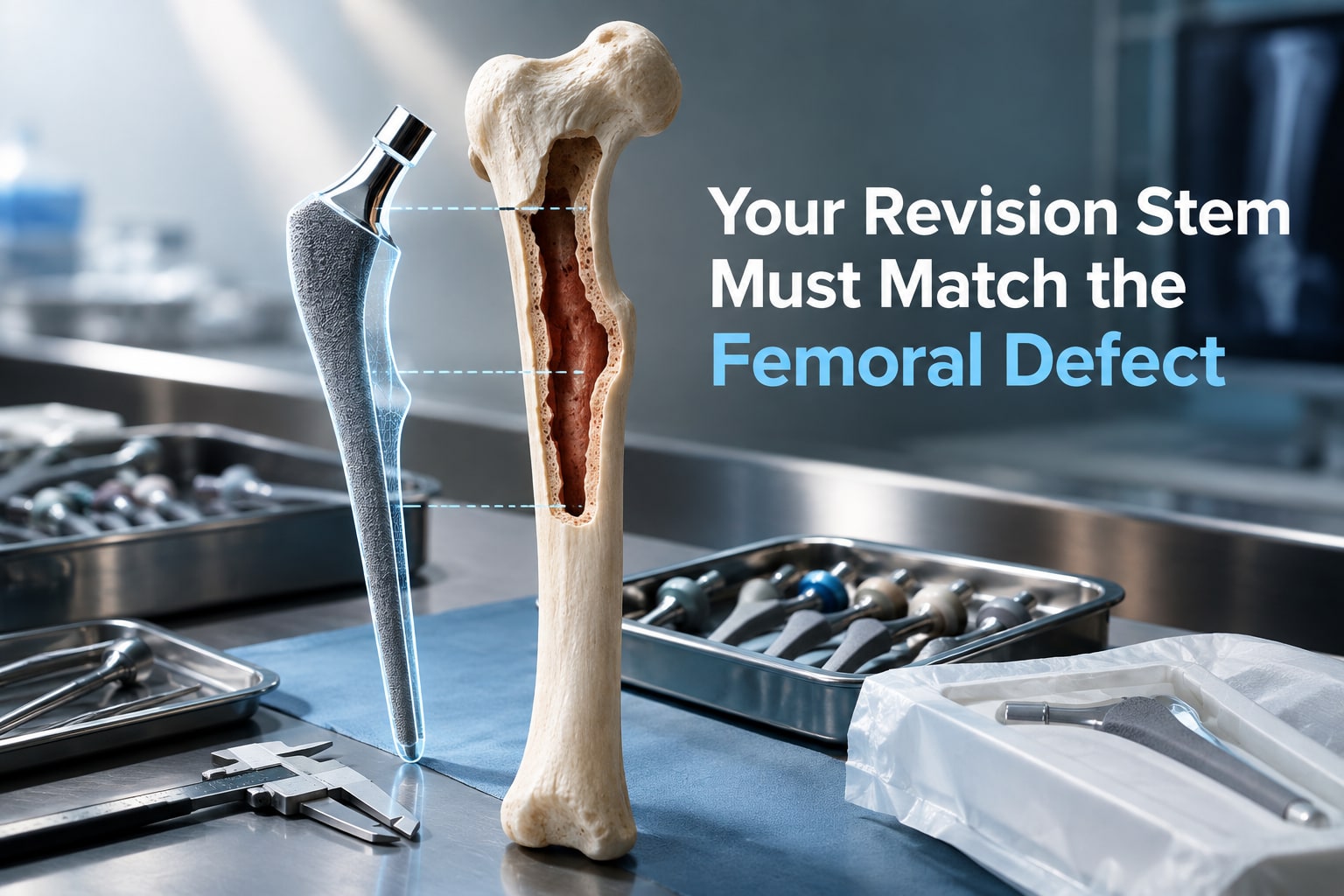
Revision hip procurement fails when a hospital orders a generic “revision stem” without defining the bone-loss pattern, distal fixation target, taper, instruments and documentation required for the case. By the end, you will be able to compare calcar designs, test manufacturer evidence, verify system compatibility and build a Santiago purchasing specification that protects both surgical readiness and implant traceability.
Key takeaways
- Confirm the stem replaces deficient calcar support, not just extends femoral fixation.
- Match stem length, diameter, offset and fixation to the femoral defect.
- Request lot traceability, test records and Chile-ready import documents.
- Use a written compatibility checklist before approving delivery and surgery scheduling.
Define the calcar design before comparing manufacturers
A calcar stem is a femoral implant with a medial proximal shoulder or body designed to replace or support deficient calcar bone; it is not simply any long revision stem.
A buyer searching for a calcar stem manufacturer for revision stem in Santiago should confirm the catalogue definition, because “calcar stem” is not a standardized implant category.
| Design | What it means | When it applies |
|---|---|---|
| Calcar-replacing stem | Medial geometry substitutes for missing proximal support | Medial calcar deficiency with remaining bone suitable for proximal or combined fixation |
| Modular tapered revision stem | Tapered, fluted distal stem with interchangeable proximal bodies | Metaphyseal loss requires axial and rotational fixation in intact distal femur |
| Primary calcar-contact stem | Shorter stem relies on preserved proximal bone for contact | Primary arthroplasty, not substantial revision bone loss |
1. Match the design to the defect shown on radiographs and planned intraoperative findings. Do not treat a calcar-replacing stem and a distally fixed tapered stem as interchangeable: fixation level, instruments, junctions and extraction strategy differ.
2. Ask the calcar stem manufacturer to identify standard and extended distal options, available diameters, lengths, offsets and neck angles. Confirm fatigue testing and material data for the complete construct, including modular junctions and neck geometry; isolated-component testing does not prove assembled-stem performance.
3. Separate design claims from clinical evidence. Restoring offset or supporting the calcar does not establish lower subsidence, fracture or re-revision rates. Review evidence for the same design, indication and follow-up, alongside documented risks such as perforation, malrotation, failed distal fixation and difficult extraction.
Match geometry and fixation to the femoral defect
The decisive specification is the fixation plan for the documented femoral defect, not the words “revision stem.” A calcar-replacing stem has a medial proximal shoulder or body that substitutes for deficient calcar support; that feature cannot compensate for absent distal femoral bone.
State the anticipated Paprosky defect, including metaphyseal deficiency, diaphyseal support loss or segmental bone loss, before comparing products.
| Design | Distinguishing specifications | Procurement question |
|---|---|---|
| Calcar-replacing stem | Medial calcar-replacing shoulder, defined neck angle, offset and proximal geometry | Does the shoulder restore medial support without forcing an unsuitable stem position? |
| Modular tapered revision stem | Tapered fluted or splined distal stem, interchangeable proximal bodies, modular junctions | Are diameter, length and distal fixation options adequate for intact femoral diaphysis? |
| Primary calcar-contact stem | Shorter metaphyseal geometry intended for preserved proximal bone | Is enough calcar and metaphyseal bone present for reliable primary fixation? |
| Long cemented revision stem | Long stem, cement mantle requirements and cement-compatible instrumentation | Can the canal accept a controlled cement mantle throughout the planned fixation zone? |
Request standard and extended lengths, diameter increments, offset choices, neck angles and compatible femoral heads. Confirm whether the system uses a modular junction, how it is protected from fretting, and whether instruments support extraction and later revision.
A revision stem manufacturer must provide fatigue data for the complete construct, including junctions and neck, not an isolated stem.
Compare documented risks—perforation, fracture, subsidence, malrotation, failed distal fixation and difficult extraction—with clinical evidence for the same design. A claim of calcar support or restored offset does not prove lower re-revision rates.
Why direct manufacturer supply improves revision-case control
Direct buying gives the revision team one accountable source for the implant, instruments and technical decisions. Instead of combining a stem from one catalogue with extraction tools or modular bodies from another, you can specify the required length, diameter, offset, neck angle, proximal body and distal fixation option as one validated configuration.
That control reduces intraoperative surprises. Ask the manufacturer to confirm taper dimensions, modular-junction assembly, cleaning, seating and impaction instructions before approval. A general distributor may confirm availability, but the manufacturer can explain whether a selected body and distal stem are designed to work together and identify the correct extraction instrument.
Lead time also becomes more meaningful. Request stock and delivery dates by catalogue number, not for a generic “revision stem.” Your contingency plan should identify an urgent replacement route when the surgeon needs an uncommon combination or the opened implant proves unsuitable.
Direct supply improves document control as well. Obtain lot and inspection records, design-change notices, sterilization status, package-integrity requirements, instrument reprocessing instructions and the manufacturer’s process for damaged or opened packaging. These records give the hospital and Chilean importer one traceable file.
When evaluating Komal Health Care Pvt Ltd as a hip implant manufacturer in Santiago, ask for this configuration-level evidence rather than relying on a product title. The same test applies to any joint replacement supplier in Santiago: direct access has value only when technical answers, delivery commitments and after-sales records follow the exact implant system.
Related product
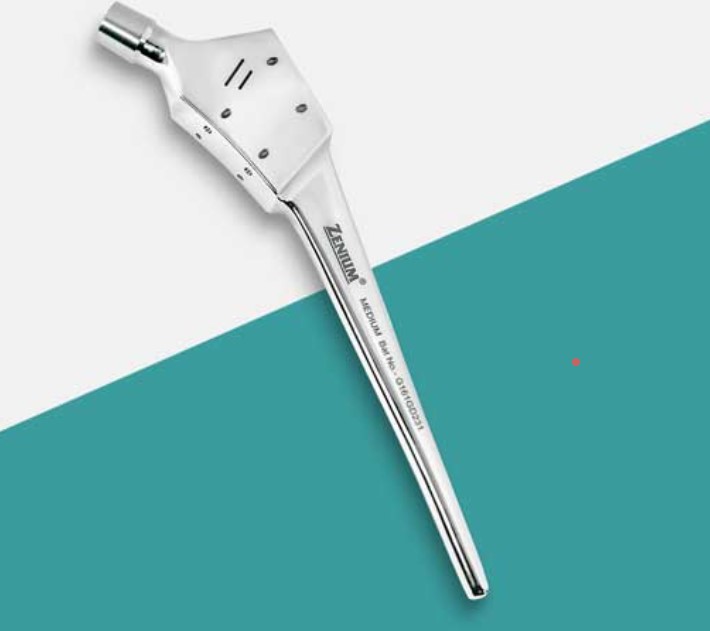 | Joint Replacement A Calcar Stem Manufacturer specializes in producing orthopedic implants designed for hip replacement surgeries, particularly when there is damage or... View product → |
Require traceability, testing and Chile-ready documentation
Approve a revision stem only after the revision stem manufacturer provides a traceability file tied to the exact catalogue number and lot or serial number. A hip implant manufacturer in Santiago should meet the same standard; “Made in” wording or distributor branding does not identify the manufacturing site, production batch or device history.
| Record or document | Demand | Hold approval if |
|---|---|---|
| Manufacturing record | Site address, model, catalogue number, lot or serial number, inspection results, and design-change history | The supplier cannot link the shipped implant to a production lot |
| Sterilization record | Sterile or non-sterile status, validated method, sterilization lot, shelf life, and package configuration | The label, certificate and packing list disagree |
| Packaging and instrument file | Seal and package-integrity requirements, damage consequences, instrument cleaning, reprocessing and impaction instructions | A sterile stem is expected to be resterilized without validated manufacturer instructions |
| Import file | Commercial invoice, packing list, airway bill, certificate of origin or free-sale evidence when requested, Spanish instructions for use, and Chilean importer details | Customs or hospital records cannot identify the device and importer |
Request stock and lead-time data by catalogue number, including diameter, length, offset and proximal-body combinations. Record an urgent replacement route before surgery; a generic stem “in stock” does not cover an uncommon configuration.
Separate design claims from evidence. Ask for clinical data using the same stem, indication and follow-up period, plus assembly instructions for every modular taper. Do not approve on an offset-restoration claim alone.
Use a pre-order checklist for compatibility and delivery
Use a signed pre-order checklist that links the implant configuration, fixation strategy, instruments, sterile status and delivery date to the planned revision case.
1. Confirm the femoral defect and fixation plan. Record whether proximal bone can support a calcar-replacing body or whether the case requires distal fixation in the intact femur. Ask for standard and extended stem lengths, diameters, offsets, neck angles, flutes or splines, and the catalogue numbers for each option.
2. Verify that every junction belongs to one validated system. Match the modular body, taper, femoral head, acetabular components and extraction tools; compatible-looking parts from different suppliers can create taper, instrument and traceability failures. Request written confirmation that the selected instruments prepare the canal and seat the chosen stem.
3. Check package and sterilization status before approval. Record whether each stem is sterile or non-sterile, the validated sterilization method, shelf life, package inspection criteria and instrument reprocessing limits. Do not resterilize a sterile stem unless the manufacturer’s instructions validate that process.
4. Tie delivery to catalogue numbers, not a generic “revision stem” promise. Obtain stock and lead times for the exact length, diameter, offset and proximal body, then document an urgent replacement route for intraoperative changes.
5. Require the Santiago joint replacement supplier to provide Spanish instructions for use where required, labels, conformity certificates, risk information and post-market contacts. Confirm the Chilean pathway with the Instituto de Salud Pública and importer. Evaluate the calcar stem manufacturer for revision stem in Santiago on traceable lot records, design-change control and inspection evidence.
Frequently asked questions
What defines a calcar stem?
A calcar stem has a medial proximal shoulder or body designed to replace or support deficient calcar bone; it is not simply any long revision stem.
How should you match a calcar stem to a femoral defect?
Compare the defect pattern with stem length, diameter, offset, proximal support and fixation method, then confirm compatibility with the existing or planned hip system.
Why use direct manufacturer supply for revision cases?
Direct supply can give your procurement team clearer access to configuration details, lot traceability, testing records and delivery communication.
Which documents should Santiago buyers request?
Request product identification, batch or lot records, test documentation, sterilisation details where applicable, instructions for use and Chile-ready import and regulatory paperwork.