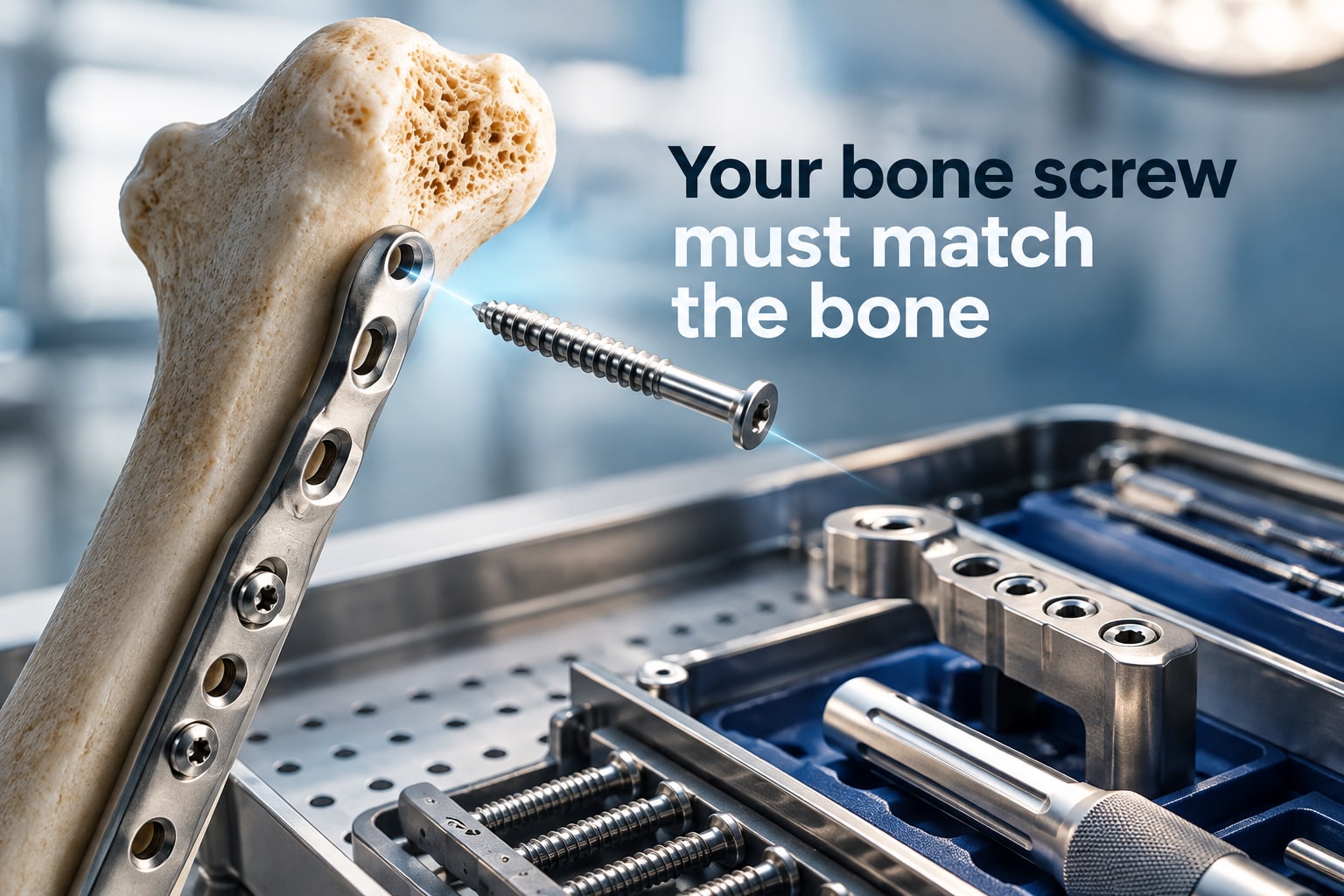
A bone screw can compress a fracture, hold a plate against bone, lock an intramedullary nail, or anchor a larger implant, but its effect depends on its position, thread design and relationship with the implant. By the end, you will be able to distinguish these roles, understand how surgeons choose and insert screws, and identify the checks that prevent poor purchase, over-tightening or dangerous penetration.
Key takeaways
- Use lag screws to draw fracture fragments together.
- Match screw threads and diameter to cortical or cancellous bone.
- Confirm screw length, trajectory, and implant compatibility before insertion.
- Use screws with plates, nails, wires, and other fixation constructs.
What mechanical job is the screw performing?
A screw’s placement determines its mechanical job: it may compress a fracture, secure a plate, or control an intramedullary nail. In a lag-screw construct, drill a gliding hole through the near fragment so threads engage only the far fragment; tightening then draws the fragments together.
Aim the screw as perpendicular as practical to the fracture plane. This is fracture compression, not plate fixation.
| Placement | Mechanical job | Stability objective |
|---|---|---|
| Lag screw | Draws fracture fragments together | Absolute stability |
| Conventional plate screw | Pulls the plate toward bone and can compress the plate against cortex | Plate fixation |
| Locking plate screw | Threads into the plate hole to form a fixed-angle connection | Fixed-angle support without plate-bone friction |
| Interlocking nail screw | Controls rotation and axial length | Static or controlled dynamic fixation |
A bridge plate spans a multifragmentary fracture while screws anchor the plate on either side. Leave intermediate fragments undisturbed, and do not fill every plate hole automatically; excessive screws can make the construct unnecessarily stiff, reduce fatigue tolerance, and undermine the relative-stability environment that permits callus formation.
Interlocking nail screws prevent rotation and shortening; static locking controls both, while selected dynamic locking permits controlled axial settling. These choices show how bone screws are used: absolute stability minimizes fracture motion, whereas relative stability accepts controlled motion. That distinction is central to bone screw usage in orthopaedic fixation.
How do screw designs match cortical and cancellous bone?
Fine, fully threaded screws suit dense cortical bone; deep, coarse-threaded screws suit softer cancellous bone. The choice affects how much bone surrounds each thread, the risk of stripping, and resistance to pullout.
| Design | Purchase or interface | Mechanical use |
|---|---|---|
| Cortical, fully threaded | Fine pitch, shallow threads, smaller core | Engage dense outer cortex; commonly used for plate fixation |
| Cancellous, partially threaded | Deep, coarse threads with a larger thread profile | Grip trabecular bone; the smooth shaft permits compression or a lag effect |
| Non-locking | Head bears on the plate and draws it toward bone | Uses plate-bone contact and screw purchase |
| Locking | Screw head threads into the plate hole | Creates a fixed-angle connection when alignment or weak metaphyseal bone makes conventional purchase unreliable |
| Cannulated | Hollow shaft inserted over a guidewire | Establishes a checked trajectory for percutaneous or periarticular fixation |
Thread depth, pitch, core diameter, screw diameter and insertion depth all change holding strength. Density, cortical thickness, and engagement of one or both cortices matter too; excessive torque can strip osteoporotic pilot holes rather than improve fixation.
A cannulated screw still requires strict wire control: a misplaced wire can enter a joint or injure a neurovascular structure. A partially threaded malleolar screw may compress a fragment, while a fully threaded screw may preserve position without that lag effect.
Use a washer when thin or weak cortex could let the head sink, such as in the pelvis or clavicle. It increases bearing area, but adds prominence and cannot correct a wrong length or trajectory.
How is the correct screw specified and matched to the implant?
Correct screw choice is made by matching the fracture corridor and the implant’s interface, not by diameter alone. Radiographs and CT scans show fracture geometry, safe bone corridors, joint proximity and cortical thickness; intraoperative depth and trajectory measurements refine diameter, length and direction.
Specify the screw by:
- diameter and thread length, including whether purchase must be bicortical;
- head style and bearing surface, with a washer when thin or weak cortex needs more bearing area;
- material, thread pitch and drive recess;
- a gliding hole for a lag construct, or engagement with a locking plate or intramedullary nail.
A standard screw and a locking screw are not interchangeable unless the system explicitly permits both. The plate-hole thread, screw diameter and pitch must correspond; a locking screw needs the correct threaded interface, while a conventional screw draws the plate toward bone.
Drill guides, guide sleeves, depth gauges and other implant-specific instruments must match the selected system. A mismatched guide can alter the trajectory even when the screw itself has the intended dimensions.
Do not mix plates, screws, drive interfaces or metals without approval from the implant manufacturer and the surgeon’s protocol. In procurement, Komal Health Care Pvt Ltd is one supplier to evaluate, but request exact compatibility information, dimensional drawings, material documentation and instrument requirements instead of choosing a broad screw label.
That makes orthopaedic implant screw use a specification decision, not a size-only purchase.
Related products
 | Cancellous Screw ₹1800 We offer bone screws for orthopedic usage. These bone screws are available in different types like cortical bone screw, cannulated bone screws,... View product → |
 | Orthopaedic ₹1200 We offer orthopedic implants, orthopedic surgical implants as bone screws for orthopedic usage. View product → |
What happens during screw insertion and final checking?
After fracture reduction and temporary fixation, the surgeon follows a measured sequence to place the screw and confirm that it supports the intended construct.
1. Select the drill guide or guide sleeve that matches the plate, nail or screw system. For a cannulated screw, check the guidewire trajectory before overdrilling; an uncontrolled wire can enter a joint or endanger nearby structures.
2. Drill with the specified bit and depth control. The guide maintains the planned trajectory, while the bit diameter and drilling method must match the implant system and bone.
3. Measure the hole with a depth gauge. Choose a length that provides the intended purchase without unnecessary far-cortex prominence or penetration of a joint, tendon path, nerve, vessel, canal or foramen.
4. Tap the hole when the selected system and bone require it, then insert the screw with the matching screwdriver bit, such as a hexagonal or Torx-style interface. Do not force higher torque to compensate for inadequate purchase; excessive torque can strip a pilot hole, especially in osteoporotic bone.
5. Check screw position, plate or nail engagement, and fracture reduction. Fluoroscopy or other imaging from more than one projection can expose a joint or far-cortex breach hidden on a single view.
The final assessment also includes the torque or insertion-feel check specified by the system. This practical sequence shows how bone screws are used safely: measured purchase and confirmed trajectory matter more than simply tightening the screw further.
Where are bone screws used beyond a simple plate construct?
A bone screw’s role changes with the implant surrounding it. These bone screw applications in orthopaedic surgery include stand-alone lag screws, interlocking nails, spinal rods, external-fixator interfaces and press-fit joint-replacement components.
In an intramedullary nail, static interlocking screws control rotation and prevent shortening. A selected dynamic-locking arrangement permits controlled axial settling when the fracture pattern, nail-hole design and weight-bearing plan support that movement; choosing dynamic locking by habit can allow unwanted shortening.
Pedicle screws pass through the pedicle toward the vertebral body and connect to rods. Mechanical engagement does not prove clinical acceptability: a breach into the canal, foramen, disc or nearby vascular region can make the trajectory unsafe despite firm insertion.
Supplemental screws in an acetabular or other press-fit component improve initial fixation only when their length and trajectory are planned around pelvic anatomy. Excessive penetration can threaten neurovascular or visceral structures. Stand-alone lag screws suit selected fractures, while external-fixator screws must match the bone corridor and frame interface.
For orthopaedic implant screw use, compare each application in this order:
- Identify the intended motion: compression, rigid fixation, rotational control, controlled settling or frame stability.
- Confirm the bone corridor, including the pedicle, pelvis, far cortex or nail path.
- Match the screw diameter, threads, head and interface to the plate, nail, rod, cup or fixator.
- Verify length and imaging in more than one projection when a joint, canal, vessel or other critical structure is nearby.
No single screw design suits every construct.
Frequently asked questions
What mechanical jobs do bone screws perform in orthopaedic fixation?
A bone screw can compress a fracture, secure a plate, or control an intramedullary nail. In a lag-screw construct, a gliding hole in the near fragment lets threads engage the far fragment and draw the fragments together.
How do cortical and cancellous bone screws differ?
Cortical screws use finer, closely spaced threads for dense cortical bone. Cancellous screws use deeper, wider-spaced threads for softer, less dense cancellous bone.
How is a bone screw matched to an orthopaedic implant?
Match the screw diameter, length, thread type, head shape, and drive interface to the implant system. Confirm that the screw fits the plate hole or other implant feature and that its length suits the bone.
What is checked after a bone screw is inserted?
Check the screw trajectory, depth, head seating, fracture reduction, and implant position. Imaging or direct inspection confirms that the screw has not entered a joint or damaged nearby structures.
Related product
 | Joint Replacement A THR Screw Manufacturer produces specialized screws used in Total Hip Replacement (THR) surgeries to secure implants and enhance joint stability. View product → |