Complex distal-humerus fractures are not solved by choosing the longest or strongest-looking plate. The right construct depends on which columns and articular fragments remain stable, how many screw trajectories the distal block can accept, and whether the implant system matches the patient’s anatomy and the planned approach. By the end, you will be able to compare plating configurations, materials, screw features, imaging checks, and supplier documentation before surgery or purchase.
Key takeaways
- Match medial and lateral support to the fracture’s column instability.
- Use parallel or orthogonal plates according to reduction and screw trajectory needs.
- Confirm distal screw capture, locking options, material, fit and imaging compatibility.
- Ask Mexico City suppliers for traceability, documentation, sizing and instrument details.
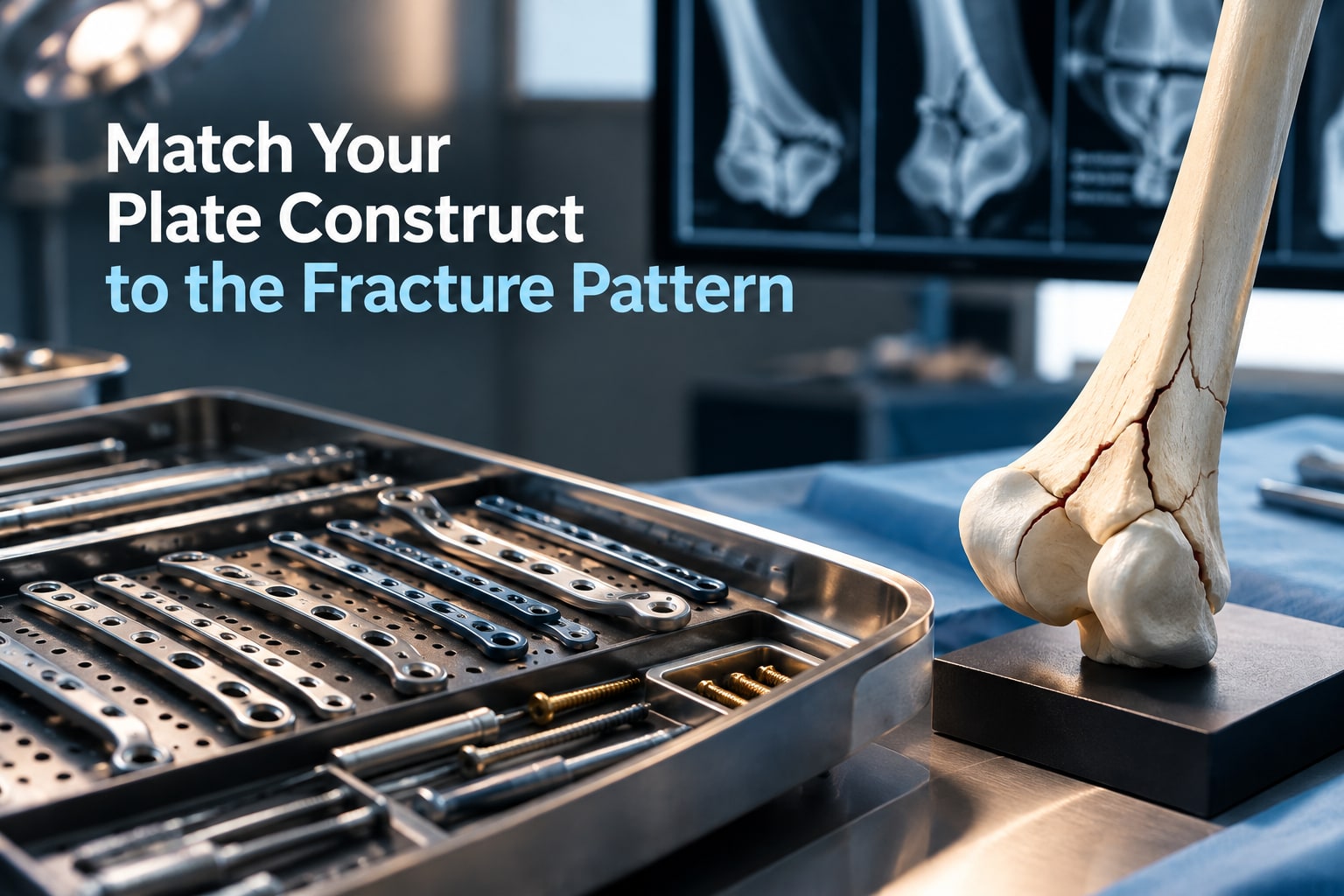
Match the Plate Construct to the Fracture Pattern
Column instability—not the fracture label alone—determines the construct. A single lateral plate is inadequate when an intra-articular split, metaphyseal comminution, bicondylar separation, coronal shear, olecranon-fossa involvement, or poor bone quality leaves the medial column unsupported. Reconstruct the articular block first, then secure it to the shaft through stable columns.
| Option | What it captures | When it applies |
|---|---|---|
| Posterolateral or dorsolateral plate | Posterior/lateral column and selected distal articular fragments | A predominantly lateral or posterolateral fracture with an intact, load-bearing medial column |
| Lateral plate with lateral support | Lateral column plus added capture of the capitellar, lateral-rim, or lateral articular fragments | A lateral plate needs broader distal support for coronal shear, lateral comminution, or a small articular block |
| Medial plate | Medial column, medial epicondylar region, and medial metaphyseal fragments | Medial-column instability, medial comminution, or a fracture that a lateral plate cannot control |
| Dual-column fixation | Independent medial and lateral support for the reconstructed articular block | Bicondylar, highly comminuted, intra-articular fractures or deficient bone on both columns |
“Dorsolateral humerus plate” is not a reliable design description: confirm the intended surface, laterality, distal screw directions, profile, and matched medial-lateral pairing. Include ulnar-nerve exposure and protection in planning; medial prominence or a screw trajectory near the cubital tunnel can create postoperative problems.
A useful humerus fracture plate comparison lists fracture coverage, plate length, distal capture, compression, and locking options—not price alone. Verify these details before sourcing distal humerus plate options in Mexico City.
Choose Between Parallel and Orthogonal Dual Plating
A single lateral plate is inadequate when the fracture is intra-articular, metaphyseal-comminuted, bicondylar, or leaves either column unstable. Dual plating restores the medial and lateral columns; reconstruct the articular block first, then attach it to the shaft through both columns.
| Construct | Plate arrangement | Compare it when |
|---|---|---|
| Parallel | Medial and lateral plates on opposing columns | Distal bone stock allows screw purchase from each side and the plates provide direct column support with useful compression |
| Orthogonal | Medial and posterolateral plates at roughly 90 degrees | Fracture lines, distal fragments, or available screw trajectories favour a posterior-lateral approach and perpendicular fixation |
Neither configuration is universally superior. Fracture morphology, distal bone stock, screw direction, and the ability to obtain interfragmentary compression decide the construct.
A useful humerus fracture plate comparison should record fracture-pattern coverage, distal screw trajectories, independent capture of articular fragments, compression capability, plate profile, laterality, and available lengths.
Confirm that “dorsolateral” means a posterolateral column plate rather than a generic lateral plate, then check whether the medial and lateral plates belong to a matched system with compatible screws, guides, drills, and drivers. A plate that fits one column but cannot secure the reconstructed articular block leaves the fixation sequence unfinished.
Evaluate Distal Screw Capture and Locking Features
Distal screw capture determines whether a reconstructed articular block stays attached to the columns. Count the holes, but also map each screw’s endpoint on a fracture model or CT: a dense cluster of short distal screws is useful only when those screws purchase separate articular fragments without entering the joint.
- Locking-hole type: Fixed-angle holes provide predictable support in short distal fragments and weak bone, but their preset trajectories can collide with fracture lines or another screw. Variable-angle holes solve that conflict within the manufacturer’s specified angular range; they do not provide unlimited polyaxial freedom.
- Screw diameter: Many systems pair 2.7-mm distal screws with 3.5-mm shaft screws. The smaller screws allow more capture points in the articular block, while larger screws improve diaphyseal purchase. Confirm diameter, thread design, and plate compatibility from the system documentation.
- Distal screw count: Prefer enough independent screws to capture the medial, lateral, and central fragments that actually exist. A high hole count does not compensate for screws that all purchase one fragment.
- Trajectory: Check fluoroscopic or CT views for joint penetration, posterior prominence, olecranon-fossa conflict, and medial-column or ulnar-nerve risk.
- Compression: Locking screws hold alignment; they do not compress a fracture. Add a lag screw or use a plate feature designed for compression when reduction requires it.
Ask a locking distal humerus implant supplier for the angular range, drill guides, driver limits, and a screw-trajectory diagram before comparing plates.
Compare Materials, Fit, and Imaging Before Ordering
Titanium and stainless steel are not interchangeable on a purchasing sheet. Compare strength and stiffness, plate thickness, screw compatibility, radiographic visibility, MRI considerations, and any nickel-containing alloy declaration.
A titanium plate can reduce imaging artifact, while stainless steel may offer a different stiffness and instrument ecosystem; neither choice proves better fixation without matching the fracture and bone quality.
| Comparison point | Titanium | Stainless steel |
|---|---|---|
| Material decision | Lower-density implant with alloy-specific strength and stiffness | Higher-density implant with alloy-specific strength and stiffness |
| Imaging | Usually less radiographic and CT artifact | Usually greater radiographic and CT artifact |
| Compatibility | Requires matching titanium screws, guides, drills, and drivers | Requires documented matching components; do not mix systems by appearance |
| Patient and facility factors | Check MRI conditions and manufacturer restrictions | Check MRI conditions, alloy composition, and nickel disclosure |
Confirm the plate’s intended surface rather than trusting the label. A dorsolateral humerus plate Mexico listing might describe a posterolateral-column plate, a lateral-column plate, or an approach-specific design. Verify left or right orientation, distal screw directions, plate length, profile, and contact with the medial epicondyle, olecranon fossa, and lateral column.
An anatomic template should sit flush without rocking; excessive prominence raises soft-tissue and ulnar-nerve concerns.
Use calibrated AP, lateral, and oblique radiographs for initial templating. Obtain CT with multiplanar or three-dimensional reconstructions when comminution obscures the columns or articular block. Mark every planned screw’s length and trajectory, then check joint penetration, olecranon-fossa entry, collision with opposing screws, and cortical escape.
For orthopedic implants in Mexico City, request templates and imaging-compatible planning files before ordering, not after delivery.
Use a Mexico City Supplier Checklist That Goes Beyond the Plate Name
A plate name does not prove that a supplier can legally place an implant on the Mexican market. Before comparing distal humerus plate options in Mexico City, request a document pack that connects the exact product, manufacturer, importer and batch.
1. Product file: request the catalogue number, intended use, laterality, plate drawing, hole count, plate dimensions, material specification, and instructions for use. Obtain the approved screw list, diameter, length range, locking angle, drill guides, drivers and compression components; never infer compatibility from “2.7” or “3.5” alone.
2. Regulatory file: request the COFEPRIS registration or authorization details applicable to the device, the Mexican importer or responsible legal entity, and Spanish labeling and instructions. Check that the registration identifies the same manufacturer, facility, product family and catalogue numbers. An ISO 13485:2016 certificate does not replace Mexican market authorization.
3. Sterility file: for sterile stock, request the sterilization method, validation summary, sterile-barrier packaging specification, expiry or shelf-life evidence and lot release record. For nonsterile stock, obtain validated hospital or contract-sterilization instructions.
4. Quality and traceability file: request the ISO 13485 certificate scope and manufacturing site, material and biocompatibility evidence, lot-number format, certificate of conformity, and complaint or recall contact.
Ask Komal Health Care Pvt Ltd to map each quotation line to these documents, especially when sourcing orthopedic implants in Mexico City. A missing lot record, mismatched catalogue number or unclear legal importer is a purchasing stop, not a paperwork detail.
Related products
 | Orthopedic Implants Locking Distal Humerus Plate , DorsoLateral ₹4200 We Are Manufacturer Locking Distal Humerus Plate , DorsoLateral . Sizes is done From 3 Hole To 14 Hole , Difference of 1 hole in Left & Right Sides . View product → |
 | Orthopedic Implants Locking Distal Humrus Plate . DorsoLateral With lateral Support ₹4200 We Are Manufacturer Of Locking distal Humrus Plate , DorsoLateral With lateral Support . Size Is From 3 Hole To 14 Holes & 1 Hole Difference . View product → |
Frequently asked questions
How do you match a distal humerus plate construct to the fracture pattern?
Reconstruct the articular block first, then support both columns when comminution, bicondylar separation, coronal shear or poor bone quality threatens stability.
What is the difference between parallel and orthogonal dual plating?
Parallel plates sit on the medial and lateral columns with coordinated distal screw capture; orthogonal plates are positioned at roughly 90 degrees to address different fracture lines and fixation paths.
Which distal screw features should you compare?
Compare the number and direction of distal screw holes, locking capability, fixed-angle control, screw length options and whether screws capture the reconstructed articular block.
What should you check before ordering a distal humerus plate in Mexico City?
Check left-right and size options, plate fit, alloy, radiographic visibility, batch traceability, regulatory documents, instruments, lead time and replacement screw availability.