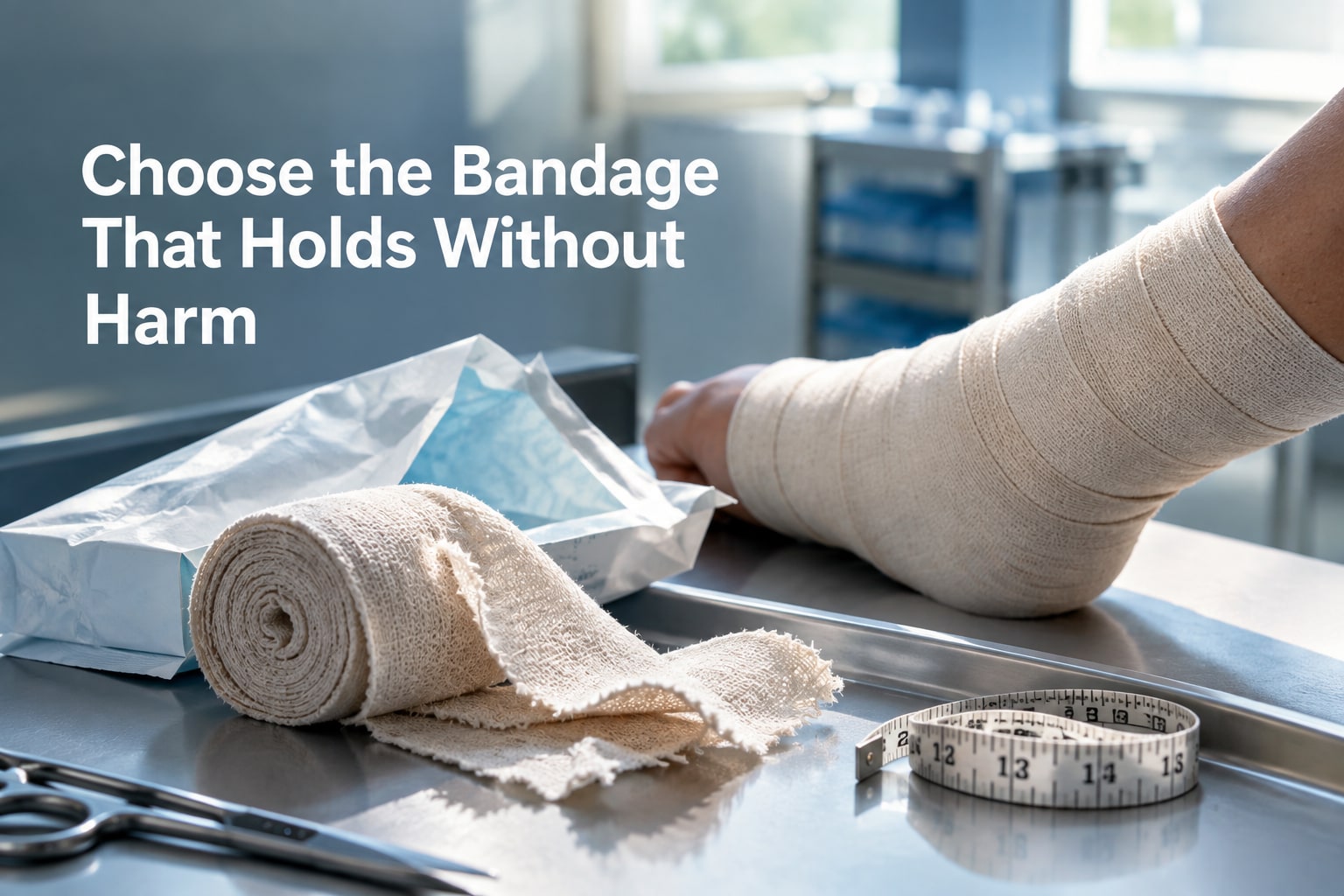
Hospitals need to match the bandage to the task: retaining a sterile dressing, supporting a limb or delivering defined therapeutic compression are different requirements. By the end, buyers will be able to compare materials, specify measurable roll characteristics, choose dimensions by body site and apply the bandage without creating avoidable circulation or skin risks.
Key takeaways
- Use cotton crepe to retain dressings or provide light support.
- Do not treat cotton crepe as therapeutic compression or a primary wound dressing.
- Specify width, length, stretch, edges, packaging and reuse requirements.
- Check skin colour, warmth, sensation and swelling after wrapping.
Match the Bandage to the Clinical Task
Choose the bandage by task: use a cotton crepe bandage to retain a dressing or provide light support, not as an automatic therapeutic-compression device or primary wound dressing.
| Clinical task | Suitable choice | Skin or wound contact |
|---|---|---|
| Retain a dressing | Cotton crepe bandage over the primary dressing | Intact skin or over a dressing |
| Provide light limb support | Conformable cotton crepe bandage | Intact skin, with padding where needed |
| Treat oedema with compression | Defined compression system selected after clinical assessment | Apply only with appropriate clinical guidance |
| Cover an open or heavily exuding wound | Low-adherent sterile contact layer, then a retaining bandage | Contact layer touches the wound; crepe stays outside |
A cotton crepe bandage can feel tight without delivering a measured therapeutic pressure. Compression treatment requires assessment of arterial supply, correct application and a defined compression system; significant peripheral arterial disease can make compression unsafe or require a clinician-set reduction.
Do not place ordinary crepe directly on a wound when fibres can shed or fluid can dry into the weave. Use a low-adherent sterile contact layer first. A gamjee roll is an absorbent cotton-wool layer enclosed or covered by gauze, useful as a bulky dressing layer but not a crepe substitute.
It is not automatically sterile or suitable for direct wound contact, so check its pack label for sterility, absorbent mass, gauze construction and wound-contact status.
Compare Stretch, Fixation and Skin Contact Before Ordering
A cylindrical package does not make bandages interchangeable. Compare how each roll stretches, applies pressure, stays in place and meets the skin before assigning an inventory code or placing an order.
| Option | Stretch and pressure control | Fixation | Absorbency and skin contact | Dressing change and disposal |
|---|---|---|---|---|
| Cotton crepe bandage | Conformable stretch for retention and light support; not a defined therapeutic compression system | Usually needs clips, tape or another fixation method | Limited absorbency; use over a suitable dressing or contact layer | Easy to remove; reuse only with explicit laundering and reuse instructions |
| Rolled gauze | Little controlled stretch; poor choice for sustained pressure | Tape, clips or tying | Absorbent gauze; direct wound contact depends on its stated construction and sterility | Single-use gauze is discarded after removal |
| Soft bandage roll | Soft padding or retention layer; pressure varies by construction | May need tape or clips; cohesive versions adhere to themselves | Cushions skin but is not automatically absorbent or sterile | Cohesive types remove without adhesive residue; follow the product’s disposal or reuse instructions |
| Elastic adhesive bandage | Stretch combines with pressure-sensitive adhesive; excessive tension can impair circulation | Adheres to skin or the underlying dressing | Adhesive contact can cause dermatitis and skin stripping | Removal may disturb fragile skin; usually discard after use |
Confirm whether a soft bandage roll is cohesive: cohesive products stick to themselves, not to skin. Do not substitute an elastic adhesive bandage for cotton crepe bandage because both arrive as rolls; the adhesive changes skin risk, pressure control and dressing-change practice. Gamjee roll is a bulky absorbent layer, not a replacement for either product.
Specify the Roll, Not Just “Cotton Bandage Cloth”
Write the purchase specification as a product identity, not “cotton bandage cloth.” Record:
- Fibre composition, finished width, relaxed length, stated length under tension and elongation.
- Fabric weight, weave, edge construction, absorbency and lint level.
- Packaging unit, individual pack integrity and sterile or non-sterile status.
A label reading 10 cm × 4 m is incomplete for comparison. One supplier may measure 4 m relaxed; another may report 4 m while stretched. Ask for both dimensions, plus the usable length after application and, where reuse is permitted, width and elasticity after laundering.
Choose the width for the body site and dressing area, not the lowest unit price.
| Site | Selection guidance | What can go wrong |
|---|---|---|
| Fingers | Narrow roll that follows the digit without excessive overlap | A narrow, tight overlap can form a pressure ridge |
| Wrists | Width that covers the circumference without bunching | Excess tension can concentrate pressure at the joint |
| Ankles | A conformable width that accommodates movement and swelling | Poor overlap can create bands of pressure |
| Limbs | Wider roll matched to limb diameter and required support | Too narrow requires more turns and uneven pressure |
| Joints | Width and stretch that follow flexion without folding | A stiff edge or wrinkle can irritate the skin |
| Postoperative dressings | Width that secures the full dressing without covering excess skin | An overly wide roll can wrinkle over contours |
Inspect a sample by unrolling, wrapping contours and removing it. Frayed edges shed loose fibres and catch on dressings; overly stiff, tightly finished edges create local pressure ridges. Ask whether the roll is intended for wound contact, and do not assume cotton or absorbency makes it sterile.
Apply Evenly and Check the Limb After Wrapping
For dressing retention or light support, apply a cotton crepe bandage with steady, moderate tension—not the maximum force you can achieve. A wrap that feels tight is not proof of therapeutic compression; excessive tension can create pressure bands, distal swelling or impaired circulation.
1. Anchor the first turn below the dressing or at the limb’s narrowest safe point. Keep the bandage flat and hold the roll close to the skin without pulling sharply.
2. Overlap each turn by about half the bandage width. Maintain even tension throughout, because alternating tight and loose sections can slip or concentrate pressure.
3. Smooth the fabric over the limb and remove folds as you proceed. Avoid wrinkles across joints, where they can form painful pressure ridges during movement.
4. Cover the dressing securely without extending the wrap unnecessarily onto unaffected areas. Accommodate expected swelling rather than tightening the bandage to prevent every movement.
5. Secure the final turn with clips, tape or the specified fixation method. Do not insert a sharp fastener where it can press into the skin or wound area.
6. Check circulation, sensation, skin temperature and distal swelling after application and again after movement. Ask about numbness or increasing pain, and compare colour and warmth with the opposite limb.
Remove the bandage promptly and obtain clinical review for numbness, increasing pain, colour change, cold skin or swelling beyond the bandage. Suspected or confirmed peripheral arterial disease requires clinical assessment before any compression is applied; the bandage label cannot establish a safe pressure level.
Evaluate Suppliers, Samples and Reuse Claims in Mumbai
Choose cotton crepe bandage in Mumbai by comparing documented samples, not by treating local stock or a familiar distributor as proof of quality. Cotton alone does not establish sterility, low bioburden, absorbency or low lint; verify the individual pack, because an intact outer carton does not make every roll sterile.
Ask each supplier for:
- Manufacturer technical specification stating fibre composition, width, relaxed length, elongation, weave, edge construction, absorbency and lint level.
- Sample rolls for repeated unrolling, contour application and removal; reject frayed edges or stiff edges that form pressure ridges.
- Batch or lot traceability linking the roll to its pack and manufacturing records.
- Regulatory or standard-compliance documents naming the applicable standard, not merely “medical grade”.
- Replacement terms for damaged, contaminated, opened or short-measure stock.
- Pack integrity, individual sterile or non-sterile status, lot identification and expiry information.
- Written laundering and reuse instructions, including the permitted number of cycles and reinspection criteria.
| Evidence | What it confirms | Failure risk |
|---|---|---|
| Individual pack label | Sterile or non-sterile status, lot and expiry | Assuming carton sterility |
| Reuse instructions | Washing method and validated limits | Treating “washable” as unlimited reuse |
| Sample measurement | Relaxed length, stretch and edge stability | Buying short or unstable rolls |
| Compliance document | Named standard and manufacturer identity | Relying on catalogue wording |
Komal Health Care Pvt Ltd is a Mumbai-based manufacturer and exporter whose hospital buyers can request technical documents and samples before approval. That comparison is safer than choosing the lowest unit price.
Related products
 | Surgical Disposable ₹36 The range of medical bandage, gauze bandages available with us is known for its woven fast edges, thick fabric, better elasticity and controlled,... View product → |
 | Surgical Disposable ₹18 The Bandages available with us includes rolled bandages, Cotton Crepe Bandage, Elastic Adhesive Bandage and Soft Bandage Roll. View product → |
Frequently asked questions
When should you use a cotton crepe bandage?
Use it to retain a dressing or provide light support. Do not use it as a primary wound dressing or assume it delivers therapeutic compression.
What should you compare before ordering cotton crepe bandages?
Compare stretch, fixation, skin contact, roll width and length, edge finish, packaging and whether the product is intended for single or repeated use.
How should you apply a cotton crepe bandage?
Wrap it with even tension and avoid wrinkles or tight turns. Afterward, check the limb for colour, warmth, sensation, swelling and increasing pain.
How can hospitals evaluate a Mumbai bandage supplier?
Request samples, inspect the roll and packaging, confirm specifications in writing, and test handling, fixation and skin contact before placing a larger order.
Related products
 | Rolled Bandages ₹18 These medical Rolled Bandages, gauze bandages like Rolled Bandages are used for different types of cuts, injuries, wounds etc. View product → |
 | Surgical Disposable ₹36 Our superior range of medical bandage, gauze bandages AS Elastic Adhesive Bandages is known for its good aesthetic appeal, woven fast edges and thick... View product → |