The word “calcar” on a product sheet does not identify one uniform implant, and a longer revision stem is not automatically the safer choice. You will be able to match the stem’s fixation strategy to the remaining femoral bone, then compare evidence, instruments, compatibility and Indian procurement documents before requesting a quotation.
Key takeaways
- Match calcar fixation to usable proximal bone and revision fixation to intact diaphyseal bone.
- Confirm stem length, diameter, taper, offset and fixation method before approval.
- Request drawings, material details, traceability records and sterilisation documentation from the supplier.
- Compare inventory, lead time, instrumentation and surgeon compatibility—not price alone.
What problem does each stem solve?
A calcar stem compared with revision stem for buyers in Mumbai should begin with the defect, not the label. A calcar stem addresses deficient proximal femoral bone or a damaged calcar by restoring support near the metaphysis. A revision stem addresses inadequate proximal bone by moving fixation below the defect into intact diaphyseal bone.
| Option | Anatomical problem | Surgical objective |
|---|---|---|
| Calcar stem | Proximal calcar or metaphyseal deficiency, with enough remaining bone for proximal support | Load the calcar or metaphysis, or replace the missing calcar while preserving usable distal femur |
| Revision stem | Extensive proximal destruction, an unstable proximal segment or poor metaphyseal purchase | Bypass damaged bone and obtain axial and rotational fixation in intact diaphyseal bone |
“Calcar stem” is not one defined category. It can mean a calcar-replacing stem, a collar-bearing stem that contacts the calcar, or a short stem designed for proximal loading. Ask the manufacturer to state the intended indication, minimum remaining calcar, fixation zone and supporting anteroposterior and lateral radiographs.
Do not infer the use from the product name. The product sheet must identify whether the stem supports primary total hip replacement, fracture reconstruction or revision surgery. A proximal-loading design fits only when usable proximal support remains; a revision design is needed when stable fixation must bypass the proximal femur.
How does femoral bone loss determine the fixation choice?
Choose a calcar-replacing or proximal-support stem when proximal bone loss still leaves enough metaphyseal or proximal femoral structure for stable loading. Choose a revision stem when poor proximal bone stock, extensive calcar destruction or an unstable proximal segment means fixation must move into intact distal diaphyseal bone.
“Calcar stem” is an imprecise purchasing term: it may mean a calcar-replacing, collar-bearing or short proximal-loading design. Ask for the minimum remaining calcar, fixation zone and radiographic examples.
| Option | Primary fixation target | Favoured when |
|---|---|---|
| Calcar or proximal-support stem | Remaining calcar and metaphysis | Proximal support can provide stable loading |
| Tapered fluted revision stem | Intact distal cortical segment | Proximal bone cannot provide reliable fixation |
The Paprosky classification helps describe remaining proximal and distal support, but it cannot prove that a stem will fit. Direct cortical contact and rotational stability remain decisive. A calcar stem comparison in Mumbai should therefore assess the usable canal, not just the classification label.
- Review anteroposterior pelvis and lateral hip radiographs, prior implant position, femoral bowing and retained hardware.
- Confirm canal diameter, length and cortical quality during extraction and reaming.
- For a tapered fluted stem, obtain axial and rotational fixation in the distal segment before using the modular body to restore leg length, offset and version.
- Reject a design that relies on its proximal body to compensate for an undersized or unstable distal segment.
What are the trade-offs in length, fixation and fixation method?
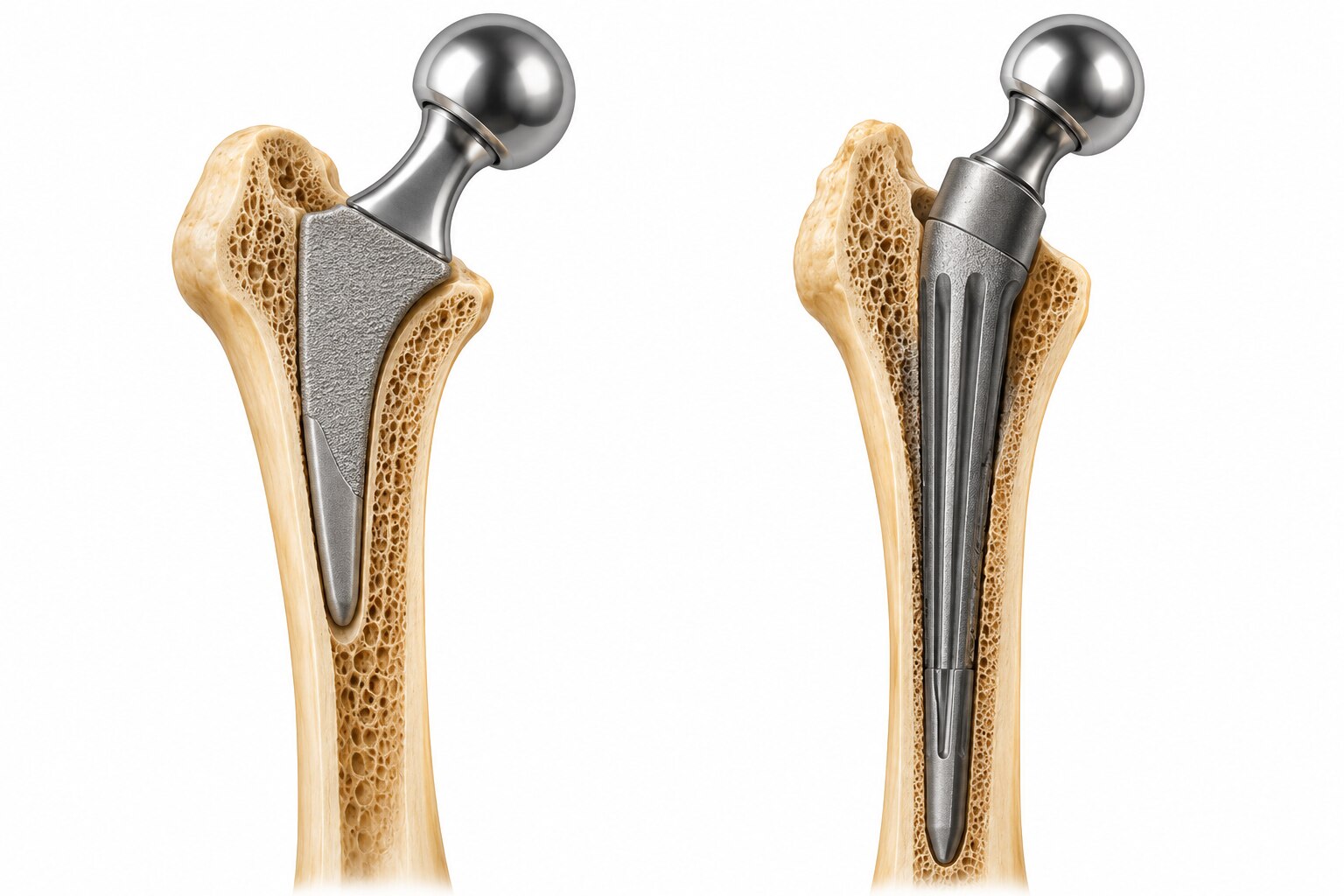
A longer stem can bypass damaged proximal bone, but it is not automatically the safer choice. Excessive distal fixation can concentrate stress at the stem tip, shield the femur from load, complicate later revision, and conflict with a bowed femur or retained hardware.
A short, proximal-loading design preserves distal bone when proximal engagement is reliable; inadequate engagement increases subsidence or loosening.
| Option | Fixation mechanism | Mechanical trade-off |
|---|---|---|
| Extensively porous-coated cylindrical | Long distal ongrowth or ingrowth surface | Durable distal fixation, but requires suitable cylindrical canal and can make later extraction difficult |
| Tapered fluted titanium | Distal cortical contact provides axial and rotational fixation; controlled settling may follow loading | Limited settling can be intended; progressive migration, height loss or rotation indicates failure |
| Cemented revision stem | Prepared cement mantle transfers load to the canal | Depends on mantle quality, cement interdigitation and correct canal preparation |
These are different solutions, not interchangeable lengths. For a cemented option, specify the planned mantle thickness, remove debris and restrict bleeding, prepare and dry the canal, use a distal cement restrictor to control cement depth, then deliver and pressurise cement before inserting the stem at the planned height and version.
For modular stems, request fatigue testing, taper-junction evidence, fretting and corrosion data, plus written rules for approved component combinations. The distal segment must first achieve axial and rotational stability; a modular body can restore length, offset and version but cannot rescue unstable fixation. This is central to any revision stem comparison in Mumbai.
What should a Mumbai buyer compare before approving a stem?
Approve a stem only when the quotation matches the surgeon’s reconstruction plan, not merely the catalogue name. Ask the supplier to state:
- Exact indication, Paprosky range, fixation zone, material grade, surface treatment, dimensions, tolerances, offset range, neck geometry, taper specification, head options, and compatibility with the planned acetabular and bearing components.
- For a modular revision stem, fatigue-testing results, junction-design data, and approved rules for mixing modular components.
- The complete instrumentation and extraction system: flexible and rigid reamers, distal sizing tools, modular trials, version-control features, cables or clamps where indicated, and cement-removal instruments for cemented revision.
Compare the quoted evidence against the actual surgical requirement:
| Item | What to verify | Why it matters |
|---|---|---|
| Clinical fit | Indication, Paprosky range, fixation zone, dimensions, offset and neck geometry | A catalogue size cannot prove canal fit or stability |
| Modular design | Fatigue results, taper-junction design, fretting or corrosion data, mixing rules | An extra junction adds another mechanical failure interface |
| Standards file | Relevant ISO 7206 test part and edition; ISO 5832 material designation | A generic ISO 13485 certificate does not establish stem performance |
| Supply control | Sterilisation method, shelf life, packaging validation, lot and UDI traceability | Missing records obstruct safe release, investigation and recall |
For femoral stem comparison in Mumbai, verify CDSCO status, the Indian importer or authorised representative, licence or registration documents, recall procedures and post-market support. A supplier such as Komal Health Care Pvt Ltd belongs in the review only when its quoted implant and instruments satisfy those documented requirements.
Related product
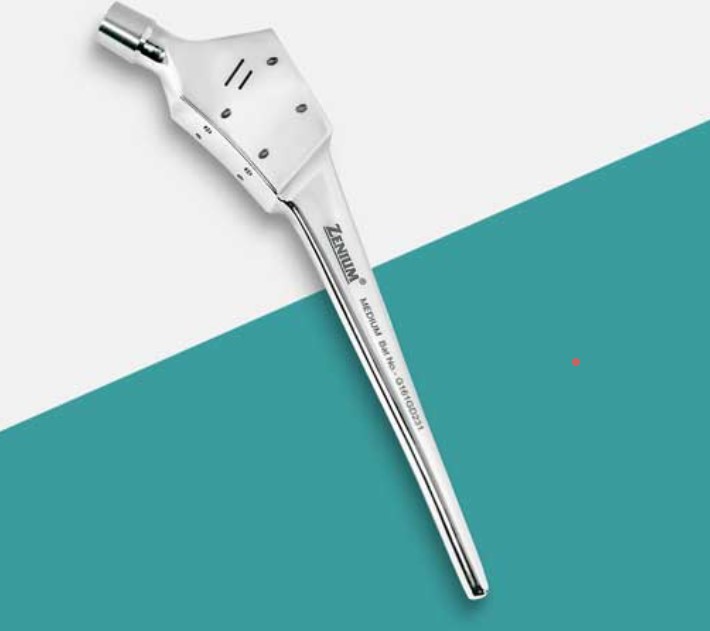 | Joint Replacement A Calcar Stem Manufacturer specializes in producing orthopedic implants designed for hip replacement surgeries, particularly when there is damage or... View product → |
How can you make the final choice safely and operationally?
Make the final choice through a documented sequence, while leaving the clinical assessment to the surgeon.
- Provide current AP pelvis and lateral hip images, the operative history, previous implant details, and information about retained hardware.
- Ask the surgeon to record usable proximal support, distal canal length, cortical quality, femoral version, and the intended fixation method.
- Compare only stems that match that fixation plan. Check trial instrumentation, bearing and acetabular compatibility, component availability, and lot or UDI traceability.
- Record the chosen indication, stem dimensions, cemented or uncemented technique, backup sizes, and required instruments in the quotation review.
| Choice | Select it when | Confirm before purchase |
|---|---|---|
| Calcar design | Usable proximal support satisfies the design’s stated requirements | Minimum remaining calcar, fixation zone, trials, neck geometry and bearing compatibility |
| Revision stem | Stable fixation must bypass damaged proximal femur | Distal canal length, cortical contact, rotational stability, reamers and modular trials |
The word “calcar” does not identify one implant type. Require the manufacturer to state whether it means a calcar-replacing stem, collar-bearing stem, or short proximal-loading stem, and provide supporting radiographs.
A longer revision stem is not automatically safer. Avoid a stem that conflicts with femoral bowing, retained hardware, or future revision access. For a tapered fluted stem, the distal segment must achieve axial and rotational stability before the modular body restores leg length, offset, or version.
Frequently asked questions
What problem does a calcar stem solve compared with a revision stem?
A calcar stem restores support near the metaphysis when proximal femoral bone or the calcar is deficient. A revision stem bypasses that defect and fixes in intact diaphyseal bone.
How does femoral bone loss determine the fixation choice?
Use a calcar stem when enough proximal bone remains for reliable metaphyseal support. Choose a revision stem when proximal bone cannot provide stable fixation and the diaphysis offers usable purchase.
What trade-offs should buyers compare between calcar and revision stems?
Compare stem length, fixation zone, cemented or cementless fixation, instrumentation, bone preparation and the risk of sacrificing additional femoral bone.
What should a Mumbai buyer check before approving a femoral stem?
Check dimensions, taper compatibility, material, surface finish, packaging, batch traceability, regulatory documents, stock status, delivery time and instrument availability.
How can buyers make the final stem choice safely?
Have the operating surgeon confirm the defect classification and fixation plan, then match the approved stem and instruments to the planned procedure before purchase.