An unaccounted gauze swab can create a serious patient-safety emergency, and an X-ray marker is only one part of the control system. By the end, you will know how markers work, how theatre teams count and document swabs, what to do after a discrepancy, and which specifications to require before purchase.
Key takeaways
- Record swab counts at opening, closing, and before wound closure.
- Request radiopaque-marker details, dimensions, pack quantity, and sterility records.
- Stop closure and repeat the count when the sponge total does not match.
- Choose small swabs, OT sponges, or abdominal pads by procedure and fluid load.
How an X-Ray-Detectable Swab Works During Surgery
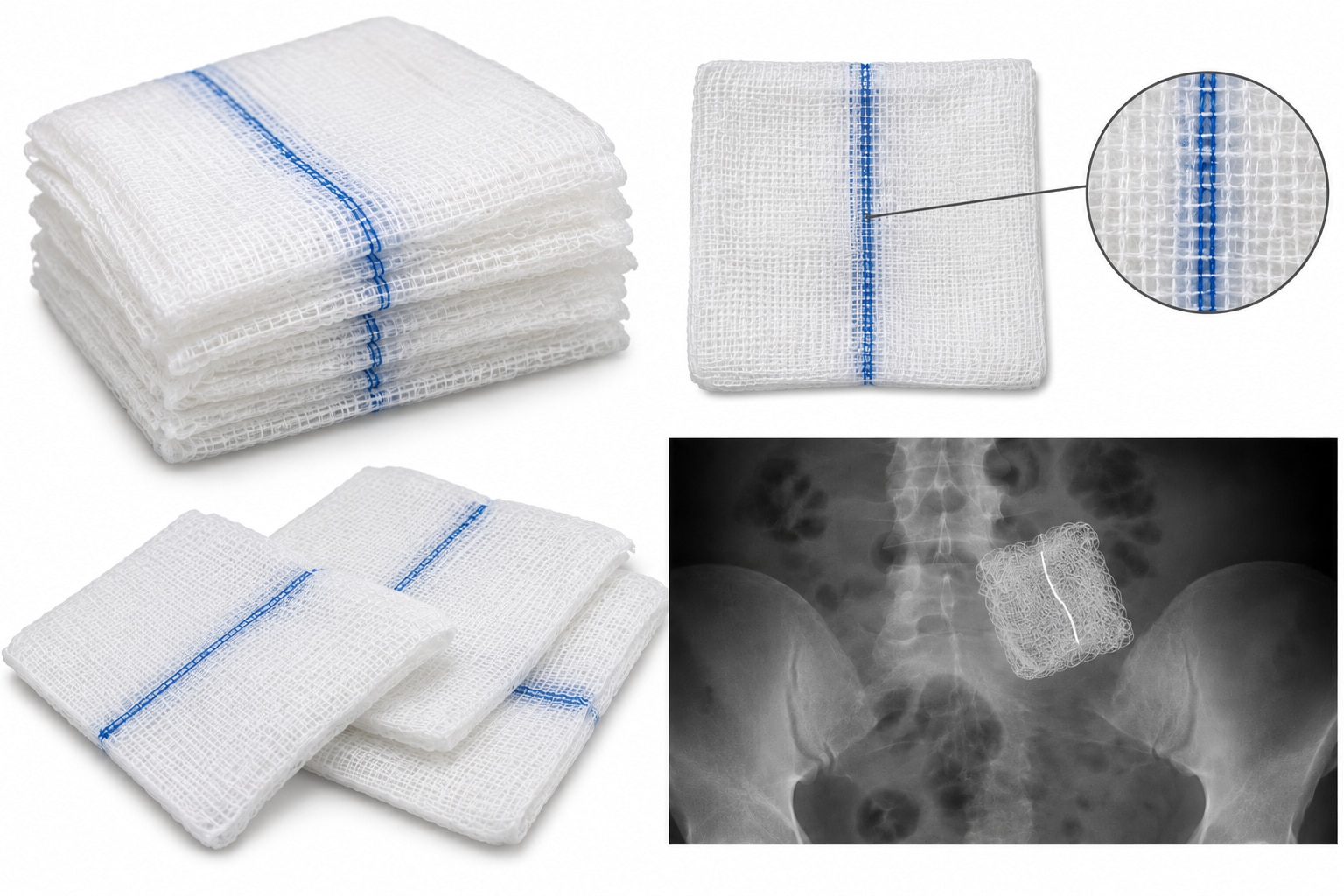
An X-ray-detectable gauze swab becomes visible on a radiograph through a radiopaque thread, strip, or marker attached to the absorbent gauze. Ordinary cotton fibres do not show reliably. The marker may run along an edge, through the swab, or inside a sealed tab, so the entire gauze swab is not necessarily radiopaque.
During an operation, the team treats it as a countable item and as a backup for locating an unaccounted swab, sponge, or pack. The marker does not replace a physical count, wound inspection, or careful handling of used materials.
- Before incision, the scrub nurse and circulating nurse count each defined unit, including items added during the case, and record the result on the operating-room record.
- During cavity closure, repeat the count while the surgeon checks the operative field. Keep used items separate from unused items so one gauze swab cannot be counted twice.
- Before skin closure, complete the final count and document it. If it does not match, stop closure, search the wound and surrounding operative areas, escalate, and request imaging under hospital policy.
A radiograph can localize the marker if the item remains unaccounted for, but documenting that an x ray detectable gauze swab was used does not resolve a discrepancy. Procurement specifications should state the marker’s position, dimensions, attachment method, and radiographic visibility; “x-ray detectable” alone is incomplete.
Who Counts Swabs and When the Count Is Recorded
The scrub nurse and circulating nurse perform the count together; the surgeon confirms the result before closure and before the patient leaves the operating room. The count covers every defined unit, including individual sponges, gauze swabs, laparotomy sponges, abdominal pads, attached markers and tape.
- Before incision, the scrub nurse presents each item while the circulating nurse counts aloud and records the total on the operating-room record. Keep small gauze swabs separate from large laparotomy or lap sponges used for packing.
- During the operation, the circulating nurse records every added or removed item. An extra sponge enters the count immediately; it cannot remain an informal addition on the sterile field.
- Before cavity closure, the scrub nurse and circulating nurse repeat the count, while the surgeon checks the operative field and wound before closing.
- Before skin closure and at the end of the procedure, they perform and document the final count. The surgeon verbally confirms whether it is correct, and the record identifies the staff members who counted and the time of each count.
The count unit must be agreed before the case begins. One sealed package might contain several countable swabs, so record individual items when that is the hospital’s rule rather than treating the package as one sponge.
If the numbers do not match, stop closure and notify the surgeon immediately. Search the wound, sterile tables, waste, linen and floor, then follow the hospital’s retained-item protocol for escalation and imaging; documenting an X-ray-detectable marker alone does not resolve the discrepancy.
What to Do When the Sponge Count Does Not Match
Stop wound closure when the sponge count does not match. The surgeon, scrub nurse and circulating nurse must announce the discrepancy, repeat the count aloud and keep all materials available for inspection. Do not rely on the record entry or assume that a missing item was discarded.
- Recount all unopened and opened packages, individual swabs, sponges, abdominal pads and attached markers.
- Search the sterile field, instrument tables, wound and operative cavity.
- Check kick buckets, waste containers, linen, drapes and the operating-room floor.
- Ask whether anyone removed, added or transferred an item; add every extra item to the count.
- Escalate to the theatre coordinator and follow the hospital’s retained-item protocol.
- Record the discrepancy, searches, notifications, imaging request and final outcome in the operating-room record.
An x ray detectable gauze swab gives imaging a radiopaque target, usually a thread or strip attached to the gauze rather than a completely radiopaque textile. Request an intraoperative radiograph when the repeated count and physical search do not reconcile, or sooner when the surgeon’s assessment and hospital policy require it.
Imaging helps locate a retained swab or sponge inside the patient, but it does not replace wound inspection or counting. Tell radiology what item is missing and where it may lie; the marker’s shape and position guide the search.
A negative image does not erase an unresolved discrepancy if the product’s marker is absent, damaged or not radiographically visible.
Choosing Between Small Swabs, OT Sponges and Abdominal Pads
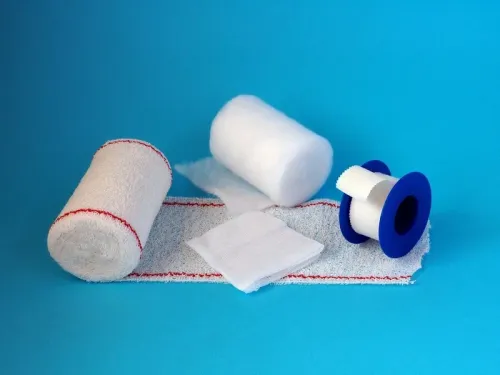
Choose the format by cavity, exposure and absorption demand: a small gauze swab for confined superficial work, an OT sponge for general operative handling, a laparotomy sponge for open major cavities, and an abdominal pad for external coverage unless its specification expressly permits internal use.
| Option | What it means | When it applies |
|---|---|---|
| Small gauze swab | Compact folded gauze, often used for wiping, dissection or limited absorption | Skin, oral, ophthalmic, hand and other confined fields |
| OT sponge, or raytec-type sponge | A larger countable gauze sponge with a radiopaque marker; “OT sponge” is not a universal size | General operations, wound exposure and moderate fluid absorption |
| Laparotomy sponge, or lap sponge | Large, highly absorbent sponge designed for packing and fluid control | Open abdominal, pelvic and other major procedures requiring cavity packing |
| Abdominal pad | A large absorbent pad, often intended as an external dressing rather than an intra-abdominal sponge | Covering a wound or absorbing drainage outside the cavity |
Do not treat these names as interchangeable. Specify internal or external use, dimensions, ply, marker configuration and whether the count unit is one swab, sponge or pad.
Count laparotomy sponges separately from small gauze swabs and OT sponges when your theatre policy uses separate categories. If staff add a sponge during surgery, enter it into the count immediately; an abdominal pad used internally must also be included and reconciled before closure.
Specifications and Receiving Checks for Hospital Procurement
Reject any pack that says only “X-ray detectable.” Before an X-ray-detectable gauze swab enters the sterile field, the purchase specification must identify the swab’s dimensions, ply, countable unit, marker position, marker size, attachment method and visibility on radiography. The gauze itself is not necessarily radiopaque.
For X-ray-detectable gauze swab usage in Mumbai, ask the supplier for:
- Fibre-shedding or lint-performance information, wet strength and absorbency data.
- Sterile or non-sterile status, sterilisation method, sterility evidence and shelf-life statement.
- Individual sterile packaging, seal integrity, pack quantity and the number of swabs per carton.
- Manufacturer name, catalogue or model number, batch or lot number, manufacture date, expiry date and applicable Indian medical-device registration or licence details.
- A sample label and instructions defining whether the count is by swab, pack, marker or attached tape. Record extra swabs added during surgery.
| Item to compare | What to verify | Why it matters |
|---|---|---|
| Swab | Dimensions, ply, folds and wet strength | A small swab cannot replace an abdominal pad in a cavity |
| Radiopaque marker | Thread or strip location, attachment and radiographic visibility | A vague claim can leave the marker hard to find |
| Sterile pack | Seal, expiry, sterilisation evidence and intact pouch | “Sterile” does not prove radiopacity |
| Traceability | Batch, model, supplier and pack count | Links a theatre incident to the supplied lot |
Komal Health Care Pvt Ltd can be included in a tender comparison only after these details appear on its quotation, sample label and delivery documents—not solely in a catalogue description.
Related products
 | Gauze Roll ₹38 We produce and supply to our clients, a wide range of Gauze Rollthat are hygienically made so that they are safe to use in various medical... View product → |
 | Surgical Dressing ₹18 Our OT Gauze Swabs, cotton swabs are available in different folds and can also be customized as per client's requirement. View product → |
Frequently asked questions
How does an X-ray-detectable gauze swab work during surgery?
A radiopaque thread, strip, or marker attached to the gauze appears on a radiograph; the cotton itself is not reliably visible.
Who counts gauze swabs during surgery?
The scrub person and circulating nurse perform and verify counts according to the theatre’s count policy, with the result recorded in the operative record.
What should the team do when the sponge count does not match?
Stop wound closure, repeat the count, search the sterile field, waste and linen, and operating area, then obtain an intraoperative radiograph when the item remains unaccounted for.
How do small swabs, OT sponges, and abdominal pads differ?
Small swabs suit confined or delicate work, OT sponges provide broader absorption for general procedures, and abdominal pads handle larger fluid volumes and operative fields.
What should hospital procurement check before receiving gauze swabs?
Check the product name, size, ply, marker design, sterility, packaging seal, lot number, expiry date, pack quantity, and conformity with the purchase specification.
Related products
 | Surgical Disposable ₹4 We offer a superior range of sterile gauze swabs which are in high demand among our Indian and international clients. View product → |
 | Surgical Disposable ₹60 We manufacture a wide range of Lap Sponge (Abdominal Pad)s, gauze sponge that finds application in operation theatres for bleeding control & other... View product → |