A femoral stem can fail through migration, fracture, malrotation, infection, bone loss, or a reconstruction error even when the first postoperative film looks acceptable. By the end, you will know how to distinguish these problems, interpret the evidence, and connect the defect pattern with the appropriate fixation and revision strategy.
Key takeaways
- Track worsening pain, gait change, and progressive radiographic findings.
- Use serial X-rays and examination to distinguish loosening, fracture, infection, and malposition.
- Choose cemented or uncemented fixation according to bone quality and reconstruction demands.
- Match revision stem length and fixation zone to the remaining femoral bone.
How Femoral Stem Problems Present and Progress
Femoral stem problems include migration, loosening, fracture, malposition, infection, stress shielding, and reconstruction errors. The warning sign is progression: worsening pain, changing gait, or a new radiographic change carries more weight than one abnormal finding immediately after surgery.
| Problem | Less concerning presentation | More concerning symptom or imaging change |
|---|---|---|
| Subsidence | Small early settling of an uncemented femoral stem as it seats in the taper or roughened fixation zone | Progressive downward migration, varus change, or loss of cortical contact on serial radiographs, especially with thigh pain |
| Aseptic loosening | Stable component with no expanding radiolucent line | Activity-related thigh or groin pain, widening radiolucent lines, osteolysis, migration, or a pedestal at the stem tip |
| Fracture or fissure | No fracture visible after broaching or insertion | New thigh pain, loss of fixation, a fracture line on postoperative films, or later displacement; occult cracks can declare themselves through migration |
| Malposition or reconstruction error | Well-fixed stem with acceptable alignment | Excessive anteversion or retroversion causing instability or impingement; reduced offset causing abductor weakness; lengthening causing nerve symptoms or gait disturbance |
| Stress shielding | Mild proximal bone resorption around a well-fixed stem | Extensive proximal loss that threatens future fixation or obscures assessment of loosening |
| Infection | Persistent pain without a clear mechanical change | Escalating pain, drainage, fever, raised inflammatory markers, or rapid loosening and osteolysis |
A single postoperative radiograph cannot establish success. Compare serial films, examine pain and gait, and use CT when rotation, fracture, or component position remains unclear. Thigh pain is not automatically normal after cementless fixation; distal tip loading, micromotion, infection, and loosening require exclusion.
How Imaging and Examination Reveal the Failure Mechanism
Pain after hip replacement is not automatically “normal cementless-stem pain.” Surgeons compare current and immediate postoperative radiographs, then use CT when plain films cannot explain migration, an occult fracture, osteolysis, component version, or bone loss.
| Mechanism | Imaging clues | Examination or confirming test |
|---|---|---|
| Early mechanical failure | Progressive subsidence, varus or valgus migration, a new fracture, or continuing movement beyond expected settling | Load-related thigh pain, a new limp, or CT evidence of inadequate contact |
| Late aseptic loosening | Progressive radiolucent lines, osteolysis, pedestal formation, or migration after an initially stable period | Start-up pain; compare serial films and exclude infection |
| Infection | New lucency, rapid bone loss, migration, or an effusion without another explanation | ESR and CRP, followed by hip aspiration for cell count, differential, culture, and selected organism testing |
| Bone loss or stress shielding | Proximal resorption around a well-fixed stem, cortical thinning, or a Paprosky defect pattern | Assess remaining fixation zones on CT and plan revision around the available bone |
| Reconstruction error | Correct stem fixation but abnormal version, offset, leg length, or neck position | Test stability, impingement, abductor tension, gait, and nerve symptoms |
A tapered fluted revision stem may settle slightly while gaining distal fixation; excessive or continuing subsidence, loss of version, or rotation under load signals failure. Axial seating alone is insufficient: the femoral stem also needs rotational stability. These femoral stem problems require different treatment from a well-fixed implant with malrotation or offset error.
Choosing Between Uncemented and Cemented Femoral Fixation
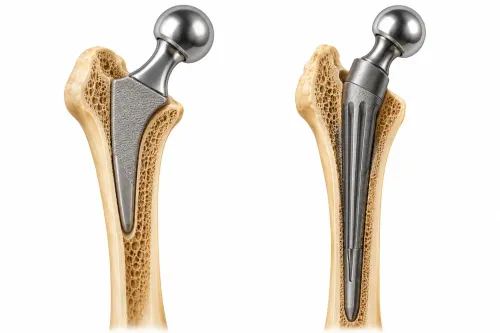
An uncemented stem provides reliable press-fit fixation when the femur has strong cortical bone, a predictable canal, and enough metaphyseal or diaphyseal contact to resist both axial settling and rotation. The broach must seat at the planned depth, control version, and contact the intended fixation zone without forcing an oversized implant.
The largest stem that enters the canal is not automatically the safest choice. Oversizing creates hoop stress and fracture risk; undersizing permits subsidence or rotation. Dorr type C morphology, osteoporosis, developmental dysplasia, older age, and female sex increase the risk of an intraoperative fissure during broaching or final insertion.
A calcar crack can destroy the press-fit of an uncemented stem even when the implant appears seated. Reduce and secure a stable crack with cerclage; an unstable fracture may require a different fixation strategy or a revision stem that bypasses the damaged segment.
| Option | What it relies on | When it fits |
|---|---|---|
| Uncemented stem | Living bone ingrowth after immediate axial and rotational stability | Good cortical stock, controlled canal preparation, and dependable press-fit |
| Cemented stem | A continuous cement mantle and secure interdigitation with prepared bone | Poor bone quality, a wide or stovepipe canal, or unreliable press-fit |
| Revision or bypass stem | Fixation in intact distal or diaphyseal femur | Proximal deficiency, unstable fracture, or inadequate remaining press-fit bone |
Cemented fixation is not a shortcut. Pulsatile lavage, canal drying, a distal restrictor, vacuum-mixed cement, pressurization, and accurate stem positioning determine whether the mantle supports the femoral stem. When these steps cannot be performed consistently, the cemented option loses its advantage.
Matching Revision Stem Design to Femoral Bone Loss
A revision stem is required when the existing stem is loose, when proximal bone cannot provide dependable fixation, or when a Vancouver B2 fracture surrounds a loose stem. Fixing a B2 fracture alone leaves the mechanical failure untreated; a well-fixed B1 stem is a different problem.
Paprosky bone loss locates the remaining fixation:
| Option | Paprosky pattern | When it applies |
|---|---|---|
| Standard stem | Type I; preserved metaphyseal bone | Use when the canal and proximal femur still provide reliable primary fixation. |
| Cemented long stem | Type II or selected III defects with a usable distal canal | Use when bone quality or canal geometry prevents press-fit fixation and a continuous cement mantle can bypass the defect. |
| Tapered fluted stem | Type IIIA or IIIB | Use distal intact diaphyseal femur for axial and rotational fixation; controlled early subsidence is acceptable, but continuing subsidence or version loss signals failure. |
| Modular stem | Type IIIA or IIIB with major proximal reconstruction needs | Adjust distal fixation, anteversion, offset, and length independently; inspect the junction for corrosion or fatigue risk. |
| Calcar-replacing stem | Medial calcar or proximal buttress deficiency | Reconstruct the missing calcar, but obtain distal fixation when proximal bone cannot support the implant. |
Paprosky Type IV bone has an expanded, nonsupportive canal and may require a specialised reconstruction rather than simply a longer primary stem. Stem dimensions come after bone assessment, not from copying the removed implant.
Stress shielding does not prove loosening: distal load transfer can resorb proximal bone around a well-fixed stem. That radiographic change still matters because it can complicate the next revision. Both fixation and reconstruction errors belong in the decision, including offset, version, and leg length.
Preventing Reconstruction and Component-Compatibility Errors
Confirm the planned femoral stem against the patient’s radiographs and templated measurements before opening the implant. Stem size, version, offset, and neck length must restore stability, abductor tension, and leg length; a well-fixed stem can still cause impingement, instability, nerve symptoms, or gait problems when reconstruction is wrong.
Use a documented intraoperative check:
- Compare trial and final components for leg length, offset, version, range of motion, and joint stability.
- Treat a calcar crack as a fixation problem, not a harmless fissure. Reduce it and apply cerclage; change the stem or bypass the fracture when press-fit is compromised.
- After distal fixation, confirm every modular revision stem junction is fully seated, clean, dry, and tightened with the specified instrument and technique.
- Record the exact manufacturer, catalogue number, size, taper, head, liner, and modular body used.
Do not mate components because their taper labels look similar. Komal Health Care Pvt Ltd can support procurement teams by requiring the exact compatibility record for an internal head, stem, and bipolar assembly rather than accepting a nominal size alone.
Mixing systems can produce incorrect taper geometry, fretting, corrosion, poor assembly, or an unvalidated material pairing.
A revision stem needs a fixation plan that matches the remaining bone. A calcar stem is not simply a collar-bearing primary stem: when the medial buttress is deficient, choose a calcar-replacing design with adequate distal fixation if proximal support cannot hold it.
Avoid interpreting proximal stress shielding alone as loosening; correlate serial films with pain, migration, and fixation.
Related products
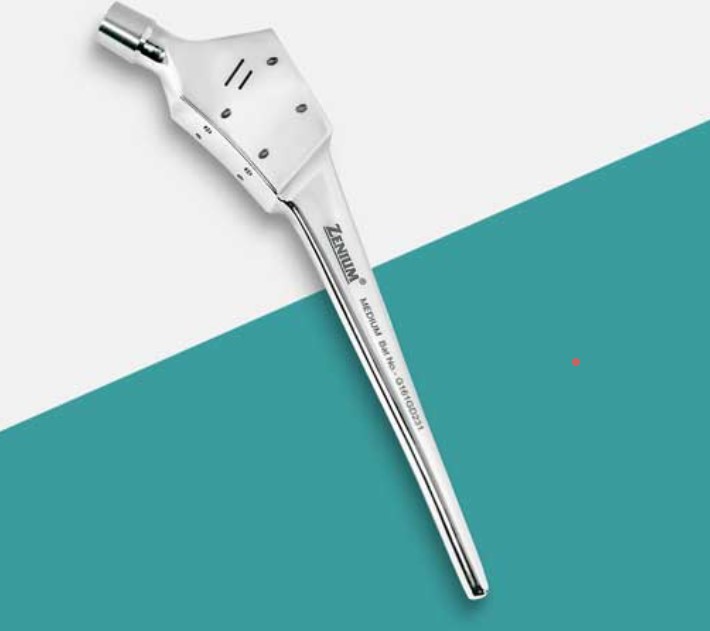 | Joint Replacement A Calcar Stem Manufacturer specializes in producing orthopedic implants designed for hip replacement surgeries, particularly when there is damage or... View product → |
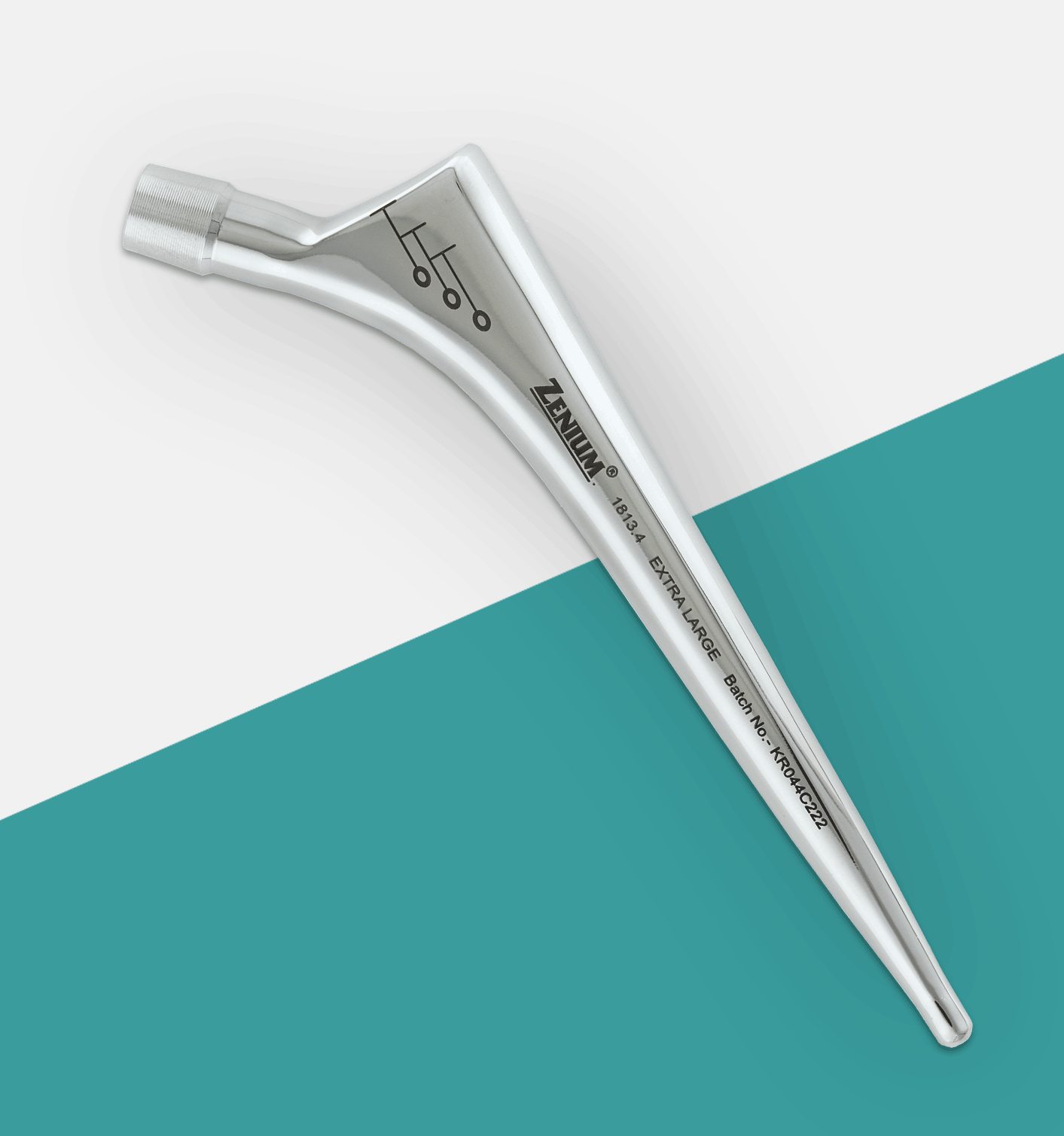 | Joint Replacement Bipolar Modular Stem (Cemented) Manufacturer The Bipolar Modular Stem (Cemented) is an orthopedic implant used in hip replacement surgeries, especially for elderly patients with fractured or... View product → |
Frequently asked questions
How do femoral stem problems present and progress?
Femoral stem problems can cause worsening pain, changing gait, migration, loosening, fracture, infection, stress shielding, or a new radiographic change. Progression across symptoms and serial images matters more than one early abnormal finding.
How do imaging and examination reveal femoral stem failure?
Clinical examination assesses pain location, gait, limb length, hip stability, and neurological findings. Serial radiographs help identify migration, radiolucent lines, subsidence, fractures, stress shielding, and changes around the stem; additional imaging or infection testing helps clarify uncertain cases.
When is an uncemented stem preferred over a cemented stem?
The choice depends on femoral bone quality, the available fixation surface, patient factors, and the reconstruction plan. Uncemented fixation relies on bone ingrowth, while cemented fixation uses bone cement to secure the stem immediately.
How is a revision stem matched to femoral bone loss?
Select the revision stem according to the amount and location of bone loss, the remaining diaphyseal fixation, femoral stability, and the need to restore leg length and offset. A calcar stem is relevant when proximal support is compromised but adequate fixation remains available.
How can reconstruction and component-compatibility errors be prevented?
Confirm implant dimensions, taper compatibility, offset, neck geometry, instrumentation, and available backup components before surgery. Match the implant system to the planned reconstruction and verify component identity from labels and operative records.