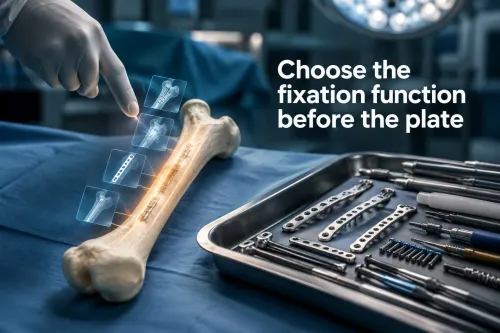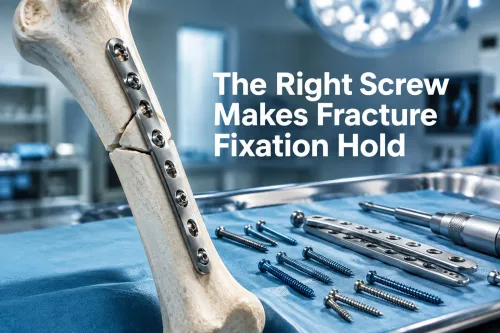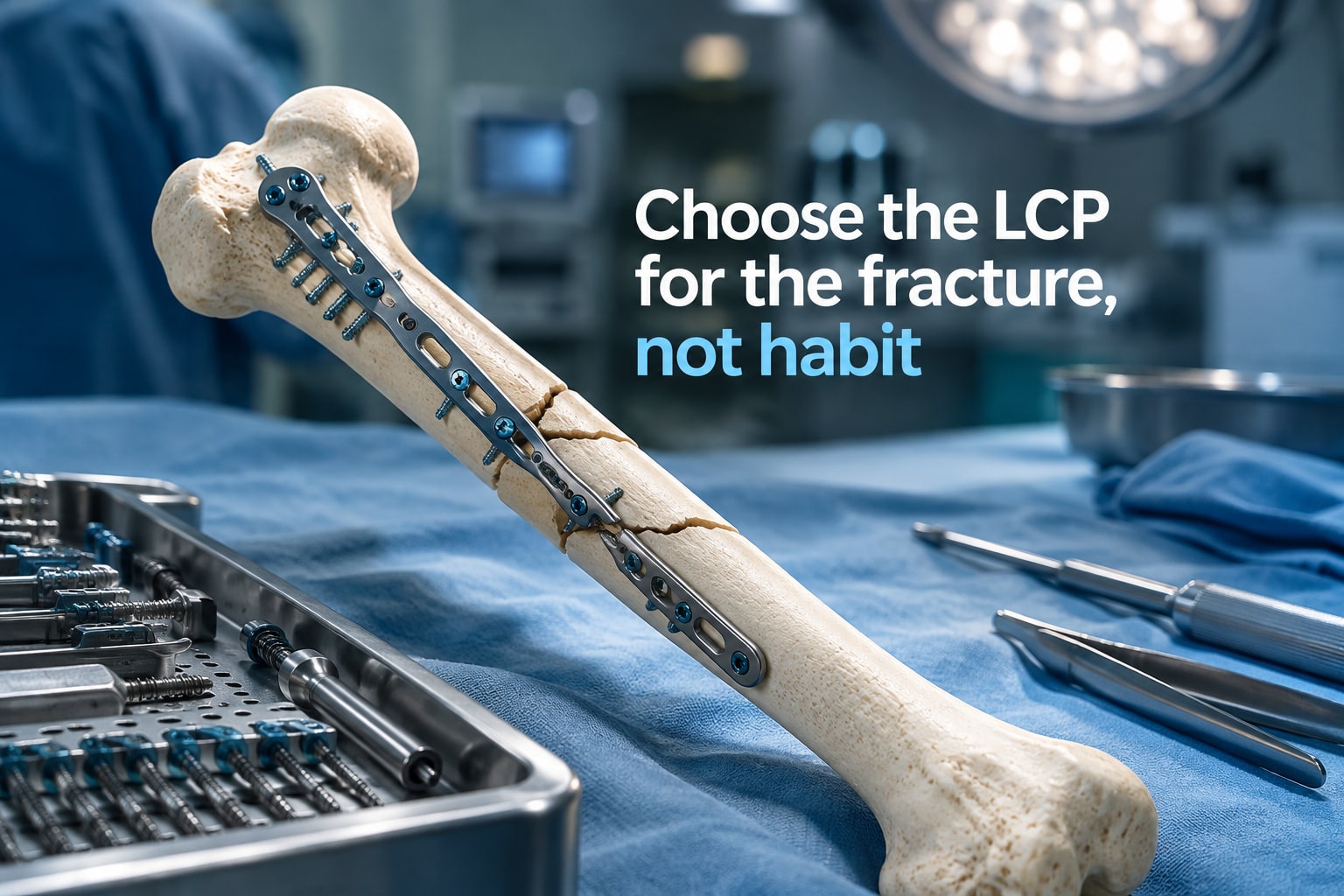
An LCP plate is most defensible when the fracture needs bridge fixation across a comminuted zone or fixed-angle support for a short metaphyseal or peri-articular fragment. You will be able to match the fracture pattern, bone and soft-tissue condition, reduction plan and implant specification before choosing an LCP over a conventional plate, nail, lag-screw construct or staged fixation.
Key takeaways
- Use an LCP when conventional screw purchase cannot provide stable fixation.
- Match plate shape, length, hole pattern and screw options to the fracture anatomy.
- Assess soft-tissue coverage, contamination, bone quality and reduction before fixation.
- Ask Santiago suppliers for traceability, technical files and sterilisation documentation.
Which complex fracture patterns justify an LCP plate?
An LCP is justified when comminution, a short metaphyseal or peri-articular fragment, osteoporotic bone, or a segmental pattern makes stable conventional screw purchase difficult. The phrase lcp plate fracture indications describes a mechanical decision, not a label for every difficult fracture.
Bridge plating uses the plate as an extramedullary splint. It restores length, alignment and rotation without opening the comminuted zone, preserves intermediate-fragment blood supply and accepts secondary callus healing.
| Option | Mechanical role | When it is more appropriate |
|---|---|---|
| LCP bridge plate | Fixed-angle splint across a comminuted or segmental zone | Metaphyseal, peri-articular or osteoporotic fractures with inadequate short-fragment purchase |
| Intramedullary nail | Load-sharing, centrally placed fixation | A suitable diaphyseal fracture with an acceptable entry site and controllable alignment |
| External fixator | Temporary or definitive frame outside compromised tissues | Severe swelling, contamination, soft-tissue loss or staged treatment |
| Dynamic compression plate | Plate-to-bone compression and axial compression | A fracture requiring compression along a reconstructable line |
| Lag screws | Interfragmentary compression across a simple line | Two-part or simple oblique fractures that permit secure screw purchase |
An LCP does not replace reduction of an articular surface; the reconstructed block still needs appropriate reduction and compression. The phrase lcp plate conditions complex fracture fixation in santiago should therefore trigger checks of reduction quality, implant fit and the intended mechanical environment. Complexity alone does not justify locking fixation.
What mechanical conditions must the construct provide?
Plan the construct to provide enough stability for alignment while allowing controlled motion that supports callus formation. The mechanical basis of sound LCP plate fracture indications is plate length, working length, screw distribution and the chosen compression method—not simply the number of locking holes.
1. Use a longer plate across a multifragmentary zone and leave an appropriate working length over the comminution. Excessive stiffness can suppress callus formation; excessive flexibility can cause malalignment, implant fatigue or screw pull-out.
2. Separate fixed-angle stability from interfragmentary compression. A locking screw threads into the plate and stabilizes its angle, but it does not pull the plate onto bone or compress the fracture.
3. When axial compression is required, place a conventional cortical screw eccentrically in the dynamic-compression portion of a combination hole. Use lag screws when the fracture geometry permits independent interfragmentary compression; locking screws do not replace either function.
4. Do not fill every hole. Distribute screws to secure adequate proximal and distal fixation while preserving the working length required for bridge fixation. A fully populated plate can create unnecessary stiffness.
5. In osteoporotic bone, confirm adequate bone stock, correct screw trajectories and sufficient plate length. Locked fixation reduces reliance on plate-to-bone friction, but it does not protect a construct from premature loading; restrict weight-bearing until biological healing supports it.
A locking plate must support a reduced fracture, not create the reduction. Use clamps, reduction tools, conventional screws or lag screws before locking displaced fragments into position.
How should the fracture and soft tissues be assessed before fixation?
Orthogonal radiographs are the starting point for lcp plate conditions for complex fracture fixation in Santiago: obtain true anteroposterior and lateral views, plus a view that exposes rotation when anatomy permits. Assess limb length, alignment, rotation, fracture level and the space available for plate and screw placement.
1. Classify the fracture as articular or extra-articular, open or closed, and contaminated or infected. Record swelling, blisters, skin viability, wounds, perfusion and the soft-tissue coverage available for definitive plating.
2. Add CT when the fracture is peri-articular, multifragmentary or difficult to interpret on plain films. CT can reveal joint steps, hidden fragments and screw trajectories that radiographs miss.
3. Defer immediate definitive plating when an active fracture-site infection, inadequate coverage or severe swelling makes implant coverage unsafe. Debridement, temporary stabilization and staged fixation protect the patient while the soft tissues recover.
4. For an intra-articular fracture, reduce the joint surface and apply interfragmentary compression where the fracture geometry permits it. Use the plate afterward to support the reconstructed articular block; locking capability does not replace joint reduction.
5. Plan fluoroscopic views that check each critical screw’s length and joint penetration. Shaft alignment views alone cannot reliably exclude an intra-articular screw, particularly near a peri-articular locking cluster.
How do anatomy and reduction strategy determine the LCP specification?
Plate selection starts with the patient’s anatomy, not the catalogue’s hole count. Review LCP plate fracture indications against the anatomic region, left or right side, bone shape, fracture span and soft-tissue envelope. Match plate length, hole pattern, width, thickness and material to the required working length and biological environment.
| Specification | Match to the case | Risk of mismatch |
|---|---|---|
| Anatomic region and side | Fit the patient’s contour and surgical approach | Poor seating or soft-tissue irritation |
| Length and hole pattern | Span the fracture while preserving working length | Excessive stiffness or inadequate control |
| Width, thickness and material | Suit bone size, load and implant position | Prominence, bending or construct failure |
Template the plate on orthogonal radiographs or CT. Plan each screw trajectory around the joint, and confirm screw length with fluoroscopic views that exclude joint penetration. Contour the plate before insertion when the system requires it: bending changes locking-hole axes, while repeated aggressive bending can damage hole geometry and make accurate screw placement unsafe.
Reduce the fracture before tightening locking screws. Use clamps, a distractor, conventional screws or lag screws to restore length, alignment, rotation and the articular surface. A locking screw does not pull a displaced fragment into position; its head can engage the plate first and lock the deformity into the construct.
For a peri-articular fragment, use the distal or proximal locking cluster only when directed screws capture a reduced articular block without entering the joint.
What should Santiago buyers verify before ordering an LCP system?
Before issuing a purchase order, convert the surgeon’s fixation plan into an itemised implant-and-instrument specification. “Locking plate” alone cannot confirm that the product fits the fracture, side, bone shape or operating-room equipment.
1. Request the exact catalogue number for each plate, its anatomic region, left or right side, available lengths, hole configuration, plate width and thickness. Include compatible screw diameters and screw types, plus radiolucent or minimally invasive options where the approach requires them.
2. Confirm that the plate, locking screws, drill guides, targeting guides and drivers belong to the same system. Nominally similar parts from different systems can produce incomplete thread engagement, incorrect screw trajectories or unusable instrumentation. List replacement instruments and their availability before shipment.
3. Ask for sterilization status, lot and batch traceability, instructions for use, and technical documentation tied to the exact implant catalogue numbers. Do not accept a generic orthopaedic-implant statement in place of device-specific records.
4. Check Chilean medical-device requirements and Instituto de Salud Pública controls for the product class, importer and intended use before shipment. This is a procurement check, not a substitute for clinical selection.
A useful specification from an orthopaedic fixation supplier in Santiago should answer each point for locking compression plate applications in Chile. Hospitals can evaluate Komal Health Care Pvt Ltd against this case-specific checklist when sourcing implants and related fixation instruments.
Related products
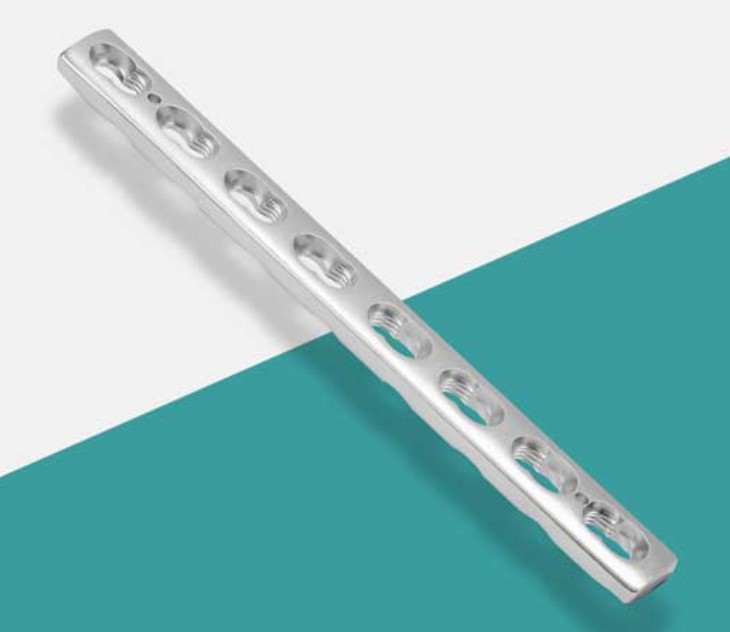 | Bone Plate LCP Plate manufacturers specialize in producing Locking Compression Plates used for internal bone fixation in orthopedic surgeries. View product → |
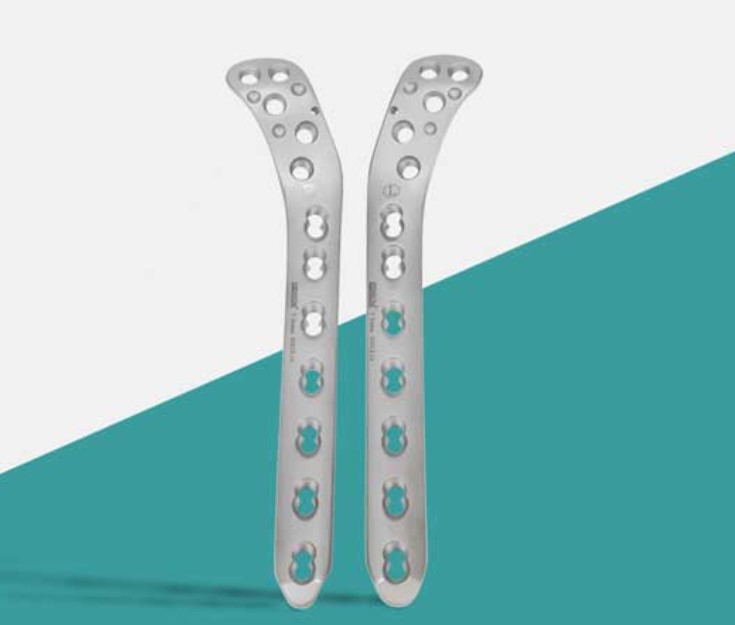 | Bone Plate Lateral Tibial Locking Plate Manufacturer Lateral Tibial Locking Plate manufacturers specialize in producing orthopedic implants designed to stabilize fractures on the lateral side of the... View product → |
Frequently asked questions
Which complex fracture patterns justify an LCP plate?
Comminuted, segmental, metaphyseal, peri-articular and osteoporotic fractures justify an LCP when conventional screw purchase cannot provide stable fixation.
What mechanical conditions must an LCP construct provide?
The construct must maintain alignment, resist bending and torsion, preserve fixation in weak bone and provide adequate working length without excessive stiffness.
How should the fracture and soft tissues be assessed before fixation?
Review radiographs and CT when joint involvement is unclear, document fracture fragments and bone quality, and assess swelling, skin condition, contamination and soft-tissue coverage.
How do anatomy and reduction strategy determine the LCP specification?
Choose the anatomical plate, length, contour, hole pattern and screw types after defining the reduction method, fracture zone, available bone and required fixation points.
What should Santiago buyers verify before ordering an LCP system?
Verify implant material, dimensions, compatibility, lot traceability, packaging, sterilisation status, instructions for use and the supplier’s quality and regulatory documents.
Related products
 | Orthopedic Implants LCP Extra Articular Distal Humerus Plate We Are Manufacturer Of LCP Extra Articular Distal Humerus Plate . Size Is from 4 Hole To 14 Holes , Difference of 1 hole . View product → |
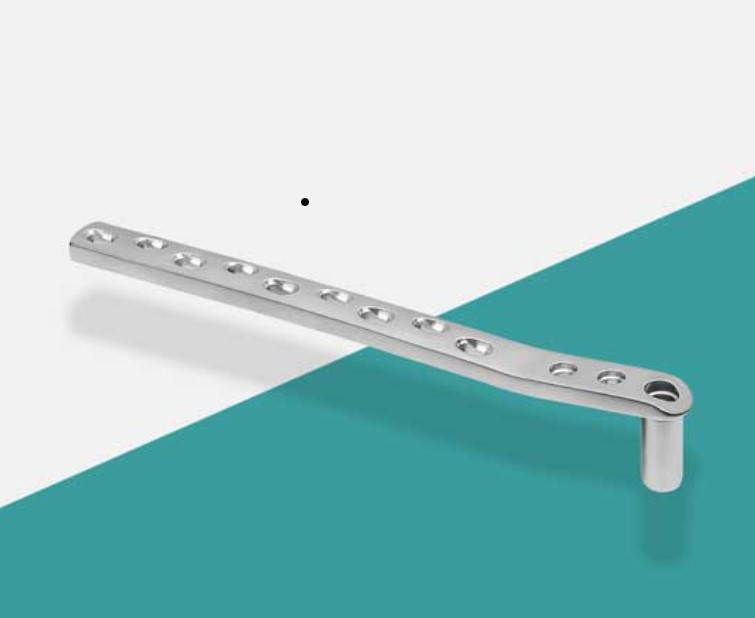 | Bone Plate Distal Femoral Compression Plate Manufacturer Distal femoral compression plate manufacturers design and produce orthopedic implants used for stabilizing fractures of the distal femur. View product → |
 | Orthopedic Implants We are The Manufacturer of LCP OLECRANON PLATES , Which are Size From 2 Holes TO 14 Holes , In Difference Of 2 Holes & Available in LEFT & RIGHT... View product → |