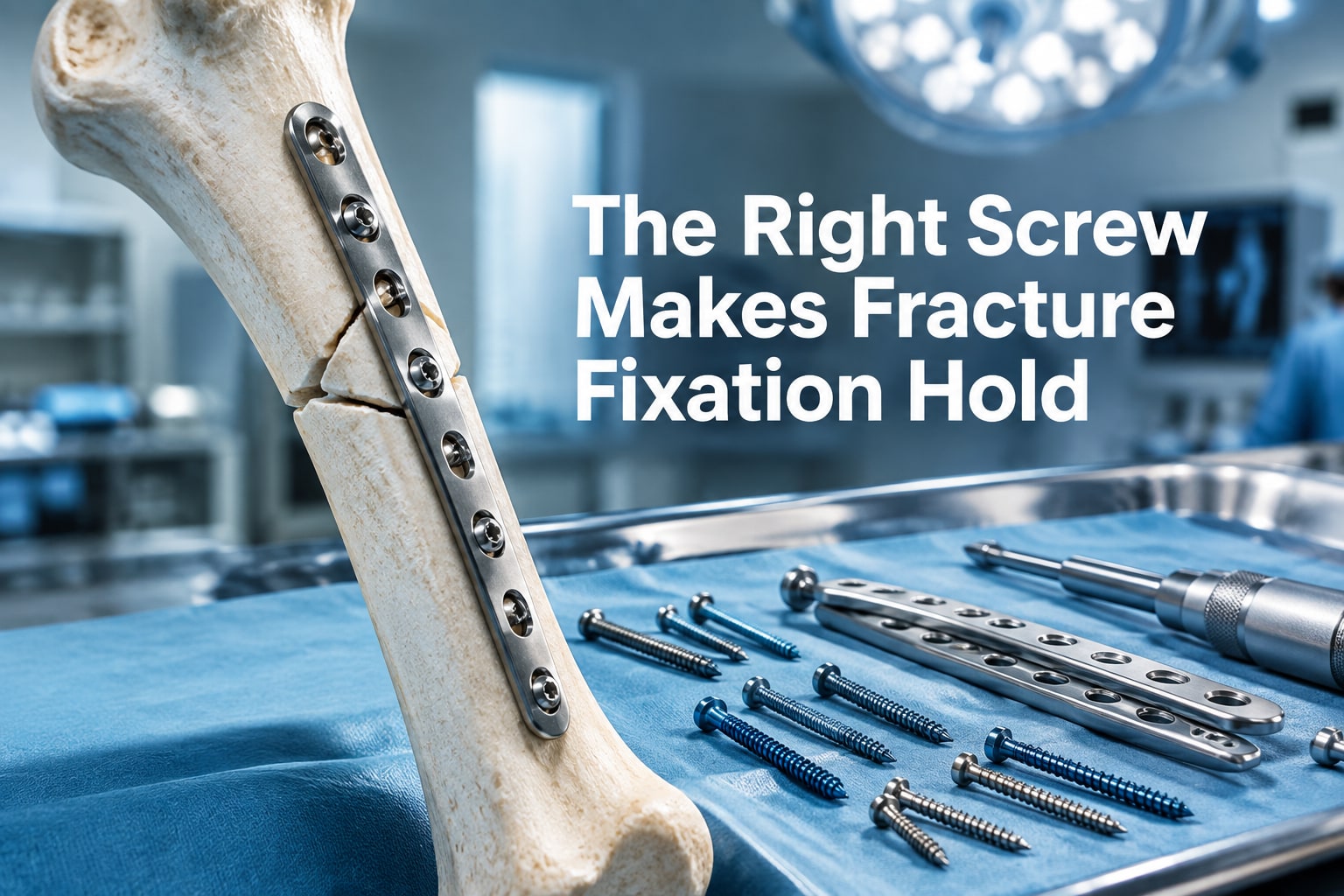
A bone screw is not defined by its diameter alone: its mechanical role depends on thread engagement, hole preparation, trajectory and the plate or nail construct around it. By the end, you will be able to distinguish compression, positional, locking and bridge fixation, understand how surgeons select and insert screws, and identify the system details a buyer must verify.
Key takeaways
- Match the screw to its mechanical job: compression, plate attachment, locking, or bridging.
- Use cortical screws for dense bone and cancellous screws for softer metaphyseal bone.
- Confirm diameter, length, thread design, material, instruments, and regulatory documents.
- Check insertion torque, pilot-hole size, and thread engagement before surgery.
What mechanical job is the screw performing?
A screw’s mechanical job depends on how it engages bone and the construct around it. Calling every screw a compression screw is inaccurate: bone screws for fracture fixation may compress fragments, hold them in position, attach a plate, lock a plate at an angle, or span a damaged zone.
| Mechanical role | What the screw does |
|---|---|
| Interfragmentary compression | Pulls one fragment toward another; an independent lag screw can compress a simple fracture line. |
| Positional fixation | Holds a reduced fracture without intentionally compressing it; threads engage both fragments. |
| Plate-to-bone fixation | A conventional screw pulls the plate against bone and creates friction. |
| Locking-plate fixation | Locks into the plate at a fixed or variable angle, providing angular stability without pressing the plate against bone. |
| Bridging | Holds a plate across a comminuted zone while the construct preserves its biology and alignment. |
The same screw family therefore serves different orthopaedic bone screw applications:
- Lag fixation of simple fracture lines
- Neutralisation or compression plating
- Bridge plating across comminution
- Locking an intramedullary nail
- Fixing fragments around a joint
A fully threaded screw can act as a lag screw when the near cortex is overdrilled to create a gliding hole; the screw does not create compression automatically. A locking screw also does not reduce a displaced fracture by itself.
Excessive stiffness, poor reduction, inadequate working length, or overly dense screw placement can impair healing and concentrate stress near construct ends.
How do cortical, cancellous, cannulated and malleolar screws differ?
Thread pattern, not screw diameter alone, determines how bone screws for fracture fixation obtain purchase. Cortical screws use fine, closely spaced threads for dense cortical bone; cancellous screws use deeper, widely spaced threads for trabecular bone in metaphyseal or epiphyseal regions. The wrong thread design can weaken fixation in metaphyseal or diaphyseal bone.
| Type | Thread or placement feature | Typical fixation problem addressed |
|---|---|---|
| Cortical | Fine, closely spaced threads | Purchase in dense shaft cortex |
| Cancellous | Deep, widely spaced threads | Purchase in softer metaphyseal or epiphyseal bone |
| Cannulated | Hollow shaft placed over a guidewire | Controlled trajectory for difficult or minimally exposed fracture lines |
| Malleolar | Size and length suited to small periarticular fragments | Stable fixation while avoiding joint, tendon, nerve and vessel injury |
Cannulated screws improve trajectory control, not accuracy by themselves. A guidewire can migrate, enter a false trajectory or remain behind after screw insertion, so imaging and a final wire check matter.
Bicortical purchase increases pull-out resistance when the far cortex is safe and useful. It is not automatically appropriate: unicortical fixation can deliberately limit far-side penetration in selected periarticular or locking-plate constructs. Screw length must account for the joint surface, tendons, nerves, vessels and nearby implants.
These distinctions shape orthopaedic bone screw applications, from simple fracture fixation to periarticular and locking constructs. A “malleolar” or “cancellous” label describes intended use and geometry, not diameter alone.
How are screw dimensions and thread engagement selected?
A screw’s nominal diameter and length come from radiographs, CT measurements, bone quality and the selected plate or intramedullary nail system. Confirm the available corridor, far-cortex purchase, thread length, head design and drive interface; the same diameter serves different bone screws for fracture fixation.
| Option | Thread engagement | Mechanical role |
|---|---|---|
| Partially threaded lag screw | Threads purchase the far fragment; the near fragment glides | Interfragmentary compression |
| Fully threaded positional screw | Threads engage both fragments | Holds reduction without automatically compressing |
| Fully threaded screw with gliding hole | Near cortex is overdrilled; threads purchase the far fragment | Lag function when accurately drilled |
A lag screw compresses only when the near cortex offers a clearance, or gliding, hole and the threads grip the far fragment. If threads bite both fragments, tightening can hold position without closing the fracture. A fully threaded screw can provide lag compression after near-cortex overdrilling, but inaccurate drilling or poor reduction defeats that effect.
Choose head shape and drive recess to match the plate, nail and insertion instruments, not preference alone. Bone density, fragment size and joint proximity also influence length and thread engagement; excessive far-side penetration can injure soft tissue.
| Material | Main advantage | Main risk |
|---|---|---|
| Stainless steel | High strength, stiffness and established instrument compatibility | Corrosion remains a system consideration |
| Titanium alloy | Lower stiffness and good corrosion resistance | Galling or cold welding at threaded interfaces |
Treat the screw, plate, driver and instruments as one compatible system. A nominally matching screw can still fail intraoperatively if its threads, recess or material do not match the system.
What happens during screw insertion and fixation?
1. Reduce the fracture and hold it with clamps, a temporary K-wire or the plate. Confirm alignment before drilling; a screw cannot reliably correct a displaced fracture unless its construct is designed to do so.
2. Select the drill bit for the screw’s diameter and function. Prepare the near cortex as a gliding hole for lag compression, or as a thread-forming pilot hole for a conventional or locking screw. Drill the far cortex only when bicortical purchase is intended.
3. Measure the prepared channel with a depth gauge. For cannulated screws, control the guidewire throughout drilling and measurement so it does not migrate into the joint or soft tissue.
4. Tap the hole when the screw system or dense cortical bone requires it. Skipping tapping can raise insertion torque, damage the thread and strip the near cortex.
5. Insert the screw along the planned trajectory. Conventional plate screws pull the plate toward bone and create plate-to-bone friction; locking screws engage the plate thread at a fixed or variable angle and do not compress the plate against bone.
6. Check reduction, screw length, joint clearance and plate engagement with fluoroscopy. Remove the guidewire and confirm that no wire has migrated or remains retained.
An oversized or damaged pilot hole, repeated insertion and removal, excessive torque or a stripped near cortex reduces holding strength. Tightening the screw further does not restore it. Use a larger diameter, different trajectory, longer purchase zone or another construct.
For bone screw usage in Santiago, verify that the instruments and implant system match before surgery.
What should a buyer verify before choosing a screw system?
Specify the construct before you compare prices. Record the intended application—lag fixation, neutralisation or compression plating, bridge plating, nail locking, or periarticular fragments—and request:
- The screw family, nominal diameter, length range, thread type and thread length.
- Head shape, drive geometry, locking-plate compatibility, material and instrument compatibility.
- Sterile status, packaging configuration, expiry information and lot traceability.
ASTM F543 provides useful mechanical evidence for metallic medical bone screws, but its tests do not establish clinical equivalence between systems.
| Test | Evidence it provides | What it does not prove |
|---|---|---|
| Dimensional testing | Controlled diameter, length and geometry | Correct fit in every plate or nail |
| Insertion torque | Resistance during placement | Safe torque for every bone condition |
| Pull-out testing | Axial holding performance under a defined setup | Performance in a specific fracture construct |
| Torsional testing | Resistance to twisting and breakage | Long-term fatigue life in a patient |
Check failure risks before approval: loosening or pull-out in weak bone, toggling in metaphyseal bone, joint penetration, plate-hole deformation and fatigue fracture under cyclic loading. Confirm screw length against joints, tendons, nerves, vessels and adjacent implants; unicortical fixation may be deliberate in selected locking constructs.
For bone screw usage in Santiago, assess a bone screw supplier Chile hospitals can audit and a surgical screw supplier in Santiago on controlled dimensions, validated testing, traceability and sterile-packaging records—not location alone. Komal Health Care Pvt Ltd belongs in that comparison only when its records match the intended plate, nail, driver and instrumentation.
Related products
 | Cancellous Screw We offer bone screws for orthopedic usage. These bone screws are available in different types like cortical bone screw, cannulated bone screws,... View product → |
 | Orthopaedic We offer orthopedic implants, orthopedic surgical implants as bone screws for orthopedic usage. View product → |
Frequently asked questions
What mechanical jobs do bone screws perform in fracture fixation?
A screw can compress fracture fragments, hold them in position, attach a plate, lock a plate at a fixed angle, or span a damaged zone.
How do cortical, cancellated, cannulated, and malleolar screws differ?
Cortical screws use fine threads for dense cortical bone; cancellous screws have deeper threads for softer bone; cannulated screws pass over a guidewire; malleolar screws are designed for fixation around the ankle and distal fibula.
How are bone screw dimensions and thread engagement selected?
Select diameter and length from the bone anatomy, fracture pattern, implant system, and required purchase. The threads must engage enough sound bone without penetrating the far cortex or joint.
What should a buyer verify before choosing a bone screw system?
Verify material, dimensions, thread profile, compatibility with plates and instruments, sterilisation instructions, batch traceability, regulatory documentation, and supplier support.