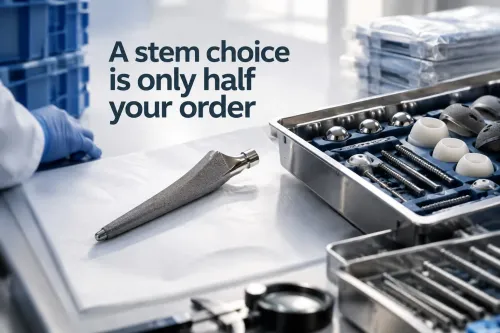
An acetabular liner does not attach to the femoral stem: it locks into the acetabular shell, while the stem carries the femoral head through its taper. By the end, you will be able to separate fixation from bearing selection, check whether the components belong to one validated system, and weigh liner materials and geometries against stability, wear and revision concerns.
Key takeaways
- The liner locks into the shell; the stem fixes on the femoral side.
- Evaluate the shell, liner, head and stem taper as one system.
- Compare polyethylene, ceramic and metal bearings by wear and fracture trade-offs.
- Request material, geometry, compatibility and quality documents from the supplier.
The liner and stem solve different mechanical problems
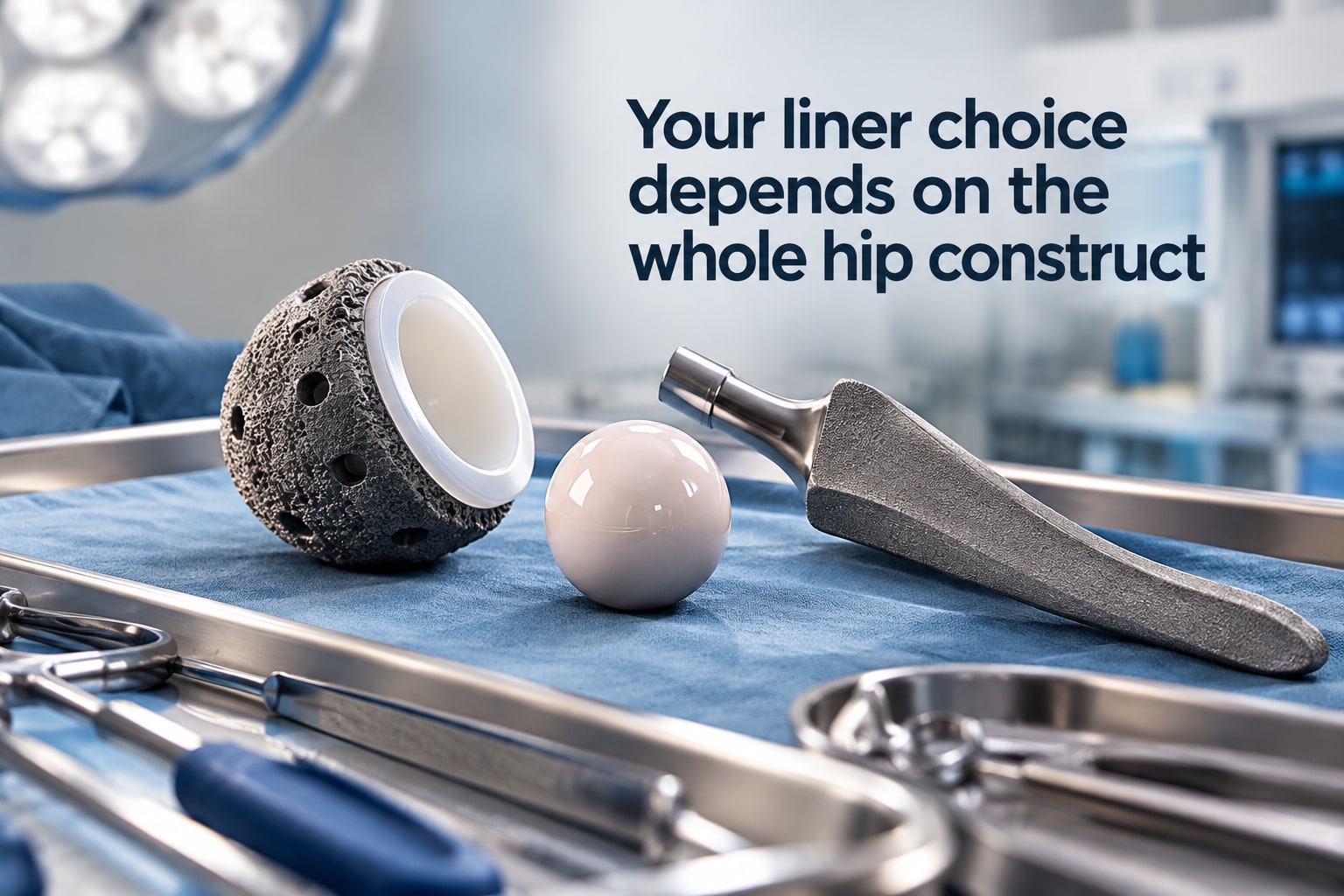
An acetabular liner with uncemented stem describes a meaningful implant construct, not a single fixation choice. The liner locks into the acetabular shell; it does not attach directly to the femoral stem. The stem fixes on the femoral side and carries the femoral head, which articulates inside the liner.
The two choices solve different mechanical problems. An uncemented stem depends on femoral preparation, press-fit stability and later bone ingrowth. The liner belongs to the acetabular bearing system, where shell fixation, locking security, head size and articulation determine performance.
Changing the liner cannot make a poorly fixed shell stable, and choosing an uncemented stem does not make a liner suitable.
Treat the phrase as shorthand for a complete, compatible construct rather than a direct stem–liner match. Check:
- The shell manufacturer and exact shell model
- The shell’s inner diameter and the liner’s outer diameter
- The backside geometry and locking mechanism
- The femoral head diameter and material
- The stem taper specification, neck length and head compatibility
Nominal head diameter alone proves nothing. A liner that fits another manufacturer’s shell on paper can fail to lock, rotate or seat correctly. The same caution applies to uncemented stem components: a femoral head must match the taper, and the approved head–liner–shell combination must be validated as a system.
The clinically relevant question is not whether the liner “goes with” an uncemented stem, but whether every interface is approved and mechanically coherent.
Treat the shell, liner, head and stem taper as one system
Compatibility depends on the complete implant chain, not on the stem’s cemented or uncemented fixation. The phrase acetabular liner with uncemented stem can mislead: the liner locks into the acetabular shell, while the femoral stem accepts the head through its taper.
| Compatibility check | What to verify | Failure if missed |
|---|---|---|
| Shell and liner | Same approved system, shell inner diameter, liner outer diameter and locking mechanism | Incomplete seating, micromotion or liner dissociation |
| Head and liner | Femoral head diameter, material and the liner’s validated internal geometry | Excessive wear, impingement or instability |
| Stem and head | Exact taper specification, geometry and neck-length options | Taper damage, poor seating or head disengagement |
| Complete combination | Manufacturer’s compatibility matrix or written approval for shell, liner, head and stem | Nominally matching parts may lack validated performance |
| Dimensions | Tolerances, minimum liner thickness and allowable head sizes | Deformation, backside damage, fracture or accelerated wear |
A larger head is not automatically safer. It can increase jump distance, but a polyethylene liner may wear more and become thinner; choosing a thin liner to preserve a large head creates another risk. Compare the manufacturer’s validated head-size and thickness limits rather than relying on shell diameter alone.
The uncemented stem provides femoral-side fixation, while shell preparation, press-fit, host-bone contact and later ingrowth determine acetabular fixation. Ask for the compatibility matrix, locking-test evidence, dimensional tolerances, regulatory status, sterilization and packaging details, lot traceability, and validated cleaning instructions. ISO 13485 certification alone does not validate a particular combination.
Compare bearing materials and liner geometries by trade-off
The best acetabular cup liner choice depends on whether your priority is wear reduction, stability, or preserving motion without overloading the construct. An uncemented stem does not change that comparison: the liner locks into the shell, while the stem accepts the femoral head.
| Option | Main advantage | Trade-off |
|---|---|---|
| Conventional polyethylene | Long clinical history and familiar handling | More wear than highly cross-linked polyethylene |
| Highly cross-linked polyethylene | Substantially lower wear, especially with ceramic or oxidized-zirconium heads | Different oxidation and mechanical behaviour; check limits for head size, liner thickness and sterilisation history |
| Ceramic-on-ceramic | Very low wear without metal-on-polyethylene debris | Squeaking, stripe wear, edge-loading sensitivity and rare ceramic fracture; cup position and clearance matter |
| Neutral liner | Preserves motion and reduces built-in rim contact | Offers less resistance to dislocation than elevated designs |
| Lipped liner | Adds a directional stability barrier | Can increase impingement, edge loading and wear if orientation is poor |
| Constrained liner | Strongest capture for severe instability or deficient soft tissues | Restricts motion and transfers higher forces to the shell and locking mechanism |
| Dual-mobility liner | Two articulations and a larger effective head diameter can reduce instability | Adds an interface with risks including intraprosthetic dislocation, polyethylene wear, modular-junction damage and system-specific technique |
A lipped, constrained or dual-mobility design is not automatically safer. Match it to instability risk, component position, soft-tissue function and revision circumstances, then confirm the shell, head diameter, taper and approved bearing combination as one system.
Match the construct to the patient and the operation
Pairing an uncemented stem with a cementless acetabular shell and liner makes sense when both sides suit the patient’s bone, anatomy and planned total hip operation. The shell gains fixation through press-fit and bone ingrowth; the uncemented stem provides femoral fixation.
The liner locks into the shell, while the femoral head mounts on the stem taper and articulates inside the liner.
Choose the construct around the operation and its main risk:
- For primary total hip replacement with adequate bone, use a compatible shell, liner, head and uncemented stem system whose sizes preserve fixation and polyethylene thickness.
- For a patient with instability risk, consider a larger head, lipped liner or dual-mobility design only after correcting component orientation and soft-tissue tension; each option brings impingement, wear or force-transfer trade-offs.
- For poor acetabular bone, focus first on shell contact, preparation, screws or revision fixation strategy. A different liner cannot rescue a shell that does not achieve stable fixation.
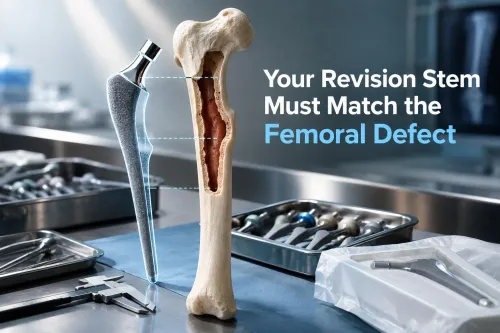
- For revision surgery, treat bone loss, retained components and dislocation mechanism as the primary decisions before selecting the bearing geometry.
The acetabular cup liner choice is not central when the urgent problem is femoral fixation, acetabular bone deficiency, leg length, offset or component orientation. Confirm the shell’s locking mechanism and dimensions, the head diameter and material, the neck length, and the stem-taper specification as one approved combination.
Nominal diameter alone does not make uncemented stem components compatible.
Use supplier evidence before calling the liner worth choosing
Request a controlled compatibility dossier before accepting a component combination. The acetabular liner manufacturer must identify the exact shell, liner, femoral head and uncemented stem-taper combinations covered by its approval; a matching nominal head diameter does not prove compatibility.
Request:
- A compatibility matrix naming shell model, shell inner diameter, liner outer diameter, locking mechanism, head diameter, head material, neck length and stem-taper geometry.
- Dimensional drawings with tolerances, plus evidence that the liner’s locking features were verified in the specified shell.
- Minimum validated liner thickness and permitted head-size combinations, especially where a thin liner preserves a larger head in a small shell.
- Packaging, sterilization, lot-traceability, regulatory-status and validated cleaning or handling documents.
| Document | What it confirms | Reject or escalate when |
|---|---|---|
| Compatibility matrix | The complete four-part combination is covered | It lists only a shell and liner, not the head and stem taper |
| Thickness and head-size data | The selected geometry has a validated safety margin | The buyer is choosing by shell size and internal diameter alone |
| Locking and tolerance report | The liner will seat without excessive motion or backside damage | The mechanism or tolerance is unspecified |
| Regulatory and traceability records | The supplied lot matches the approved product | The label, lot number or approval status cannot be reconciled |
ISO 13485 certification supports the manufacturer’s quality system; it does not prove clinical performance for a particular combination. Komal Health Care Pvt Ltd should therefore be assessed against the same evidence checklist, not by catalogue range alone.
Frequently asked questions
Does an acetabular liner attach directly to an uncemented stem?
No. The liner locks into the acetabular shell, while the uncemented stem carries the femoral head on the opposite side of the joint.
What components must you assess together?
Assess the acetabular shell, liner, femoral head and stem taper as one construct because their dimensions and interfaces must be compatible.
How should you compare acetabular liner materials and geometries?
Compare bearing materials and liner geometries by their trade-offs in wear, fracture resistance, stability, range of motion and surgical demands.
What supplier evidence should you request?
Request documented material specifications, dimensional compatibility, locking-feature details, sterilisation information, traceability records and quality-system evidence.