A calcar-stem order cannot be specified safely by stem length alone. You need to match the reconstruction plan, fixation method, taper, compatible components, instruments, documentation, and confirmed stock before a Santiago hospital accepts a quotation.
Key takeaways
- Match the stem family to femoral bone loss and the fixation plan.
- Include dimensions, laterality, materials, instruments, and documentation in the order.
- Check fit, traceability, and regulatory documents before approving the quote.
- Separate Santiago stock from export supply and production lead time.
Choose the stem family from the femoral defect and fixation plan
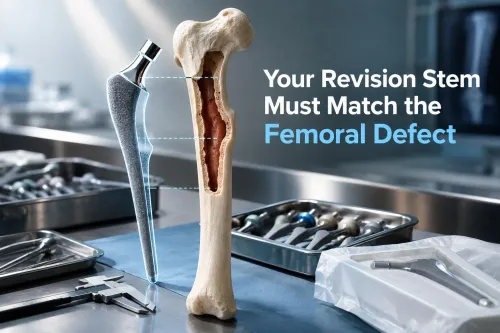
A standard primary stem loses its rationale when proximal femoral bone cannot provide reliable support. Proximal bone loss, calcar fracture, femoral-neck deficiency, or revision reconstruction can point toward a calcar-supporting or calcar-replacing family instead.
| Option | What it means | When it applies |
|---|---|---|
| Standard primary | Stem relies mainly on intact proximal femur | Adequate proximal bone remains |
| Conventional cemented | Cement fixes the stem in the prepared femoral canal | Cement fixation is the planned principle |
| Uncemented | Bone ingrowth or press-fit provides fixation | The plan calls for biological or mechanical fixation without cement |
| Calcar-replacing | Design substitutes for a deficient calcar and restores proximal support | Calcar loss or fracture prevents reliable support |
| Revision | Often provides longer or distal fixation below damaged proximal bone | Reconstruction extends into the femoral shaft |
| Modular | Separate body, neck, or distal segments can be assembled | Geometry or fixation needs adjustment |
These labels can overlap. A modular revision stem may be uncemented, while a calcar stem may use cement; “modular” describes construction, whereas “cemented” and “uncemented” describe fixation.
Before requesting a quote, ask the surgeon or hospital clinical team to document:
- Femoral-defect pattern and whether the case is primary or revision
- Calcar-supporting versus calcar-replacing intent
- Fixation principle, distal diameter, required fixation length, and permitted modular combinations
- Laterality, stem family, offset, neck geometry, taper, and compatible head or cup
A calcar stem manufacturer in Santiago should be checked for product family and manufacturing origin separately. A Santiago address does not prove local manufacture; verify the legal manufacturer, Chilean importer or distributor, and stock location.
Turn the surgical plan into a complete order specification
Put the planned reconstruction into a line-by-line enquiry before requesting a price; a stem catalogue number alone cannot define a usable order.
| Field | Record on the enquiry | Why it matters |
|---|---|---|
| Catalogue and family | Reference, calcar-supporting or calcar-replacing family | Confirms the intended reconstruction |
| Geometry | Right or left side, stem diameter, proximal-body or calcar size, offset, neck geometry, overall length | Prevents a visually similar but clinically unsuitable substitute |
| Distal fixation | Distal diameter, length range, fixation method, and stated fixation principle | Calcar reconstruction can shift fixation requirements below the proximal femur |
| Junction | Taper, modular junction, permitted combinations, and assembly limits | System-specific locking and taper standards are not interchangeable |
| Mating components | Internal head, bipolar cup, acetabular cup, liner or shell, with catalogue numbers | A “hip implant” label does not establish compatibility |
| Cement system | Cemented restrictor and bone-cement system, when required | The stem and fixation materials must match the surgical plan |
State the complete size mix, including backup diameters, body sizes, lengths, offsets, and sides. Ordering one nominal size can leave the case without a workable option.
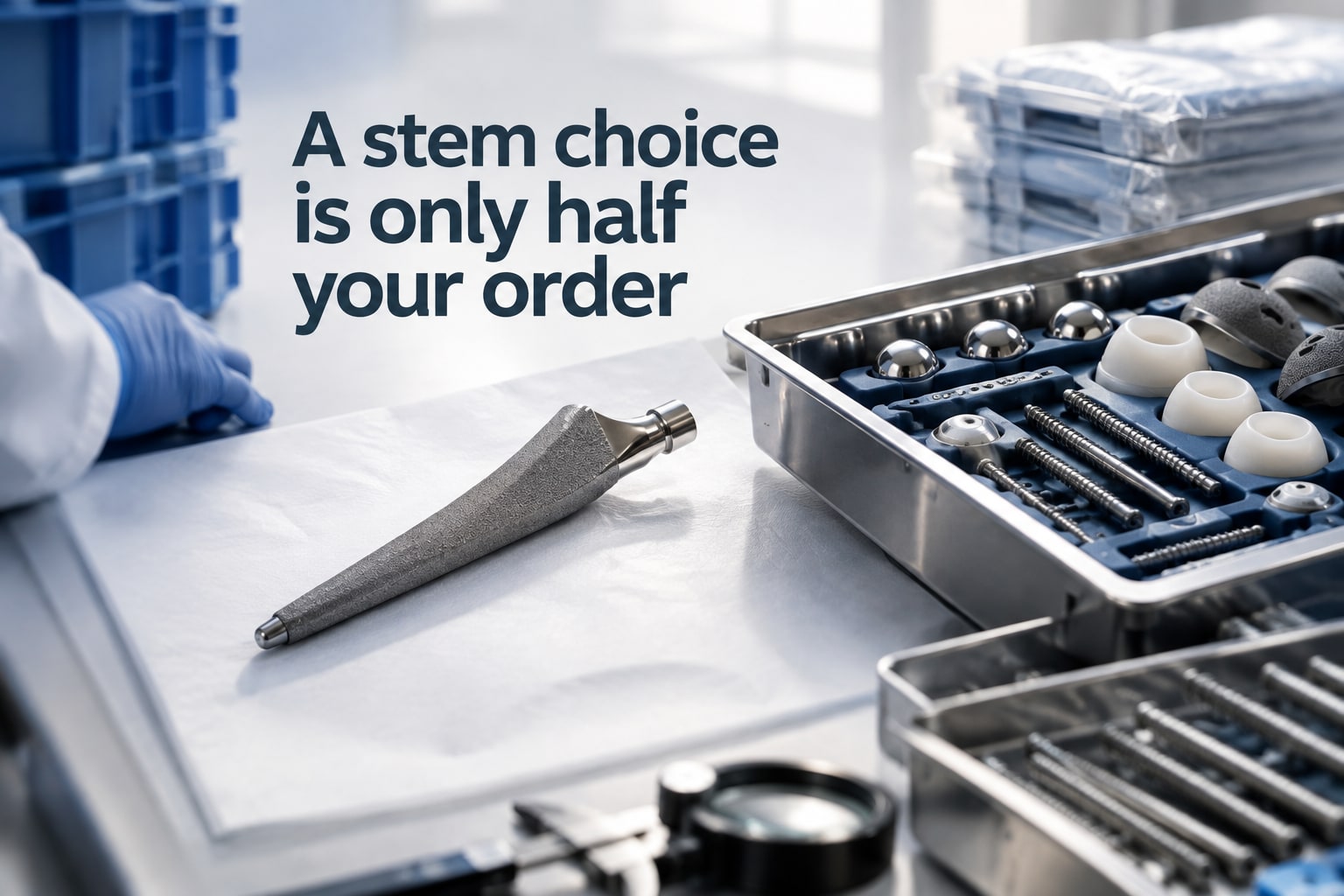
Request the complete surgical system when required:
- Trial stems, broaches or rasps
- Modular assembly tools and impactors
- Extraction instruments and backup components
Ask the hip implant supplier in Santiago to confirm these identifiers in writing, including permitted head, cup, liner, shell, taper, and locking combinations. Compare clinical review, compatibility checks, internal approvals, receiving inspection, and instrument completeness—not unit price alone.
Verify fit, traceability, and documents before approving the quote
Approve the quote only when the proposed implant matches the surgeon’s planned configuration, not merely the phrase “calcar stem.” Compare the package label and catalogue reference with the preoperative plan, radiographs, sizing chart, and trial components.
| Check | Confirm | Stop if unclear |
|---|---|---|
| Identity | Manufacturer, catalogue reference, product family, and exact size | Label and quotation show different references |
| Geometry | Right or left side, offset, neck geometry, stem length, and diameter | Any dimension differs from the surgical plan |
| Connection | Taper, modular junction, head, cup, liner, restrictor, and cement system | A mating component lacks a compatibility reference |
| Fixation | Cemented or uncemented method and permitted configuration | The quoted fixation principle differs from the plan |
| Supply state | Sterile finished implant or non-sterile reusable trial or instrument | Packaging, shelf life, or reprocessing status is unstated |
Request these documents before releasing the purchase order:
- Product catalogue or technical sheet, intended-use statement, and material specification for the exact configuration.
- Sterilization status and method, lot or batch traceability, expiry date or shelf-life information, and instructions for use.
- Warnings, contraindications, certificate of conformity or destination-market declaration where required, and complaint or recall contact.
Reusable instruments and trials need cleaning, disinfection, sterilization, packaging, and reprocessing instructions; do not treat them as sterile implants. Check that an ISO 13485 or ISO 14971 reference applies to the manufacturer and product route under review. Neither proves Chilean sale authorization or patient suitability.
If any taper, component, instrument set, or cement system remains unclear, stop and obtain written confirmation from the manufacturer and clinical team.
Confirm Santiago availability as stock, export supply, or production lead time
Availability has three meanings: stock physically in Santiago, stock held elsewhere for export, or production with a manufacturing lead time. Treat a catalogue listing as proof that the range exists, not proof that your required size and side variant is ready for dispatch.
1. Ask the supplier to classify every requested configuration separately as “in Santiago,” “export stock,” or “production.” Request the exact catalogue reference, lot or serial number, quantity available, remaining sterile shelf life where applicable, packaging configuration, dispatch point, and estimated dispatch date.
2. Confirm the delivery address, import and customs responsibility, Chilean importer or distributor, sterile-device documentation, hospital receiving hours, and restrictions such as appointment-only delivery or limited dock access. A Santiago delivery address does not prove that the manufacturer is located in Santiago.
3. Send this enquiry template: product code; stem geometry; fixation method; available sizes; compatible heads, cups, restrictors, cement, and instruments; sterile packaging details; quantity; quote validity; delivery terms; dispatch point; and documents supplied with shipment. Request the manufacturer’s name and address, instructions for use, sterilization information, expiry or shelf-life record, and complaint or recall contact.
4. For a quotation from Komal Health Care Pvt Ltd, apply the same written checks. The phrase calcar stem availability in Santiago, or manufacturer of implants calcar stem supplier in Santiago, does not establish local manufacture, unrestricted clinical availability, or a guaranteed lead time.
Confirm each size, side, instrument set, document, and delivery interval before scheduling surgery.
Related product
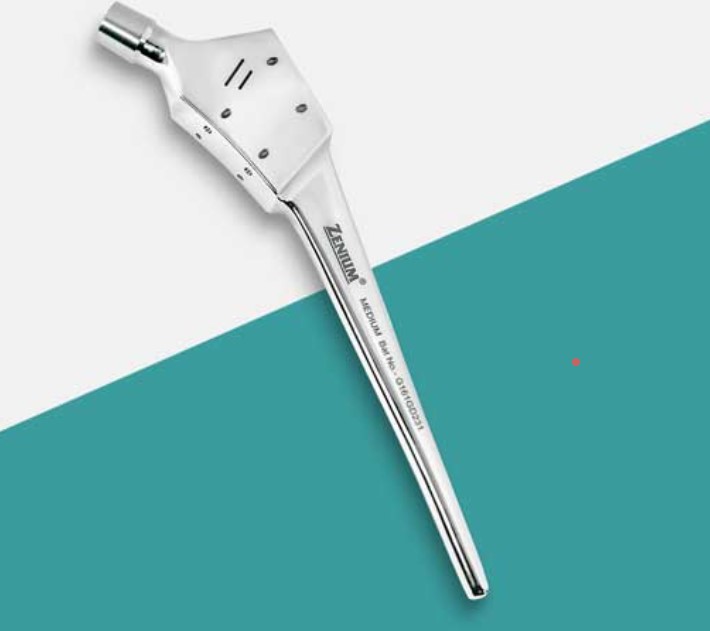 | Joint Replacement A Calcar Stem Manufacturer specializes in producing orthopedic implants designed for hip replacement surgeries, particularly when there is damage or... View product → |
Release the shipment only after receiving and contingency checks
Release the shipment into clinical inventory only after receiving and contingency checks are complete. Keep each package unopened during inspection and quarantine anything with visible damage.
1. Inspect the carton and sterile barrier for crushing, moisture, punctures, broken seals, tampering, or damaged labels. Photograph defects and do not release affected items.
2. Match the manufacturer name, product code, stem side, size, lot or batch number, expiry date where applicable, and quantity against the purchase order and packing list.
3. Reconcile sterile implants, non-sterile instruments, trial components, and reusable devices as separate inventory categories. File the instructions for use and traceability records with the hospital’s implant record.
4. Ask the supplier to state the contingency for an unavailable preferred size, matching taper, compatible head or cup, modular body, trial, or extraction instrument. Confirm whether the replacement would require clinical approval, a new quotation, or a different reconstruction plan.
A calcar stem is the wrong procurement choice when the surgeon’s plan requires another fixation strategy, the stem cannot connect to the planned components, or the required size and geometry cannot be supplied with the necessary instruments and documents. Do not substitute a visually similar stem; return the specification to the clinical team.
Keep the final purchase file with the legal manufacturer, importer or distributor, product code, size, lot or serial number, sterilization information, shelf life, delivery evidence, and post-market contact.
Frequently asked questions
How do you choose a calcar stem family?
Choose it from the femoral defect, available proximal bone, calcar support required, and planned fixation method.
What should a complete calcar stem order specify?
State the stem family, dimensions, laterality, material, quantity, compatible components, instruments, and required documents.
What should you verify before approving a calcar stem quote?
Verify the proposed fit, component compatibility, batch and serial traceability, packaging, instructions for use, and regulatory documents.
How can you confirm calcar stem availability in Santiago?
Ask whether the quoted units are physically stocked in Santiago, held for export, or assigned to a production lead time.