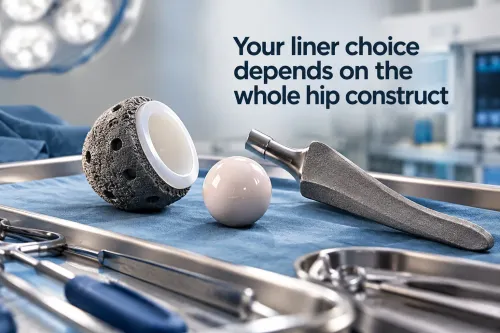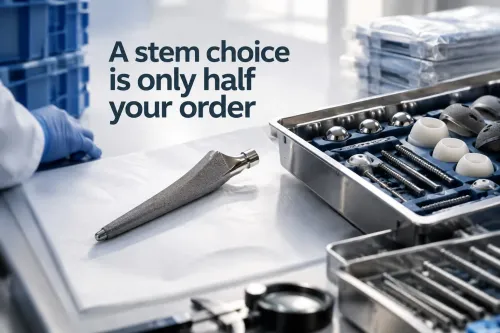
A liner cannot be evaluated by material or diameter alone: its shell interface, femoral-head pairing, geometry, fixation strategy and traceability determine whether the complete hip construct is suitable. By comparing bearing materials, design options and procurement checks, hospital teams can distinguish a clinically appropriate system from a quotation that only looks interchangeable.
Key takeaways
- Compare the shell, liner, head and stem as one complete construct.
- Match ceramic, polyethylene or metal bearings to patient and revision priorities.
- Confirm liner geometry and femoral head pairing before approving an implant.
- Request compatibility, sterility, batch and Chilean procurement records.
Compare the complete hip construct, not an isolated liner
An acetabular liner is only the bearing insert that locks into an acetabular shell; it is not interchangeable with the shell, femoral head or femoral stem. A total hip replacement implant comparison must therefore assess the assembled construct, not the liner’s unit price.
Compare these components and records:
- Acetabular shell: outer diameters, fixation method, screw options and shell–liner locking mechanism.
- Liner: inner diameter, thickness, neutral or elevated-rim geometry, and available constrained or dual-mobility designs.
- Femoral head: diameter, material, taper specification and compatibility with the liner.
- Femoral stem: size range, geometry, offset, neck options and cemented or cementless fixation.
- Surgical system: trial liners, trial heads, insertion instruments, extraction tools and revision components.
- Documentation: compatibility matrix, catalogue numbers, lot traceability, sterilisation status and published clinical evidence.
The distinction behind “acetabular cup liner versus total hip replacement components in santiago” is a procurement distinction: a liner is one modular replacement part, while a complete set requires coordinated components and instruments.
| Comparison level | What the hospital receives | Main procurement risk |
|---|---|---|
| Liner-only quotation | One insert with stated diameter and material | It may not lock into the selected shell or pair with the available head |
| Complete construct quotation | Shell, liner, head, stem, trials, instruments and compatibility records | Higher initial comparison effort, but fewer substitution and intraoperative gaps |
Also compare permitted shell and liner orientation features. An elevated rim does not correct malversion; excessive inclination can produce edge loading, impingement, dislocation and accelerated wear.
How polyethylene, ceramic and metal bearing options change trade-offs
The lowest purchase price does not identify the lowest lifetime cost. A total hip replacement implant comparison must account for the liner, shell, locking mechanism, femoral head, stem and fixation method, because changing one bearing surface changes wear, revision risk and procurement requirements.
| Option | Wear and fracture resistance | Noise | Revision and cost implications |
|---|---|---|---|
| Conventional polyethylene | Higher volumetric wear than highly cross-linked polyethylene; resists catastrophic fracture but can deform, crack or generate debris over time | Usually quiet | Familiar and often lower-cost, but wear-related osteolysis can complicate later revision |
| Highly cross-linked polyethylene | Lower in-vivo wear, provided formulation, irradiation, remelting or annealing, oxidation control, thickness and positioning are suitable | Usually quiet | Often adds material cost; request the exact formulation and processing history rather than accepting “UHMWPE” or “XLPE” |
| Ceramic | Very low wear with a compatible head; modern ceramic fracture is uncommon but remains a distinct failure mode, and scratching or taper contamination matters | Squeaking or clicking can occur | Higher component and handling cost; ceramic fracture or noise can create difficult revision scenarios |
| Metal | High fracture resistance, but metal-on-metal wear can release cobalt and chromium debris | Clicking or other noise is possible | Requires patient selection, adverse-tissue and systemic-exposure surveillance; it should not enter routine procurement as a generic alternative |
Ceramic heads paired with polyethylene liners can lower wear without choosing ceramic-on-ceramic. Metal-on-polyethylene avoids metal-on-metal exposure concerns, while a thinner liner can reduce its wear margin. Compare published follow-up, ISO or ASTM testing, regulatory indications and warranty failure modes—not labels such as “premium” or “low wear.”
Separate liner material from liner geometry and head pairing
Geometry controls stability and motion; material controls wear, fracture risk and bearing behavior. Do not treat a neutral, lipped or constrained liner as interchangeable simply because its inner diameter matches.
| Geometry | Femoral-head pairing | Material interaction | Procurement consequence |
|---|---|---|---|
| Neutral | Uses the system’s standard head size; a larger head can increase jump distance but may require a thinner liner | Polyethylene, ceramic and metal options retain their own wear and fracture trade-offs | Record the largest approved head and minimum validated liner thickness |
| Elevated-rim | Directs additional coverage toward the selected rim; confirm head clearance through the intended range of motion | A larger head does not eliminate impingement, and a thin polyethylene section remains vulnerable to wear | Check rim orientation, shell position limits and approved head materials |
| Lipped | Adds a defined anti-dislocation lip; pair it with the manufacturer’s specified head diameter and neck geometry | Ceramic or cobalt-chromium heads do not correct contact between the lip and neck | Confirm lip position options and the risk of neck impingement |
| Constrained | Mechanically captures the head, so the head diameter and capture mechanism must match exactly | Material choice cannot offset restricted motion or forces transferred to the locking interface | Reserve for selected instability or revision indications and verify the constraint’s load limits |
| Dual-mobility | Uses a small femoral head inside a mobile polyethylene component, creating a second articulation against the shell | The mobile polyethylene component introduces wear and intraprosthetic-dislocation considerations | Confirm shell compatibility, mobile-component sizes and the approved inner-head material |
A ceramic head is not automatically compatible with every polyethylene or dual-mobility liner. Require technical documentation naming the shell, locking geometry, liner, head diameter and head material as an approved combination.
Verify compatibility, sterility and Chilean procurement documentation
A quotation becomes procurement-ready only after the hospital can link the quoted liner to an authorised supply chain, a specific shell and a documented sterile package. Treat a low unit price as incomplete until these checks are closed.
1. Request the implant-system compatibility matrix. It must identify shell manufacturer and model, internal locking geometry, shell diameter, liner size, liner material, approved femoral-head diameter and head material. Do not accept cross-manufacturer pairing because the dimensions appear similar.
Require the manufacturer’s instructions for use and confirmation that the quoted liner is compatible with the hospital’s existing instruments and trial components.
2. Inspect sterility evidence for each catalogue item. Record the sterilization method, sterile-barrier configuration, packaging inspection criteria, expiry date or shelf-life, storage conditions, and reprocessing prohibition. Require lot and serial traceability, including the label format used in the patient record. A damaged seal, missing expiry date or mismatched label should stop receipt.
3. Verify Chilean supply responsibility before issuing a purchase order. Ask the acetabular cup liner supplier in Chile to identify the legal importer or distributor, the product’s applicable Instituto de Salud Pública requirements, Spanish technical documents, and the contact responsible for adverse-event and field-action reporting. Commercial availability does not prove authorisation to supply a hospital.
4. Compare the quotation with the complete implant set: shell, liner, head, stem, fixation method, instruments and trial parts. A hip cup liner manufacturer in Santiago should provide this system-level documentation, not only a component price. Apply the same hospital hip implant procurement checklist to Komal Health Care Pvt Ltd, including traceability and post-market contacts.
Related product
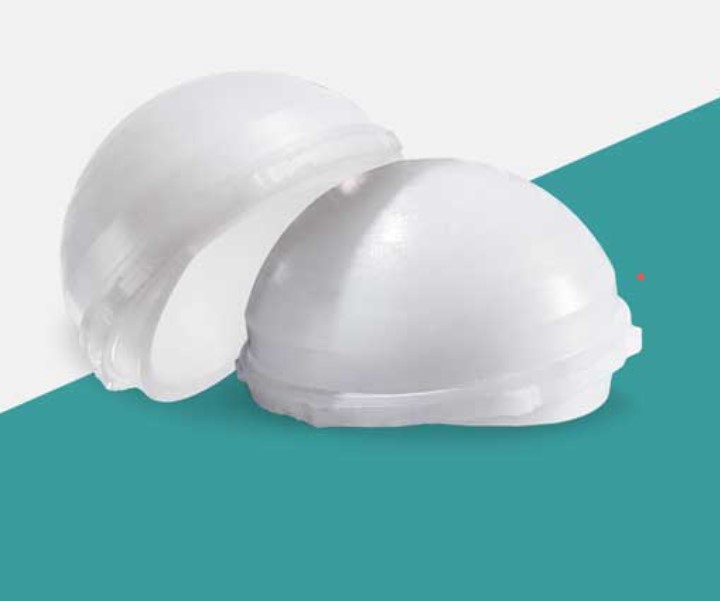 | Joint Replacement Acetabular Cup Liner Manufacturer An Acetabular Cup Liner Manufacturer specializes in producing liners that fit inside the acetabular cup during total hip replacement surgeries. View product → |
Match the liner system to the patient and the revision plan
Select the liner system by combining patient risk, operative constraints and evidence for the complete bearing couple. A young, active patient may justify a wear-focused, well-supported bearing choice; age alone does not justify ceramic, dual mobility or metal. Avoid metal-on-metal unless the indication, cobalt and chromium surveillance, adverse-tissue risk assessment and regulatory guidance are explicit.
| Option | Patient or surgical fit | Evidence and revision implication |
|---|---|---|
| Neutral polyethylene or ceramic | Routine primary replacement with stable soft tissues and accurate component positioning | Compare registry survivorship, wear, fracture reports and head compatibility |
| Elevated-rim or lipped liner | Directional instability risk that a modest rim increase can address | Confirm impingement risk and whether the lip limits revision exposure |
| Dual-mobility liner | Recurrent instability, abductor deficiency or selected revision cases | Review dislocation, intraprosthetic-dislocation and long-term revision data |
| Constrained liner | Severe instability when other soft-tissue or implant solutions are inadequate | Treat as salvage; assess locking, loosening and difficult future revision |
For hospital hip implant procurement, require these decision checks:
- In primary surgery, confirm shell position, bone quality, head diameter, offset, stem geometry and the surgeon’s plan for infection, fracture or early instability.
- In revision, identify retained shell type, locking geometry, shell fixation and bone loss; replace the shell when the liner cannot lock securely or the shell is loose.
- Compare independent registry data, peer-reviewed follow-up, manufacturer instructions, adverse-event reports and documented compatibility—not catalogue claims alone.
A liner from another manufacturer is unacceptable without written system authorization. Require a revision pathway with available liners, extraction tools, trials and traceability records.
Frequently asked questions
Why should hospitals compare the complete hip construct instead of an isolated liner?
The liner must lock into a specific acetabular shell and work with a compatible femoral head, stem and instrumentation. Compare the assembled construct, not the liner’s unit price.
How do polyethylene, ceramic and metal bearings change the trade-offs?
Bearing materials differ in wear behaviour, fracture and damage risks, cost, revision implications and compatibility. Assess the material alongside head size, shell design and patient factors.
What must a hospital verify before ordering an acetabular cup liner in Chile?
Check the exact shell and liner model, locking mechanism, size range, head pairing, sterile packaging, expiry date, lot or batch number, instructions for use and required Chilean procurement or import documentation.
How should a hospital match the liner system to the patient and revision plan?
Consider age, activity, instability risk, bone quality, primary or revision surgery and the likely future revision strategy before selecting material, geometry and head size.