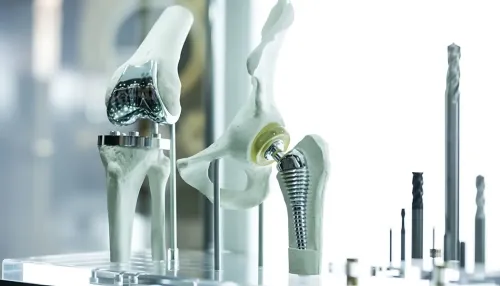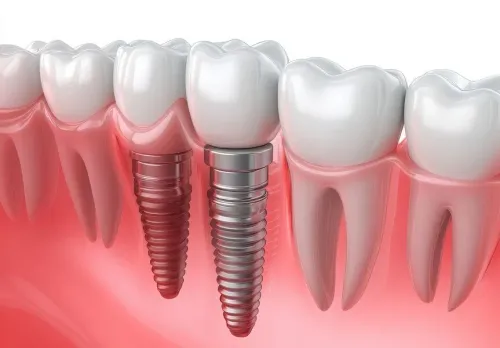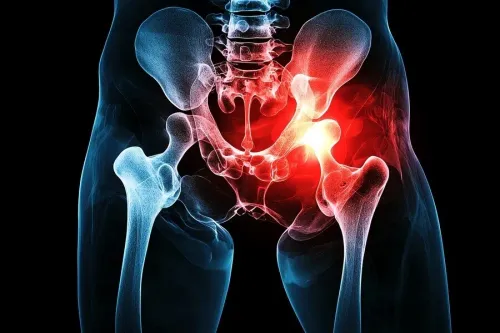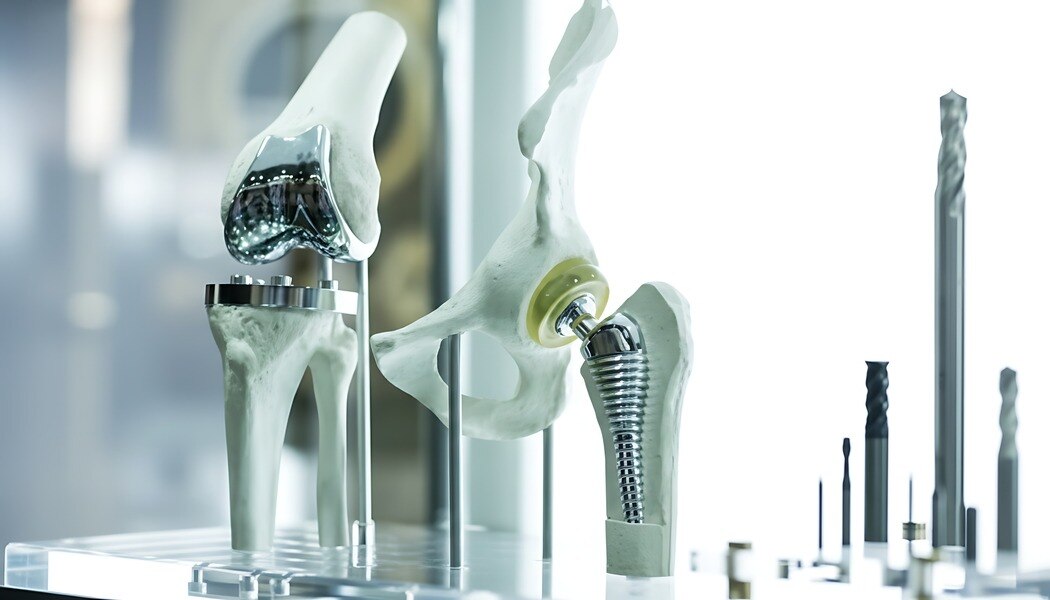
An uncemented femoral stem must be stable twice: first through press-fit mechanics in the operating room, then through bone ingrowth over time. By the end, you will be able to link common complications to canal anatomy, bone quality, fixation zones, and the choice between primary, long, revision, modular, calcar-replacing, and cemented options.
Key takeaways
- Confirm axial and rotational stability before implantation.
- Reject a stem that fails to achieve adequate cortical contact.
- Choose long or revision stems when proximal bone cannot support fixation.
- Compare patient bone quality, fracture risk, and revision needs before selecting fixation.
How uncemented fixation succeeds—and how it fails
An uncemented stem stays in place first through press-fit: the femoral stem is wedged against prepared cortical and cancellous bone, creating immediate axial and rotational stability. Its porous coating then provides a surface for bone ingrowth.
Initial mechanical stability is not the same as later biological fixation; excessive micromotion prevents bone from bridging the coating and leaves fibrous tissue instead.
| Fixation stage | What holds the stem | What goes wrong when it fails |
|---|---|---|
| Initial press-fit | Canal contact and interference between the stem and prepared femur | Intraoperative fracture, inadequate rotational control, or early subsidence |
| Bone ingrowth | New bone growing into the porous surface | Persistent micromotion, failed ingrowth, thigh pain, and aseptic loosening |
| Load transfer | Stem geometry distributes force through the femur | Distal loading can cause stress shielding, proximal bone loss, and calcar or trochanteric resorption |
A small amount of early settling can represent seating of a tapered design. Progressive migration after that settling phase signals inadequate fixation and raises the risk of later loosening.
A stem that achieves axial fixation can still be a poor choice if broaching or insertion splits fragile bone, especially in older patients, women, Dorr type B or C femora, osteoporosis, or a history of falls.
Canal bow, anteversion, dysplasia, deformity, prior fracture, and revision bone loss also affect fit. A mismatch can force compromises in offset, leg length, or version, while distal contact can produce thigh pain. Infection is a separate failure pathway, but instability and reoperation increase its consequences.
How to detect a poor stem fit before implantation
A poor match appears when the planned uncemented stem does not follow the femoral canal on templated anteroposterior and lateral radiographs. Compare stem width, length, offset, and version with the entire canal, including the femoral bow; CT helps when deformity, dysplasia, previous fracture, or hardware obscures the canal.
| Finding | What it signals | Why the selected stem is risky |
|---|---|---|
| Dorr type C canal, thin cortices | Poor proximal bone stock | Broaching or insertion can split the femur |
| Stem contacts one cortex or misses the bow | Geometric mismatch | A long stem can bind, perforate, or leave unstable fixation |
| Wide metaphysis with narrow diaphysis | Limited press-fit zone | A standard stem may subside or require excessive insertion force |
| Calcar defect, cyst, fracture line, or bone loss | Inadequate proximal support | The stem may sink, rotate, or cause an occult fracture |
- Check the broach at the planned depth. It should seat without excessive hammering and should not stop high because of a tight cortex.
- Apply axial traction to the broach or trial stem. Noticeable pistoning indicates inadequate axial stability.
- Test rotation by alternating internal and external torque. Visible or palpable rocking means the stem does not control version.
- Inspect the calcar after broaching and trial reduction. A crack, widening fracture line, or new cortical split requires stabilization and reassessment.
Do not accept “tight” as proof of a good fit: an oversized stem can create hoop stress, while an undersized one can settle into varus. In fragile bone, older age, osteoporosis, and a planned fall risk strengthen the case for a stem that achieves stability without force.
Uncemented versus cemented fixation in practical use
An uncemented stem must achieve press-fit stability at implantation; bone ingrowth comes later. A cemented femoral stem relies on a cured polymethylmethacrylate mantle for immediate fixation, so it does not require the same bone-to-implant press fit.
| Decision point | Uncemented fixation | Cemented fixation |
|---|---|---|
| Immediate stability | Depends on axial and rotational press fit; excessive micromotion permits subsidence or failed ingrowth. | Comes from the cement mantle after pressurization and curing. |
| Bone quality | Performs best with adequate cortical support; osteoporosis, Dorr type C canals, and stovepipe femora increase fracture and instability risk. | Useful when fragile or widened bone cannot hold a reliable press-fit. |
| Surgical technique | Requires accurate broaching, controlled insertion, and recognition of calcar cracks; forceful impaction can split the femur. | Requires canal preparation, cement restrictor placement, lavage, retrograde cement delivery, and controlled pressurization. |
| Weight-bearing | Full weight-bearing is often allowed when fixation is stable; restrictions follow fracture, subsidence, or poor purchase. | Stable fixation commonly supports early full weight-bearing, subject to the reconstruction and fracture pattern. |
| Early complications | Higher concern for intraoperative and early postoperative periprosthetic fracture, subsidence, and thigh pain in vulnerable bone. | Lower press-fit fracture risk, but cement implantation can cause acute cardiopulmonary reactions and cement-related technical failure. |
Do not treat the fixation label as the decision. Match the method to bone strength, femoral shape, fall risk, and the force needed to insert the selected stem. A porous coating cannot rescue an unstable uncemented stem.
Choosing among primary, long, and revision stems
A standard uncemented femoral stem fits an intact metaphysis that can provide firm axial and rotational press-fit without forceful broaching. Choose it when the calcar, proximal walls, and canal shape are reliable; distal fixation that carries too much load can cause stress shielding and later proximal bone loss.
| Option | What it means | When it fits |
|---|---|---|
| Standard uncemented stem | Shorter metaphyseal fixation with porous surfaces for later bone ingrowth | Intact proximal femur, adequate calcar, and stable broach fit |
| Uncemented long stem | Extends fixation into the diaphysis and bypasses proximal defects | Proximal bone loss or deformity when the full femoral bow and distal cortex accept the stem |
| Uncemented revision stem | Designed for deficient bone and longer distal fixation | Revision bone loss, failed fixation, or distorted proximal anatomy; assess distal perforation and fracture risk |
| Calcar-replacing stem | Replaces missing medial proximal support while restoring length and offset | Calcar destruction or proximal femoral deficiency that prevents a standard metaphyseal fit |
| Modular stem | Separate distal and proximal bodies permit adjustment of length, offset, and version | Complex revision anatomy; weigh that flexibility against fretting, corrosion, fracture, and disengagement at junctions |
| Cemented stem | Cement provides immediate fixation instead of relying on bone ingrowth | Elderly or osteoporotic patients, Dorr type C stovepipe canals, and fragile femora at high early fracture risk |
An uncemented long stem is not simply a longer primary implant. Check its path against the bowed canal on full-length imaging; a distal tip can contact one cortex, crack the femur, or perforate it even when the proximal fit looks satisfactory.
Use fluoroscopy when anatomy is distorted. Reserve a cemented option when press-fit would demand excessive force or leave inadequate rotational stability.
A decision checklist for safer hip implant selection
Document the decision before ordering: record the diagnosis, operative side, age, activity, fall risk, Dorr canal type, bone quality, femoral bow, deformity, dysplasia, previous fracture or hardware, and the planned weight-bearing restriction.
- Save calibrated anteroposterior and lateral radiographs, CT images when anatomy is distorted, and a full-length femoral template.
- Record the intended stem size, neck cut, leg length, offset, version, canal-fill target, and the level where distal fixation is expected.
- Define the fallback plan: alternative stem sizes, cerclage cables, fracture fixation, fluoroscopy, and a cemented option.
- For an uncemented revision stem, document proximal bone loss, distal fixation length, junction type, and the number of modular junctions.
- For an uncemented long stem, document the full femoral bow and the planned cortex clearances; proximal fit alone is not enough.
Compare suppliers on the details that control insertion and recovery:
| Item | Compare | Why it matters |
|---|---|---|
| Stem geometry | Taper, length, bow, offset, version, and size increments | Prevents cortical contact, malalignment, or inadequate rotational stability |
| Surface and material | Porous coating location, alloy, and ingrowth zone | Separates intended biological fixation from unsupported regions |
| Modularity | Junction design, locking method, fatigue data, and loading history | More adjustment introduces fretting, corrosion, fracture, or disengagement risks |
| Instrument set | Broach shape, handles, rasps, extraction tools, and trial components | Poor instruments encourage aggressive broaching or forceful insertion |
| Fracture support | Compatible cables, clamps, sleeves, fluoroscopy, and training | A missed calcar crack can become stem instability |
Komal Health Care Pvt Ltd’s calcar and cemented options deserve comparison when fragile proximal bone makes press-fit insertion unsafe.
Frequently asked questions
How does an uncemented femoral stem achieve fixation?
It gains immediate axial and rotational stability through press-fit, then relies on bone ingrowth into its porous coating.
How can you detect a poor uncemented stem fit before implantation?
Check whether the trial stem achieves stable axial and rotational fixation with appropriate cortical contact during preparation.
When is cemented fixation preferable to an uncemented stem?
Compare bone quality, fracture risk, and the fixation demands of the individual patient before choosing cemented or uncemented fixation.
When should you consider an uncemented long stem or revision stem?
Consider these stems when proximal femoral bone cannot provide reliable fixation and the implant must engage stronger bone farther distally.