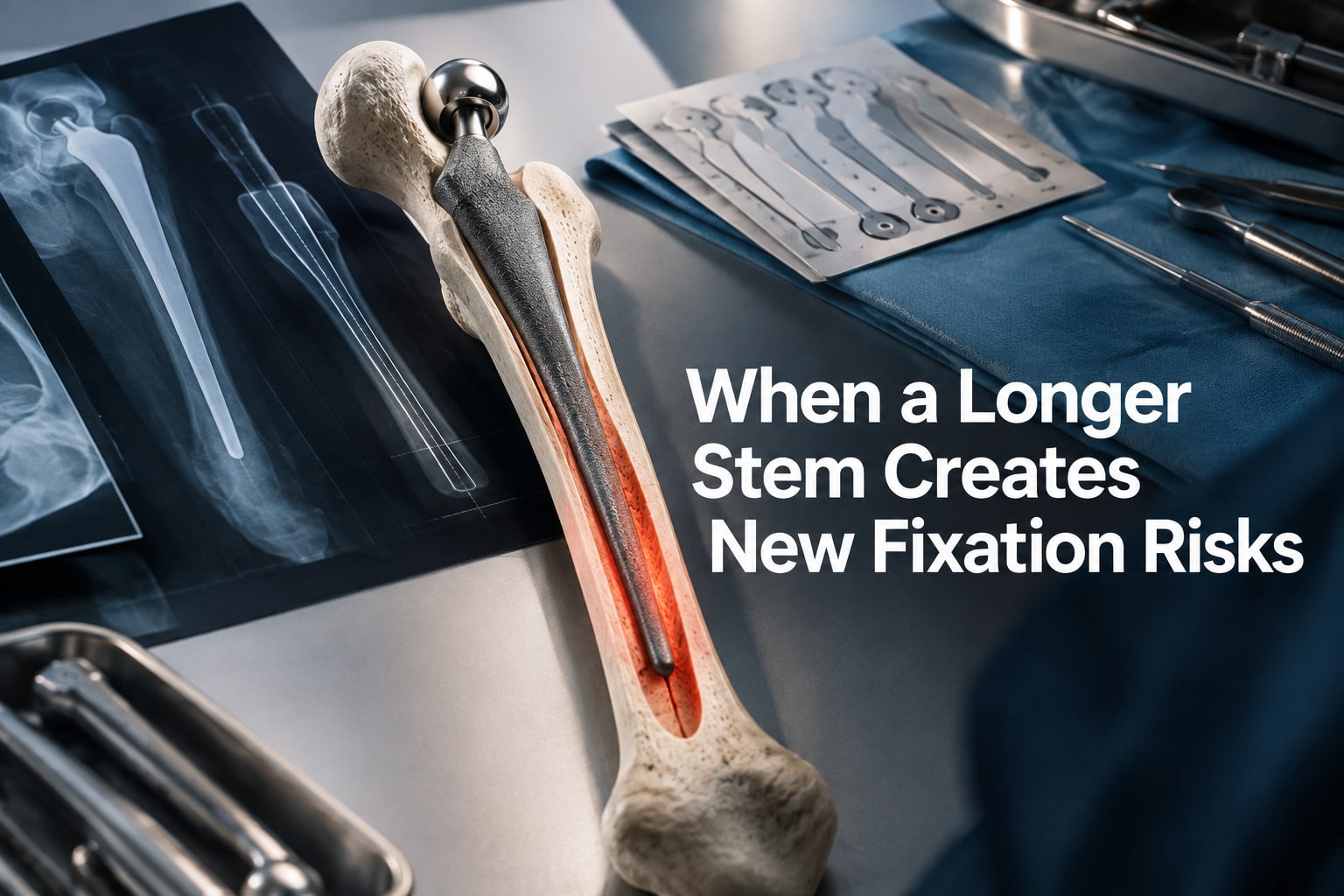
A long uncemented femoral stem can restore fixation when the proximal femur is deficient, but added length does not guarantee stability. You will be able to distinguish planned mechanical behaviour from failure, assess whether the femur can support distal fixation, and compare the choice with cemented and other revision options.
Key takeaways
- Use a long stem when proximal femoral bone cannot provide reliable fixation.
- Check for distal perforation, fracture, subsidence, stress shielding, and difficult revision.
- Use radiographs and, when needed, CT to assess distal bone before selecting fixation.
- Compare stem geometry, modularity, instruments, documentation, and supplier traceability.
What an uncemented long stem is—and when its length is justified
An uncemented long stem is a femoral component that extends beyond the fixation zone of a standard-length uncemented stem. It seeks press-fit fixation in stronger distal femoral bone when the proximal femur cannot support the implant reliably. Length varies by implant system and reconstruction, so compare catalogue dimensions rather than assuming a universal definition.
| Option | Primary fixation | When it may apply |
|---|---|---|
| Standard uncemented stem | Proximal press-fit, followed by bone ongrowth or ingrowth | Proximal femoral bone remains supportive |
| Uncemented long stem | Mechanical distal engagement first, followed by biological fixation | Revision, femoral bone loss, periprosthetic fracture, deformity or a deficient proximal femur |
| Cemented long stem | Cement interlock provides fixation at implantation | Immediate cement fixation is preferred or press-fit is unreliable |
The justification is not length itself but a safe, circumferential distal cortical tube. Distal cortical continuity, bone quality, canal shape, taper geometry and intact fixation length determine whether the femoral stem will resist axial migration and rotation. A capacious, osteoporotic or bowed canal can leave a long uncemented stem unstable, painful or prone to subsidence.
The “two femoral diameters” bypass rule helps planning but does not guarantee fixation. Excessive distal loading can cause thigh pain and proximal stress shielding, with later cortical thinning and calcar loss. A long stem can also make extraction more destructive, requiring an extended trochanteric osteotomy, cortical window or additional bone removal.
Choose it when distal fixation solves a documented deficiency, not as a substitute for accurate sizing or canal preparation.
Which uncemented long stem problems begin during fixation?
Most uncemented long stem problems begin before bone ingrowth. During insertion, oversizing, forceful broaching or anterior-cortex contact can split the femur, especially in older patients, women, osteoporotic bone and femora with abnormal geometry. Keep cables, cerclage equipment and a fracture-management plan in the operating room before inserting the uncemented stem.
Early fixation must control both axial movement and rotation. Poor canal preparation, inadequate distal scratch-fit, weak remaining cortex or excessive taper mismatch can allow micromotion, subsidence, version loss and fibrous rather than bony fixation. Experimental osseointegration research often places a transition range around 50–150 micrometres, but that figure is not a universal clinical cutoff.
| Finding | What it may mean | What to check |
|---|---|---|
| Small, early, self-limiting migration | Wedging and secondary fixation in a tapered femoral stem | Serial radiographs rather than one subsidence threshold |
| Progressive migration, changing version or painful migration | Inadequate fixation | Stem fit, alignment, fracture and component position |
| Thigh pain with distal loading or stem-tip contact | Load concentration without aseptic loosening | Radiographs, fracture exclusion, fit, infection and adverse-tissue testing |
| Proximal cortical thinning or calcar bone loss | Distal fixation has shifted load away from the proximal femur | Stress shielding and future revision bone stock |
A long stem can remain radiographically fixed while causing stress shielding. Persistent pain, worsening migration or instability requires investigation rather than automatic attribution to loosening.
How imaging and alternatives determine whether distal fixation is safe
Use full-length femoral radiographs when possible; a hip-only anteroposterior film can hide unsafe anatomy. Use CT when bone loss, deformity, previous hardware or canal shape is unclear. Assess cortical thickness, femoral bow, canal width and geometry, the defect or fracture line, intact distal fixation below it, and the expected leg length, offset and version.
Classify bone loss using the treating team’s system, such as Paprosky, and document the remaining circumferential cortex.
| Option | What it provides | When it applies |
|---|---|---|
| Standard-length uncemented stem | Proximal press-fit fixation | Proximal bone supports fixation |
| Calcar-replacing stem | Reconstruction of the neck and calcar | The defect is concentrated at the neck and calcar |
| Uncemented long stem | Distal mechanical fixation beyond deficient proximal bone | Proximal fixation is unreliable, but the distal cortical tube is intact |
| Modular tapered revision stem | Independent adjustment of distal fixation and proximal reconstruction | Distal engagement and proximal leg length, offset or version need separate control |
A straight femoral stem can strike or perforate an anteriorly bowed femur. Excessive distal engagement can force varus and change offset or leg length, even when radiographs show stability.
A cemented long stem provides immediate cement fixation and permits cement-in-cement or revision cementing techniques, but demands control of cement mantle thickness and extrusion and makes pressurisation and later removal more difficult. The central choice is immediate stability versus biological fixation, proximal bone preservation and future extraction.
How stem design, modularity and the total hip construct change the risk
A long stem that reaches solid distal bone is not automatically a safer choice. Compare curvature, taper, diameter, material, surface coating and distal fixation profile, because each changes load transfer, femoral preparation, and the risk of anterior cortical contact.
Filling the distal canal can improve axial and torsional stability, but it can also increase thigh pain and proximal stress shielding.
| Option | Benefit | Added concern |
|---|---|---|
| Straight, tightly fitting stem | Strong distal axial and rotational fixation | May mismatch a bowed femur, force varus, or risk perforation |
| Curved or tapered stem | Better accommodation of canal geometry and controlled fixation | Limited catalog choices can restrict offset, version, or leg-length correction |
| Modular uncemented revision stem | Separates distal fixation from proximal body selection | Fretting, corrosion, fracture, or disengagement at the junction |
| Large offset or distal-fill design | Helps restore tension and stability | Raises bending loads, extraction difficulty, thigh pain, and proximal bone loss |
Record the manufacturer’s assembly sequence and inspect every taper before closure; incomplete seating can turn modularity into one of the key uncemented long stem problems. Select the femoral component with the acetabular component, head size, bearing, orientation, offset, leg length, abductor function, and soft-tissue tension.
A long stem can achieve fixation yet leave impingement, dislocation, limb-length discrepancy, or excessive offset. Age, activity, bone quality, femoral morphology, prior implants, and future revision needs determine whether preserving proximal bone outweighs immediate fixation. Published outcomes do not replace implant-specific survivorship, comparative data, and stated selection criteria.
What should the selection and supplier checklist include?
Approve an uncemented long stem only against a documented reconstruction plan, not a claim that it suits revision surgery. Template it on suitable full-length imaging; confirm target leg length, offset and version; prepare backup diameters and fixation options; and have cables, fracture-management instruments and extraction tools ready.
These steps address uncemented long stem problems before they become avoidable revisions.
| Finding | Required response |
|---|---|
| Subsidence, migration or new radiolucent lines | Compare serial radiographs and investigate progression |
| Fracture, malalignment or proximal bone loss | Review fixation, alignment and bone stock promptly |
| Worsening pain, new limp, leg-length change or instability | Assess component position, fracture and infection; do not label all thigh pain loosening |
Before approving hip implants, request the exact catalogue, stem lengths and diameters, taper dimensions, coating and material, modular-junction instructions, compatible heads and acetabular components, instrument list, sizing templates, sterilization status, shelf life, lot and batch traceability, instructions for use, and regulatory records for the selling market.
Ask how the supplier handles damaged packaging, recalled lots, unavailable sizes and intraoperative exchange.
- Reject the option when infection is uncontrolled, bone stock cannot provide fixation, the canal is severely widened, press-fit cannot be achieved, or distal fixation risks perforation or fracture.
- Evaluate Komal Health Care Pvt Ltd against this same evidence when sourcing implants and instruments; the checklist matters more than broad suitability claims.
Frequently asked questions
What is an uncemented long stem?
It is a femoral component that extends beyond the fixation zone of a standard uncemented stem and seeks press-fit fixation in stronger distal femoral bone.
When is an uncemented long stem justified?
Its length is justified when the proximal femur cannot reliably support a standard stem, such as during complex reconstruction or revision. Compare the implant system’s catalogue dimensions rather than relying on a universal length.
Which problems can begin during fixation?
Fixation can create risks including femoral perforation, intraoperative fracture, poor contact, malposition, subsidence, and excessive distal loading. Imaging and careful preparation help assess whether distal fixation is safe.
What should you compare when selecting a long stem?
Compare stem geometry, distal fixation strategy, modularity, instrumentation, compatibility with the total hip construct, imaging requirements, technical documentation, and supplier traceability.