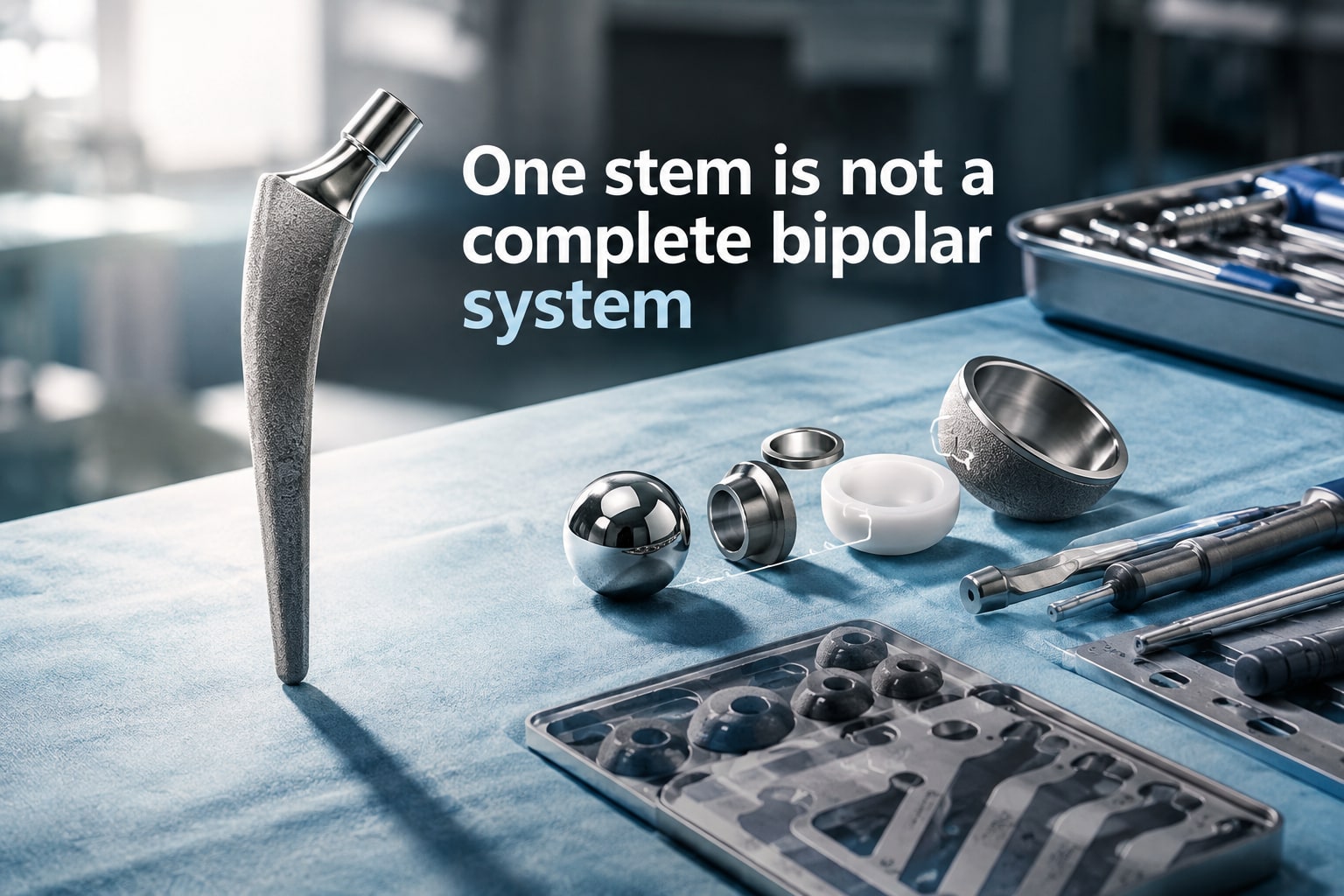
A cup diameter range does not tell you whether a cemented femoral stem will fit, how it will be fixed, or which head and taper combinations are approved. By the end, you will have a practical specification checklist for comparing stem dimensions, cementing requirements, component compatibility, clinical selection, and Indian procurement documents.
Key takeaways
- Request a signed specification sheet covering every cemented stem size.
- Do not compare cemented stems using overall length alone.
- Match the stem, head, taper, liner, shell, and instruments as one system.
- Confirm traceability documents and Mumbai supply requirements before ordering.
Request the complete cemented femoral stem specification sheet
Overall stem length cannot tell you whether two cemented stem sizes are interchangeable. Request a signed, current specification sheet with every size and a templating radiograph or digital template before comparing hip implants from different suppliers.
| Specification | Obtain from supplier | Why it matters |
|---|---|---|
| Size geometry | Stem lengths, proximal and distal widths, distal diameter, offset options, neck-shaft angle, neck lengths, available sizes, and left, right or universal configuration | A similar length can conceal a different head centre, offset or canal fit |
| Modular interface | Exact taper dimensions, taper type, head options, and compatibility with the stated stainless-steel 316L/LVM bipolar shell and liner | A detachable neck does not prove that the shell, liner, head and stem form a working bipolar system |
| Cemented construction | Proximal cross-section, distal geometry, collar or collarless design, centralizer provision, polished or matte surface, and surface-finish specification | These features affect cement mantle formation, stem subsidence and revision planning |
| Material | Exact alloy designation, such as wrought stainless steel, linked to ISO 5832-1 or the applicable material standard and edition | “Medical-grade metal” is not a traceable material specification |
| Cement interface | Minimum recommended cement-mantle thickness, distal plug or centralizer requirements, and radiographic acceptance criteria | A nominal stem dimension is not the final mantle thickness |
Ask for the manufacturer’s complete size matrix, not a brochure showing only one representative stem. Confirm that the taper dimensions match the supplied heads and that each listed stem size has a corresponding template; otherwise a Mumbai buyer cannot compare suppliers or order a complete cemented stem construct safely.
Separate cemented fixation requirements from press-fit design
A cemented stem requires a femoral canal prepared for a continuous cement mantle, not a tight press-fit. The broach or rasp creates space around the femoral stem; the surgeon then plugs, lavages, dries, and fills the canal according to the surgical technique.
Request the manufacturer’s minimum mantle thickness rather than treating the nominal stem width as the final fixation envelope.
Immediate fixation comes from cured polymethylmethacrylate interlock with bone and stem. A centralizer helps centre the distal stem and reduce cortical contact, but it cannot replace the cement mantle. Confirm the centralizer size and compatibility in the implant and instrument documents.
Specify the complete cement system, not simply “PMMA cement”:
- Cement viscosity and radiopacifier
- Antibiotic content and its clinical indication
- Vacuum or hand-mixing method
- Delivery system and working time
Cemented fixation also changes radiographic review. On the immediate postoperative image, assess the continuous mantle, stem position, distal centralisation, cement defects, and cortical injury against the supplier’s acceptance criteria. Serial films then track radiolucent lines, cement fracture, migration, or subsidence.
A press-fit stem instead requires review for seating, cortical contact, and later bone integration; do not apply its criteria to a cemented construct.
Match the stem, head, taper, liner, and bipolar shell as one system
Modular compatibility means every connection and bearing surface is approved to work together, not merely that each part is sold for hip implants. A modular bipolar construct has two articulations: the femoral head inside the bipolar liner, and the bipolar shell against the native acetabulum.
Confirm these details before placing an order:
- Femoral stem size, offset, neck-shaft angle, proximal and distal dimensions, and taper designation.
- Femoral head diameter, taper length, material, and the assembly conditions approved for that femoral stem.
- Bipolar liner inner diameter and material, matched to the selected head.
- Bipolar shell outer diameter, inner bearing dimensions, shell material, and liner material.
- The manufacturer’s compatibility matrix linking each stem, head, liner, and shell combination.
- A test report and risk assessment for the offered configuration, rather than evidence from a different stem length, head size, or bipolar assembly.
A published 37–55 mm cup range is insufficient because it usually states only the available outer shell diameters. The outer shell is chosen against the prepared femoral head and acetabular anatomy; the inner bearing size is governed by the femoral-head component.
The range does not identify the correct taper, head diameter, liner, materials, or approved assembly. Mixing similar-looking tapers can cause incomplete seating, fretting, or trunnion damage. Treat the femoral stem, head, taper, liner, and shell as one system, and reject a quotation that cannot show those links.
Use templating and trial reduction to choose size, offset, and procedure
Select the cemented stem from a calibrated AP pelvis template and confirm it during trial reduction, not from overall length alone. Compare proximal body width, distal diameter, offset, neck-shaft angle, and head-centre position with the contralateral hip; manufacturers’ size numbers are not interchangeable.
During surgery, broach to the planned fit, then trial the stem, neck option, head, and bipolar shell. Check leg length, offset, abductor tension, stability through flexion and rotation, and range of motion. A centralizer helps centre the distal stem and limits cortical contact; it does not create an adequate cement mantle.
Confirm its size and instrument compatibility in the surgical technique.
Cemented bipolar hemiarthroplasty and total hip arthroplasty serve different acetabular conditions and activity demands.
| Option | Choose it when | Trial reduction must confirm |
|---|---|---|
| Cemented modular bipolar hemiarthroplasty | The fracture involves the femoral neck, the acetabulum is reasonably preserved, and limiting acetabular component surgery is desirable | Stable inner head-liner and outer shell-acetabulum motion, restored length, and no impingement |
| Total hip arthroplasty | Acetabular arthritis, erosion, inflammatory disease, severe pain, or higher functional demand makes native-acetabulum articulation unsuitable | Stable cup, head, and stem combination with correct offset, length, and component clearance |
A modular bipolar is not simply a detachable-neck stem. Its femoral head, liner, shell, taper, and cemented stem form two articulations and must be tested as one compatible system. Record the selected size, offset, head, shell, and liner in the operative and purchasing documents; these details identify the hip implants actually used.
Verify Mumbai compliance, traceability, and the matching instrument set
For bipolar modular stem cemented specifications in Mumbai, require a device file before accepting hip implants. Verify the Medical Devices Rules, 2017 status, applicable manufacturing or import licence, device classification, and Indian authorised-agent details where relevant. A CE mark or ISO 13485 certificate alone does not authorise Indian supply.
| Document | What to verify | Acceptance test |
|---|---|---|
| Regulatory file | Licence, classification, Indian label, IFU, authorised-agent details | Names and catalogue numbers match the shipment |
| Traceability | Catalogue number, exact stem size, offset, lot or batch, UDI or equivalent where assigned | Every box and delivery note carries matching identifiers |
| Testing file | ISO 7206-4 fatigue report with tested size, configuration, cycle count and pass/fail basis; risk assessment | Evidence covers each offered stem, neck, head and bipolar assembly |
| Packaging record | Sterilisation method, expiry or shelf-life, sterile barrier and single-use statement | Seal, pouch and carton are intact; expiry is visible |
| Delivery file | Packing list, certificate of conformity, invoice, quantity and instrument-set record | Instruments match the surgical technique and supplied implant system |
Ask Komal Health Care Pvt Ltd to map each quoted configuration to its test report, risk assessment, IFU and lot record rather than supplying a generic range certificate.
Reject or quarantine a box with a broken seal, missing batch number, unclear expiry, or an instrument mismatch. Confirm the centralizer size separately: it positions the distal stem and does not replace a cement mantle.
Related product
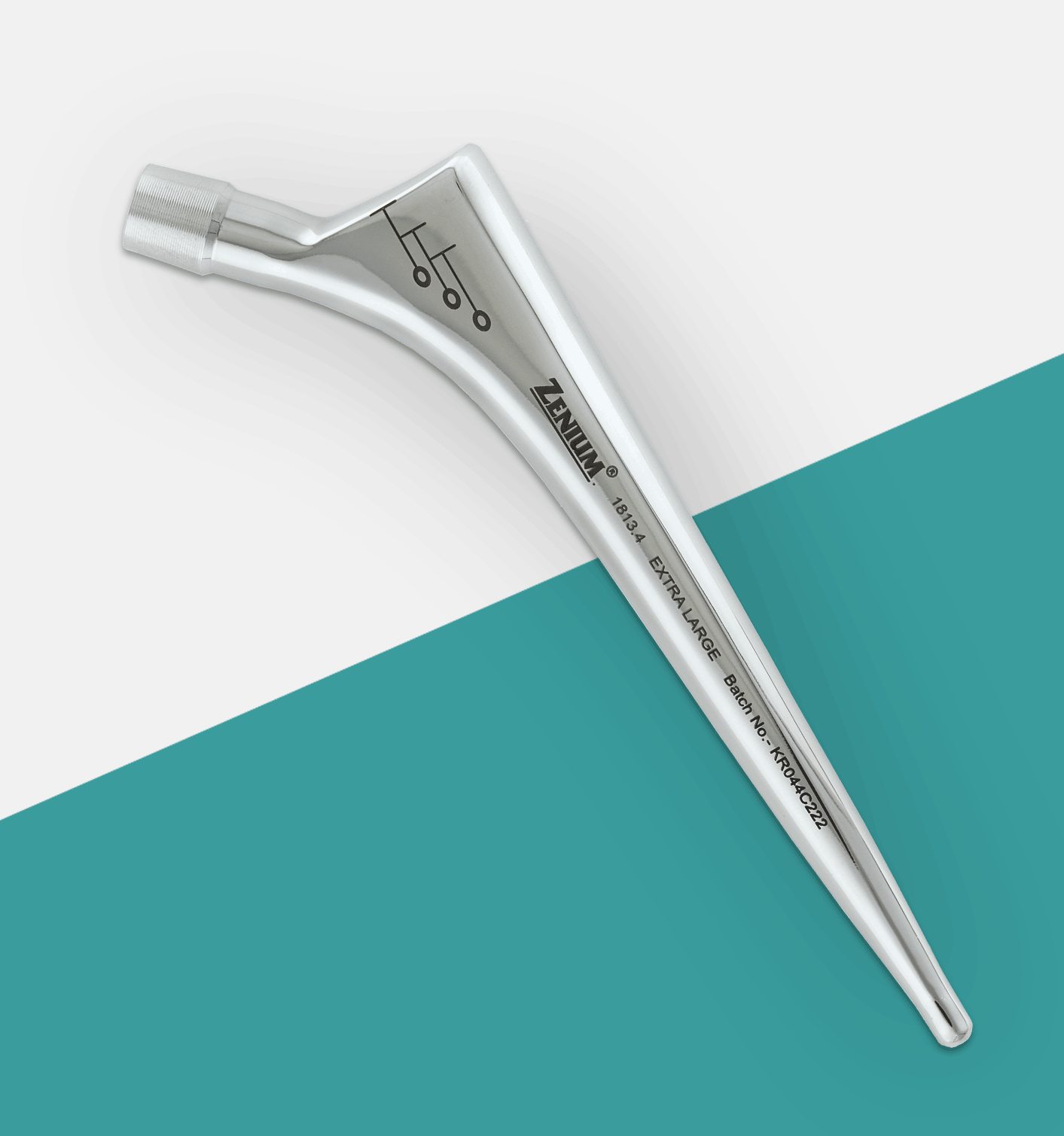 | Joint Replacement Bipolar Modular Stem (Cemented) Manufacturer The Bipolar Modular Stem (Cemented) is an orthopedic implant used in hip replacement surgeries, especially for elderly patients with fractured or... View product → |
Frequently asked questions
What should Mumbai buyers request in a cemented femoral stem specification sheet?
Request a signed, current sheet listing every stem size, dimensions, offset options, taper details, cemented fixation features, materials, and compatible components.
How does a cemented stem differ from a press-fit femoral stem?
A cemented stem relies on bone cement for fixation and requires cement-compatible geometry, while a press-fit stem depends on initial mechanical stability and later bone ingrowth.
How do you match components in a modular bipolar hip implant?
Confirm that the femoral stem, femoral head, taper, liner, bipolar shell, and instruments are specified as compatible parts of one system.
How do templating and trial reduction guide stem selection?
Use radiographic or digital templating, then trial reduction to assess stem size, offset, leg length, stability, and the planned surgical procedure.
What compliance and traceability checks should Mumbai implant buyers complete?
Verify the supplier’s required Indian documentation, device identification, batch and lot records, certificates, authorised supply details, and the matching instrument set.