An X-ray-detectable marker helps locate a retained swab, but it does not replace a disciplined surgical count or prove that every product carrying the label is suitable for theatre use. By the end, you will be able to define the right swab, inspect its construction and packaging, compare cotton with non-woven materials, and choose between a small gauze swab and an abdominal pad.
Key takeaways
- Confirm the radiopaque marker is present, continuous and visible on the product label.
- Inspect the sterile barrier, seal, expiry date, lot number and pack count before use.
- Specify size, ply, edge finish, marker type, sterility and packaging in every purchase order.
- Choose an abdominal pad when a procedure needs greater fluid capacity and larger coverage.
What an X-ray-detectable gauze swab actually contains—and how it supports the surgical count
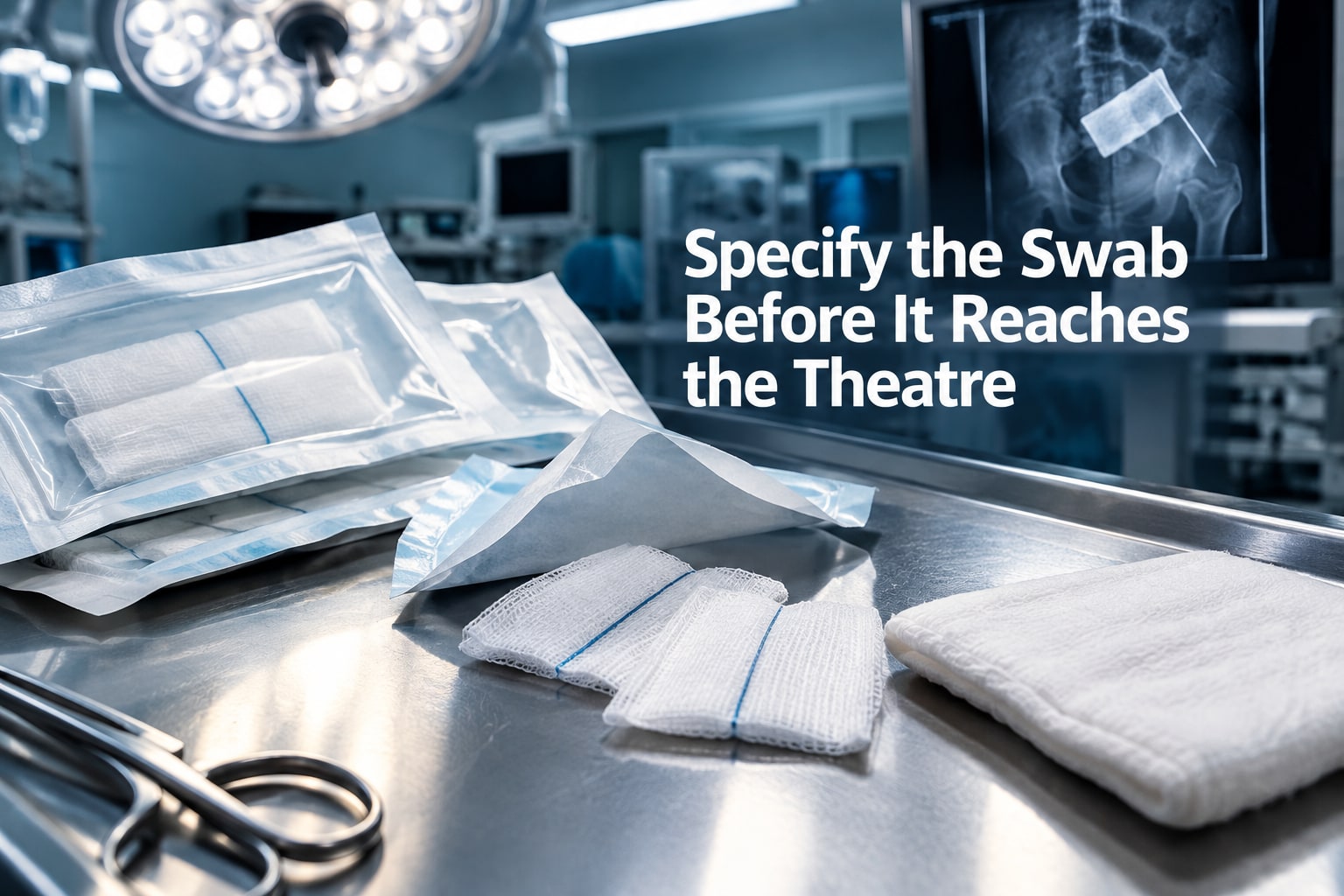
An x ray detectable gauze swab is a textile swab with a radiopaque thread, tape or marker attached to, or incorporated into, the gauze. The cotton or synthetic textile is not necessarily radiopaque throughout.
An X-ray marker is not the same as a metal-detectable marker: visibility on a radiograph does not guarantee detection by a ferromagnetic or metal-detection system, and vice versa.
Use the swab within a disciplined count, not as a substitute for one:
- Record each opened pack and its stated quantity before the operation starts.
- Count all sponges before incision, including items placed on the sterile field.
- Repeat the count during the procedure whenever required by local protocol, after additions or removals, and at closure.
- Reconcile used, unused and discarded items before sign-out; investigate every discrepancy.
This follows the WHO Surgical Safety Checklist approach to instrument, sponge and needle counts. If the count is incorrect, or the team suspects a retained item, an X-ray supports the retained-item investigation. It does not replace the manual count or the theatre’s retained-item protocol.
The marker must remain attached and visible after soaking, compression, handling and removal. A loose marker can separate, while a folded or poorly positioned marker can disappear into a dense mass or become difficult to interpret. Verify radiographic visibility under the hospital’s normal X-ray conditions, including marker orientation and surrounding blood or fluid.
What to inspect on the swab, pack and sterile barrier before use
1. Confirm the radiopaque marker is visible, correctly positioned and securely attached. Count the markers on each gauze swab, check that none is folded into an inaccessible edge, and verify visibility under the hospital’s normal X-ray conditions, including the expected orientation and surrounding blood or fluid.
A marker that disappears when soaked or compressed has failed its practical purpose.
2. Inspect the textile before use. Check woven edges for cuts and fraying, pull-free loose threads, lint or particle shedding, consistent folds, finished and unfolded dimensions, and stated ply count. Wet one sample and look for absorbency, tearing, distortion, edge separation or loss of shape.
Ask for the absorbency and lint-test methods, including sample size; “highly absorbent” and “low lint” are not test results.
3. Read the pack label for sterile or non-sterile status, lot number, expiry date or shelf-life, sterilisation method, and package quantity. A sealed pouch alone does not prove sterility: sterile stock needs a validated sterilisation process, a defined sterile barrier and traceable lot information.
Reject packs with punctures, lifted seals, moisture, damaged corners or illegible labels.
4. Prefer unit-of-use packs that show the quantity clearly, keep marker-bearing items together and support reconciliation of opened, used, unused and discarded sponges. Mixed quantities or unlabelled tray repacking create count discrepancies. Record each opened pack and separate a gauze swab from larger sponge types during the count; never treat their quantities as interchangeable.
The purchase specification to send to every supplier
Send every supplier the same specification so “X-ray-detectable gauze swab” cannot describe different products. Require the supplier to state each field below and attach test reports or controlled specifications, not a general quality statement.
- Finished size and unfolded size, in millimetres; ply count; thread count; cotton, rayon/polyester, cellulose or other non-woven construction.
- Marker material, radiopaque construction, marker count and exact placement; require visibility on radiographs in the hospital’s stated conditions, including the marker orientation.
- Sterile or non-sterile status; units per pack; sterilisation method and validated process; lot number; expiry date or shelf-life; sterile-barrier material, seal configuration and integrity evidence.
- Retention after soaking and compression; wet-strength value; woven-edge integrity; loose-thread control; lint or particle-shedding method, sample size and result.
- Absorbency test method, fluid used, exposure time, sample size and acceptance value.
- Material composition, extractables, biocompatibility evidence for intended tissue contact and particulate data. “Medical grade cotton” alone is insufficient.
- Destination-market classification, registration, listing, labelling and quality-system obligations. For the United States, check whether the product falls under the Class II surgical sponge listing in 21 CFR 878.4490 and confirm obligations for its exact claims.
| Field | Supplier response required | Evidence to compare |
|---|---|---|
| Dimensions and construction | Finished/unfolded size, plies, thread count, material | Approved product specification |
| Marker | Material, count, placement and radiographic result | Visibility and retention reports |
| Pack and release | Quantity, sterility, sterilisation, barrier, lot and expiry | Batch and packaging records |
Use this same request when comparing Komal Health Care Pvt Ltd with other manufacturers; a product name does not prove performance.
Related products
 | Gauze Roll ₹38 We produce and supply to our clients, a wide range of Gauze Rollthat are hygienically made so that they are safe to use in various medical... View product → |
 | Surgical Dressing ₹18 Our OT Gauze Swabs, cotton swabs are available in different folds and can also be customized as per client's requirement. View product → |
Cotton gauze or non-woven swab: which construction fits the procedure?
A woven cotton gauze swab gives familiar tactile feedback and predictable folded formats, but a cut edge can fray and release lint. Ply count alone does not prove absorbency: yarn weight, weave density, finishing and compression also change performance.
| Construction | Dry and wet behaviour | Theatre consequence |
|---|---|---|
| Woven cotton gauze | Familiar drape and feel; wet fabric can lose shape and expose frayed edges | Useful for wiping or light packing when edge integrity is verified |
| Rayon/polyester non woven swab | Often fewer loose yarns and less fraying; bonding can alter drape and wet strength | Consider when shape retention and low loose-fibre release matter |
| Cellulose-based non woven swab | Fluid handling depends on fibre structure, bonding and compression | Compare absorption using the same stated test method and sample size |
| Either construction | Tearing, tissue release and tactile feedback change when soaked | Test removal from wet tissue, not only dry handling |
| Either construction | Non woven does not mean lint-free; die-cut quality and fibre shedding still matter | Request lint or particle-shedding data |
| Either construction | Cost per use depends on fluid capacity, waste and handling time | Compare equal finished sizes, not package counts or ply numbers |
| Either construction | A marker must stay attached through soaking, compression and removal | Reject a swab with a loose, folded or poorly positioned marker |
Choose a gauze swab for wiping, local absorption or limited packing; select another specification when the field demands greater capacity. Test both options wet, because a distinct dry textile can become difficult to distinguish from tissue once soaked. Compare equal finished and unfolded sizes under identical test conditions.
When to buy a gauze swab, and when an abdominal pad is the safer specification
Choose a gauze swab for wiping, local absorption or limited packing; choose an abdominal pad or abdominal lap sponge for larger fluid loads and open abdominal or laparotomy procedures. These are not interchangeable countable units.
“Large gauze” is not a sufficient purchase description. For an abdominal pad or larger sponge, specify unfolded dimensions, plies or layers, an absorbency target with its test method and sample size, radiopaque marker position, and whether an attached retrieval tape or loop is required. A higher package count does not compensate for lower capacity.
Confirm that the marker, tape or loop remains attached after soaking, compression, wet handling and removal. The item must remain easy to identify during the count, even when saturated or folded.
Adding small gauze swabs to an open-abdominal pack does not replace correctly specified abdominal pads; the smaller item differs in capacity, visibility, handling and count implications.
Review the pack before release to the theatre:
- List each sponge type separately, including the gauze swab, abdominal pad and quantity.
- Check that each unit-of-use pack states its contents clearly and keeps marker-bearing sponges together.
- Record every opened pack and reconcile used, unused and discarded sponges.
- Resolve any discrepancy before closure; do not treat an extra small swab as an equivalent replacement for a missing abdominal pad.
A pack matched to the operative field reduces fluid-management and retained-item risks that a mixed, ambiguously labelled assortment creates.
Frequently asked questions
What does an x-ray-detectable gauze swab contain?
It contains cotton or synthetic gauze with a radiopaque thread, tape or marker attached to or incorporated into the textile.
What should you inspect before using a gauze swab?
Check the marker, dimensions, textile condition, sterile barrier, seal, expiry date, lot number and stated pack count.
What should a purchase specification for a gauze swab include?
State the material, size, ply, edge finish, radiopaque marker, sterility, packaging, quantity per pack and required documentation.
Should you choose cotton gauze or a non-woven swab?
Choose cotton gauze when you need a familiar woven construction; choose a non-woven swab when low lint and consistent absorbency matter.
When is an abdominal pad safer than a gauze swab?
Specify an abdominal pad when the procedure requires larger coverage, higher fluid capacity or a larger radiopaque marker for count control.
Related products
 | Surgical Disposable ₹4 We offer a superior range of sterile gauze swabs which are in high demand among our Indian and international clients. View product → |
 | Surgical Disposable ₹18 Our organization manufactures a premium range of Gauze Dressings that includes sterilized and non-sterilized Gauze Swabs, lab sponge and gauze roll. View product → |
 | Dressings Chlorhexidine Gauze Dressing (Antiseptic Tulle Dressing) ₹120 Chlorhexidine dressing and antiseptic tulle dressing B.P. Consists of fabric of Leno weave of cotton, which has been impregnated with white soft... View product → |