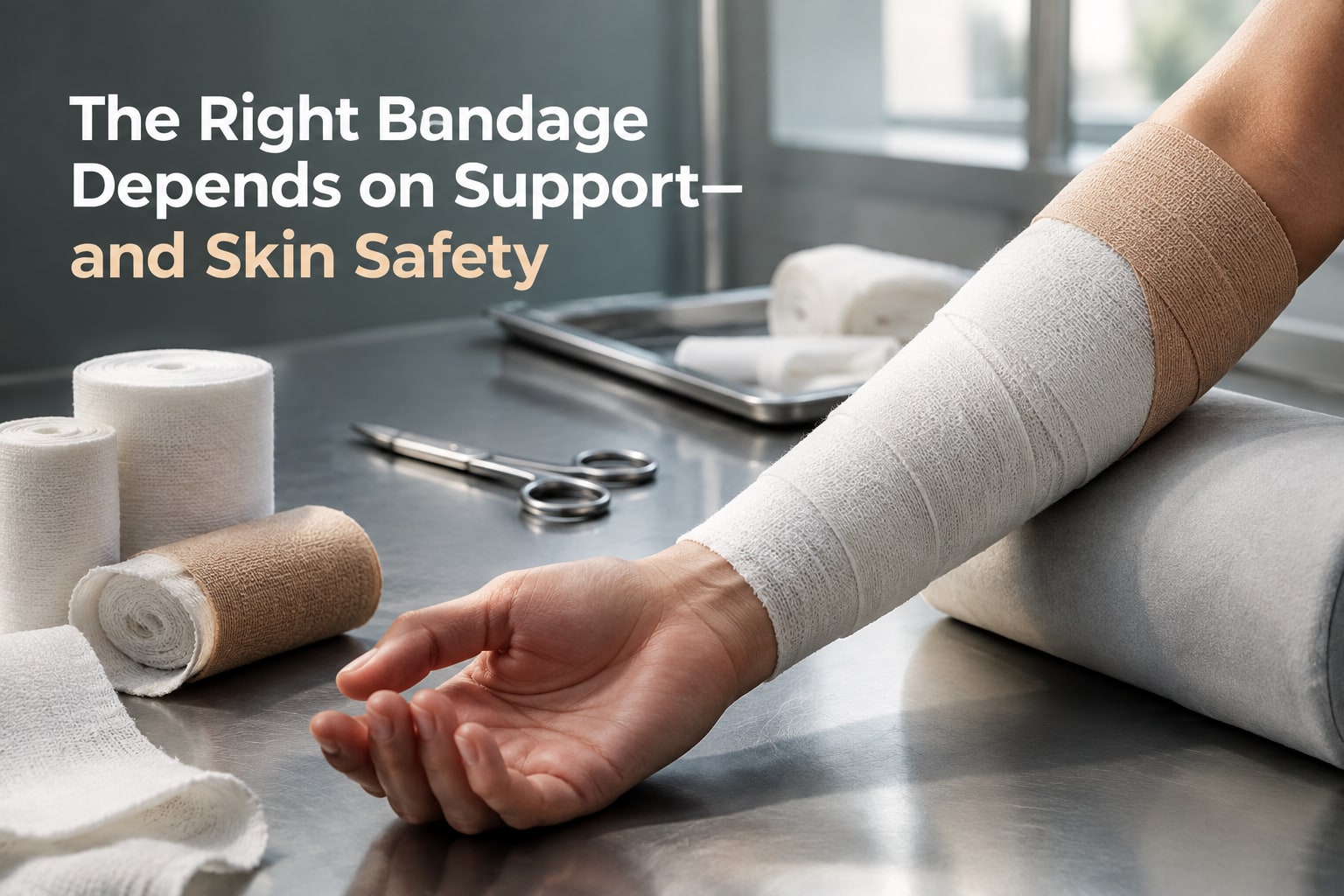
The right support bandage depends on whether you need adjustable compression, reliable self-adherence, dressing retention, or protection from adhesive contact. By the end, you will know which material fits common injuries, how to apply it without compromising circulation, and which specifications matter when comparing products.
Key takeaways
- Use cotton crepe for adjustable compression or dressing retention.
- Choose elastic adhesive bandage when stretch support and fixed placement matter.
- Check skin condition before applying adhesive bandages.
- Loosen any wrap causing numbness, tingling, coldness, or colour change.
What Each Bandage Is Designed to Do
A cotton crepe bandage provides adjustable external compression or holds a dressing in place; an elastic adhesive bandage provides stretch support and stays fixed without separate clips or tape. Neither replaces a plaster or synthetic cast.
| Option | What it is designed to do | What it is not designed to do |
|---|---|---|
| Cotton crepe bandage | Give removable support, light compression, or dressing retention; secure it with clips, tape, or a fastening system. | Immobilise a fracture or act as a rigid cast. |
| Elastic adhesive bandage | Provide elastic support and compression while adhering to itself or the skin, reducing slippage during movement. | Suit frequent reapplication, repeated wound inspection, or atraumatic removal. |
| Cast padding | Cushion skin and bony prominences beneath plaster or fiberglass, limiting direct pressure from hard immobilisation material. | Serve as the outer support layer or replace the cast. |
| Soft roll | Usually provide bulky padding beneath a splint or cast; the term can describe cotton, synthetic, or blended material. | Guarantee a defined performance without specifications for bulk, material, and intended use. |
| Bandage cloth | Describe a woven textile substrate used to make a bandage. | Establish elasticity, compression, adhesive coating, sterility, edge construction, or cast-padding suitability. |
Check the label before treating soft roll or bandage cloth as an equivalent product. A dependable specification identifies its material, width, thickness or bulk, stretch, absorbency, linting, sterilisation status, and whether it contacts intact skin or sits beneath a cast.
Adhesion Changes Support, Removal, and Skin Risk
A cotton crepe bandage creates external compression through its stretch and the tension you apply; it does not stick to skin. An elastic adhesive bandage combines stretch with a pressure-sensitive adhesive, so it supports tissue and stays in place without clips or tape.
| Option | Support and fixation | Removal and skin effect |
|---|---|---|
| Cotton crepe bandage | Compression comes from wrapping tension; secure it with clips, tape, or its fastening system | Repositionable and easier to remove for skin checks; it can loosen, slip, or become too tight |
| Elastic adhesive bandage | Compression comes from wrapping tension, while adhesion holds the bandage in position | More stable during movement; removal can strip fragile epidermis, leave residue, disturb a dressing, or trigger irritation |
Choose cotton crepe bandage when you need repeated reapplication, frequent wound inspection, or low-trauma removal. It works well as a removable outer retention layer, but it is not an immobilisation device and cannot replace a plaster or synthetic cast.
Choose elastic adhesive bandage when separate clips would interfere with movement or when a dressing needs firm retention. Do not confuse it with cohesive wrap: cohesive material adheres mainly to itself, while elastic adhesive bandage is designed to bond to skin.
Avoid placing adhesive over an open wound unless the product instructions or a clinician specifically permits it.
Remove either bandage promptly for increasing pain, numbness, blue or pale skin, coldness, or swelling beyond the wrap. Those signs can indicate excessive compression or impaired circulation, not a need for another layer.
Choose by Injury, Skin Condition, and Required Fixation
An elastic adhesive bandage suits an ankle sprain when you need support that stays under movement and the skin is intact. Choose a cotton crepe bandage when swelling is changing, you need repeated inspection, or removal must be gentle.
| Need | Better choice | Reason and limit |
|---|---|---|
| Ankle sprain | Elastic adhesive bandage for short-term support; cotton crepe bandage for adjustable compression | Adhesive elastic maintains tension during movement, but excessive overlap can restrict circulation |
| Knee or wrist support | Elastic adhesive bandage for firm, consistent support; cotton crepe bandage for removable support | Use the non-adhesive option when you will reapply or inspect the area often |
| Swelling | Cotton crepe bandage | You can loosen, remove, and reapply it as swelling changes |
| Dressing retention | Cotton crepe bandage | It holds a dressing as an outer layer without adhesive touching the wound; secure it with clips or tape |
| Splint or cast security | Cotton crepe bandage for temporary external securing | It does not replace the splint or cast; use a soft roll beneath a cast or splint for padding, not as the final restraint |
Do not use elastic adhesive bandage over fragile, irritated, hairy, or repeatedly inspected skin. Its adhesive can cause skin stripping during removal, while cotton crepe is easier to reposition.
Neither option should hide increasing pain, numbness, blue or pale skin, coldness, or swelling below the wrap. Remove the bandage promptly and seek clinical assessment if these signs appear.
Apply the Wrap Without Creating a Circulation Problem
Check the skin and circulation before wrapping, then position the joint in the posture recommended for the injury. Start at the end of the limb and work upward, overlapping each turn by about half the bandage width. Keep the pressure even; do not pull either bandage to its maximum stretch.
- Use a cotton crepe bandage with light, steady tension. Secure it with clips or tape, keep fasteners away from a wound, and leave fingers or toes visible for checks.
- Apply an elastic adhesive bandage with gentle tension and smooth each turn without folds. Do not rely on heavy overlap for extra support; sustained tension can become excessive compression.
- Recheck the exposed fingers or toes after application and again if pain or swelling changes. Compare colour and temperature with the opposite limb.
Remove and reapply the wrap if it slips, bunches, leaves deep edge marks, feels increasingly tight, or causes new pressure or swelling. Never add another layer to hide worsening symptoms.
Remove it promptly and seek clinical assessment for increasing pain, numbness or tingling, pale or blue skin, unusual coldness, marked distal swelling, or difficulty moving the fingers or toes. These signs can indicate impaired circulation or nerve function.
Elastic adhesive material also needs careful removal: peel it slowly while supporting the skin, and stop if the skin tears or a wound is involved.
Compare Specifications Before You Buy or Supply a Bandage
A dependable support bandage is specified by measurable performance, not by “bandage cloth” on a catalogue line. Ask for material composition, finished width and length, thickness or bulk, nominal stretch, recovery, edge construction, fastening method, and sterile or non-sterile status.
For reusable cotton, require dimensional stability after washing; for skin contact, require absorbency, linting, and contact limitations.
| Product | Specifications to compare | What the omission hides |
|---|---|---|
| Cotton crepe bandage | Cotton or blend percentage, width, length, stretch, recovery, edge fraying, fastening method, sterile status | “Elastic” or “crepe” alone does not establish repeatable compression |
| Elastic adhesive bandage | Backing composition, adhesive type, latex status, elongation, width, length, tearability, residue, skin-contact limits, packaging | Adhesion, allergy risk, removal behaviour, and usable support can differ sharply |
| Cast padding or soft roll | Fibre, thickness or bulk, absorbency, linting, roll dimensions, intended under-cast use, sterile status | A bulky roll is not a support bandage; uneven padding creates pressure points |
| Bandage cloth | Woven material, with the same performance fields above | The term does not confirm elasticity, compression, adhesive coating, sterility, or padding suitability |
A manufacturer or exporter fits the decision by converting these fields into a product specification, sample approval, batch record, and packing declaration. For a supplier such as Komal Health Care Pvt Ltd, submit those requirements before purchase and reject substitutions described only by fabric name.
That prevents a soft roll or padding material from arriving as an unsuitable support bandage.
Related products
 | Dressings ₹36 We are manufacture of Elastic Adhesive Bandage product .Our superior range of medical bandage, gauze bandages AS Elastic Adhesive Bandages is known... View product → |
 | Surgical Disposable ₹36 The range of medical bandage, gauze bandages available with us is known for its woven fast edges, thick fabric, better elasticity and controlled,... View product → |
Frequently asked questions
What is the main difference between cotton crepe and elastic adhesive bandages?
Cotton crepe provides adjustable external compression or holds a dressing with separate clips or tape. Elastic adhesive bandage stretches and stays fixed to the skin without separate fasteners.
When should you avoid an elastic adhesive bandage?
Avoid it on fragile, irritated, broken, or adhesive-sensitive skin. Choose a non-adhesive cotton crepe bandage when you need easier removal or adjustable pressure.
How do you prevent a bandage from causing circulation problems?
Wrap evenly without excessive tension, keep fingers or toes visible when possible, and check for numbness, tingling, coldness, swelling, or colour change. Loosen the wrap if these signs appear.
Can either bandage replace a plaster or synthetic cast?
No. Cotton crepe and elastic adhesive bandages provide external support or dressing retention but do not provide the rigid immobilisation of a plaster or synthetic cast.
Related products
 | Surgical Disposable ₹18 The Bandages available with us includes rolled bandages, Cotton Crepe Bandage, Elastic Adhesive Bandage and Soft Bandage Roll. View product → |
 | Rolled Bandages ₹18 These medical Rolled Bandages, gauze bandages like Rolled Bandages are used for different types of cuts, injuries, wounds etc. View product → |
 | Surgical Disposable ₹27 These Gamjee Roll are highly absorbent cotton are available in low adherent gauze cover and is applied over dressing to provide low adherent wound... View product → |
 | Surgical Dressing ₹65 We offer a quality range of Combination dressing pads, combine dressing pad where high absorbency is required to handle heavy drainage, promote... View product → |