A failed joint replacement rarely presents as a simple loose stem. You need to identify whether the main threat is infection, bone loss, poor geometry, inadequate fixation, instability or fracture risk before selecting a joint replacement prosthesis. By the end, you will be able to connect the failure work-up and femoral bone stock to a defensible revision stem plan.
Key takeaways
- Identify infection, loosening, fracture and instability before choosing a revision stem.
- Classify femoral bone loss to match stem length, fixation and reconstruction support.
- Use an uncemented long stem when distal bone provides reliable axial and rotational fixation.
- Check modular junctions, alignment, stability and radiographs throughout follow-up.
What must be established before selecting a revision stem?
Before selecting a revision stem, establish why the primary joint replacement prosthesis failed: infection, loosening, subsidence, fracture, malversion, bone loss, instability or a reconstruction error.
1. Review the operative report, implant stickers, prior radiographs and revision history. Identify the stem design, fixation method, diameter, length, modular junctions and extraction risks; an unknown implant can make removal and replacement needlessly hazardous.
2. Exclude occult periprosthetic joint infection before labelling the failure mechanical. Order ESR and CRP as screening tests, then use joint aspiration for synovial white-cell analysis, differential count and cultures when suspicion remains. Obtain multiple intraoperative tissue cultures because an unexpected positive result can change fixation and antibiotic treatment.
3. Obtain standing anteroposterior and lateral hip radiographs plus full-length femur views. Look for migration, radiolucent lines, pedestal formation, cortical perforation, fracture, alignment change, leg-length discrepancy and loss of offset.
4. Use CT when radiographs do not define cavitary or segmental bone loss, cortical thinning, stem position or a suspected fracture. Classify the remaining femur with a Paprosky-type assessment and decide whether fixation exists in the proximal metaphysis, diaphysis or neither.
A tapered, fluted uncemented revision stem can show controlled early axial subsidence by design; progressive migration, version loss, pain or radiographic failure is different. Also plan for a narrow or bowed femur, difficult explantation and intraoperative fracture with full-length imaging, selected prophylactic cerclage and backup fixation.
Only after these causes are separated should you choose a monoblock or modular revision stem and its fixation strategy.
How does femoral bone loss change the stem choice?
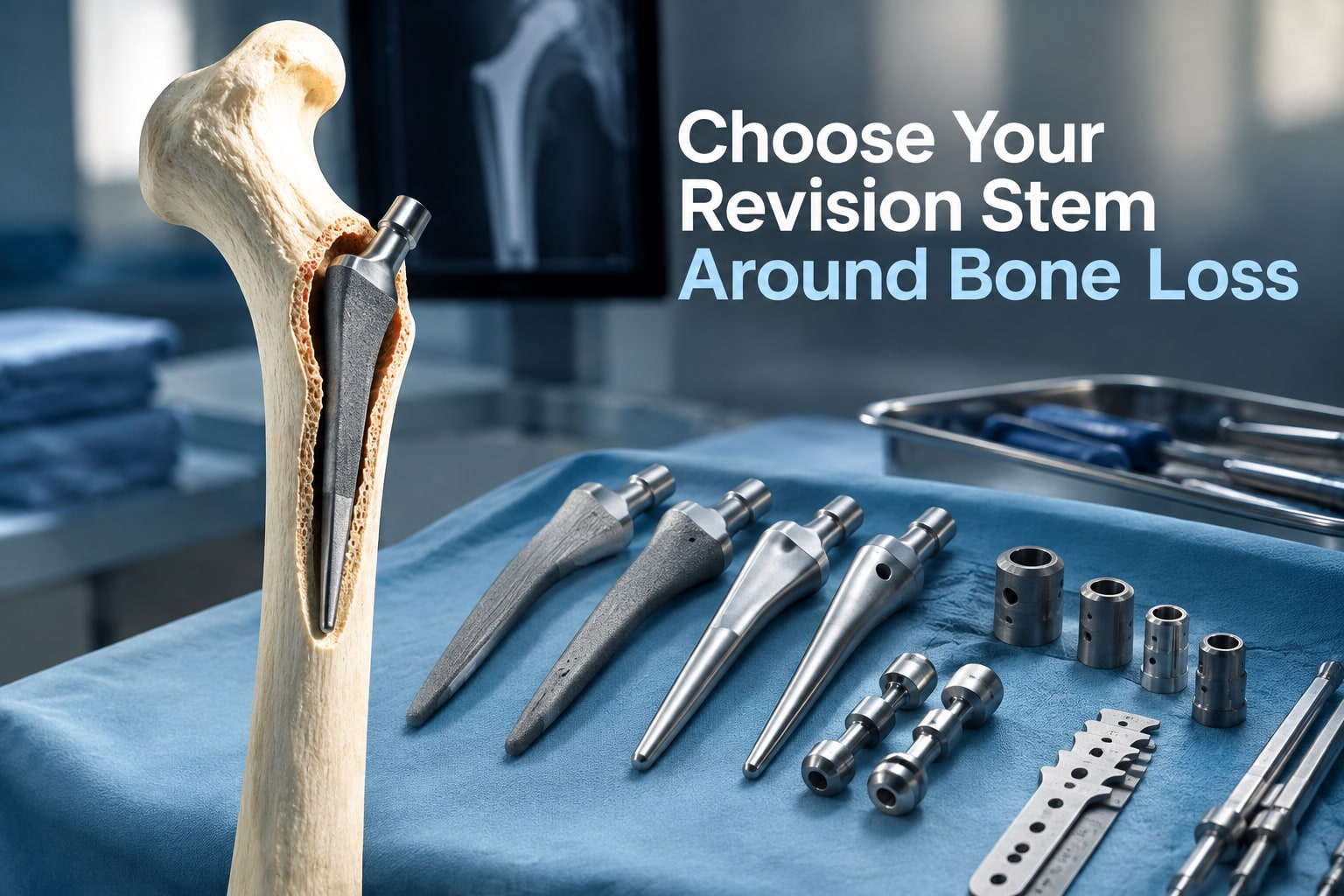
Paprosky Type I or II bone loss often leaves enough proximal femur for metaphyseal or proximal fixation. As bone loss extends into the diaphysis, the reliable fixation point moves lower; the stem must bypass the deficient segment and obtain firm cortical purchase.
- Type I: Use a revision stem that engages preserved proximal bone when the metaphysis remains supportive.
- Type II: Consider a longer stem with metaphyseal and diaphyseal purchase when proximal support is inadequate but the canal remains intact.
- Type IIIA: Rely on distal fixation because extensive metaphyseal loss has weakened the proximal femur, while the diaphysis still offers a usable fixation zone.
- Type IIIB: Expect limited distal support; a tapered, fluted stem alone may not achieve dependable fixation, so add structural grafting or another reconstructive method when the remaining diaphysis is short or compromised.
- Type IV: Treat the femur as severely deficient. Distal fixation may be impossible, making a proximal femoral replacement, allograft-prosthesis composite, or custom reconstruction more appropriate than routine stem exchange.
These categories guide the plan, but full-length femur images must confirm canal diameter, bowing, cortical thickness, and the length of intact diaphysis.
A longer revision stem does not solve every revision stem problem: forceful press-fit insertion in a Type III or IV femur can cause perforation or fracture, while excessive length and stiffness can cause distal stress concentration and proximal stress shielding. A backup fixation plan is essential.
When is cemented or uncemented long-stem fixation appropriate?
Cemented fixation suits a revision femur when the canal is too wide, irregular or deficient for dependable distal press-fit. Cement fills the available canal and can provide immediate fixation, but it depends on adequate cement containment and a workable mantle; placing cement into severely deficient bone does not restore missing support.
| Option | What it means | When it applies |
|---|---|---|
| Cemented revision stem | Fixation through a cement mantle inside the femoral canal | A wide or irregular canal lacks reliable distal cortical contact, or controlled cement fixation offers the safer reconstruction |
| Uncemented revision stem | Press-fit fixation through distal cortical engagement and later bone ongrowth | The distal femur provides healthy, preferably circumferential cortical contact and the stem can bypass the defect |
| Uncemented long stem | A longer press-fit stem that transfers fixation beyond proximal bone loss | A defect can be bypassed without forcing excessive diameter, length or stiffness |
Do not treat “two cortical diameters” as a guarantee. Bypassing a cortical window or distal defect by roughly two femoral diameters is a planning guide; defect shape, canal quality, stem stiffness and circumferential contact determine whether it works.
A wide canal can leave the stem undersized and allow subsidence, while aggressive oversizing can cause cortical perforation or intraoperative fracture.
- Subsidence from inadequate distal purchase
- Perforation from an anteriorly bowed femur
- Fracture from excessive press-fit
- Distal stress concentration from an overly stiff stem
Check lateral radiographs and use CT or three-dimensional templating when femoral bowing is pronounced. A very long, stiff uncemented stem can protect distal fixation while worsening proximal stress shielding and loading the bone near its tip; select length, diameter and stiffness for bone preservation, not maximum bypass alone.
What does modularity solve, and what risks does it add?
With proximal landmarks missing, a modular revision stem lets distal fixation and proximal reconstruction be set independently. That helps rebuild the hip centre and restore leg length, offset and version in a joint replacement prosthesis.
The surgeon must still assess abductor tension and stability together: correct length with inadequate offset can leave a limp, while incorrect version can cause dislocation.
A modular construct permits separate adjustment of:
- Distal fixation, including stem depth and rotational stability
- Proximal body height to restore leg length
- Neck length and offset to tension the abductors
- Version to align the femur with the acetabular component
| Option | Control of reconstruction | Main concern |
|---|---|---|
| Modular revision stem | Adjusts distal fixation, body height, offset and version independently | The extra junction adds fretting, corrosion, fracture and disengagement risk |
| Monoblock revision stem | Removes the modular junction and its assembly interface | Offers less independent control when proximal landmarks are absent |
| Any modular assembly | Uses matched components assembled at the planned depth and rotation | Incomplete taper seating, contamination, incorrect component selection or failure to lock the connection can cause assembly error |
Inspect the junction for full seating and confirm the final components against the manufacturer’s assembly instructions. Modularity solves a geometry problem; it does not compensate for poor planning, and a well-fixed stem can still leave malversion, inadequate offset or instability.
How should the construct be checked during surgery and follow-up?
Check the construct against the planned bone-fixation strategy, not stem length alone. Confirm where the remaining femur will grip the implant, whether the diameter and stiffness protect proximal bone, and whether the stem tip creates a stress concentration that could fracture an osteoporotic distal femur.
Before surgery, obtain the supplier’s exact system records:
- Stem length, diameter, taper, coating, flute geometry and allowable subsidence range
- Compatibility of bodies, necks, heads, screws and instruments across the implant system
- Assembly instructions, impaction limits, torque values, lot numbers and UDI records
- Radiographs, templates and trial components that match the available implant sizes
For any supplier, including Komal Health Care Pvt Ltd, request these documents before opening the case; a visually similar modular part can still have an incompatible taper or locking mechanism.
During surgery, use trial reduction and imaging to verify version, offset, leg length, cortical contact and absence of perforation. Check every modular junction for complete seating and clean mating surfaces, then test stability through the planned range of motion.
Obtain tissue cultures when infection remains possible; an unexpected positive result can change fixation and antibiotic treatment for the joint replacement prosthesis.
Follow serial standing anteroposterior and lateral radiographs rather than relying on one postoperative image. Record:
- Subsidence, alignment, version and progressive radiolucent lines
- Pedestal formation, cortical remodeling and proximal stress shielding
- Fracture, leg-length change, offset loss and recurrent instability
- Pain linked to progressive migration or loss of fixation
Small early migration can be intended with a tapered, fluted uncemented long stem. Progressive migration or painful radiographic change signals failure; no single subsidence threshold suits every design.
Related product
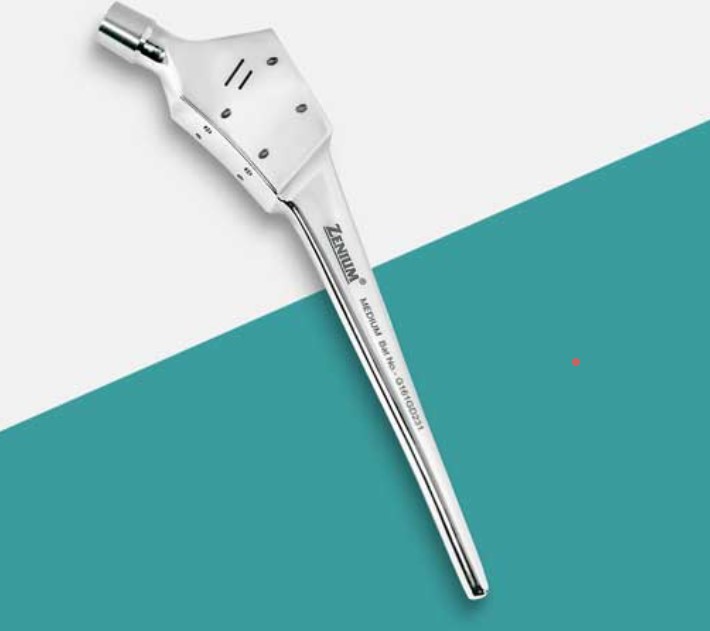 | Joint Replacement A Calcar Stem Manufacturer specializes in producing orthopedic implants designed for hip replacement surgeries, particularly when there is damage or... View product → |
Frequently asked questions
What must be established before selecting a revision stem?
Establish why the joint replacement prosthesis failed, including infection, loosening, subsidence, fracture, malversion, bone loss, instability or reconstruction error.
How does femoral bone loss change the stem choice?
The location and severity of femoral bone loss determine whether the stem can obtain fixation in the proximal femur or must bypass the defect and engage stronger distal bone.
When is cemented or uncemented long-stem fixation appropriate?
Choose fixation according to bone quality, the available fixation segment, defect geometry and the need for immediate stability. An uncemented long stem requires reliable distal axial and rotational support.
What does modularity solve, and what risks does it add?
Modularity helps the surgeon adjust length, version, offset and stability during reconstruction. It adds junctions that require correct assembly and introduce potential fretting, corrosion or mechanical failure.
How should the construct be checked during surgery and follow-up?
Check stem seating, alignment, version, offset, leg length, stability, fracture risk and modular connections during surgery, then monitor radiographs and clinical symptoms for migration, loosening or renewed instability.