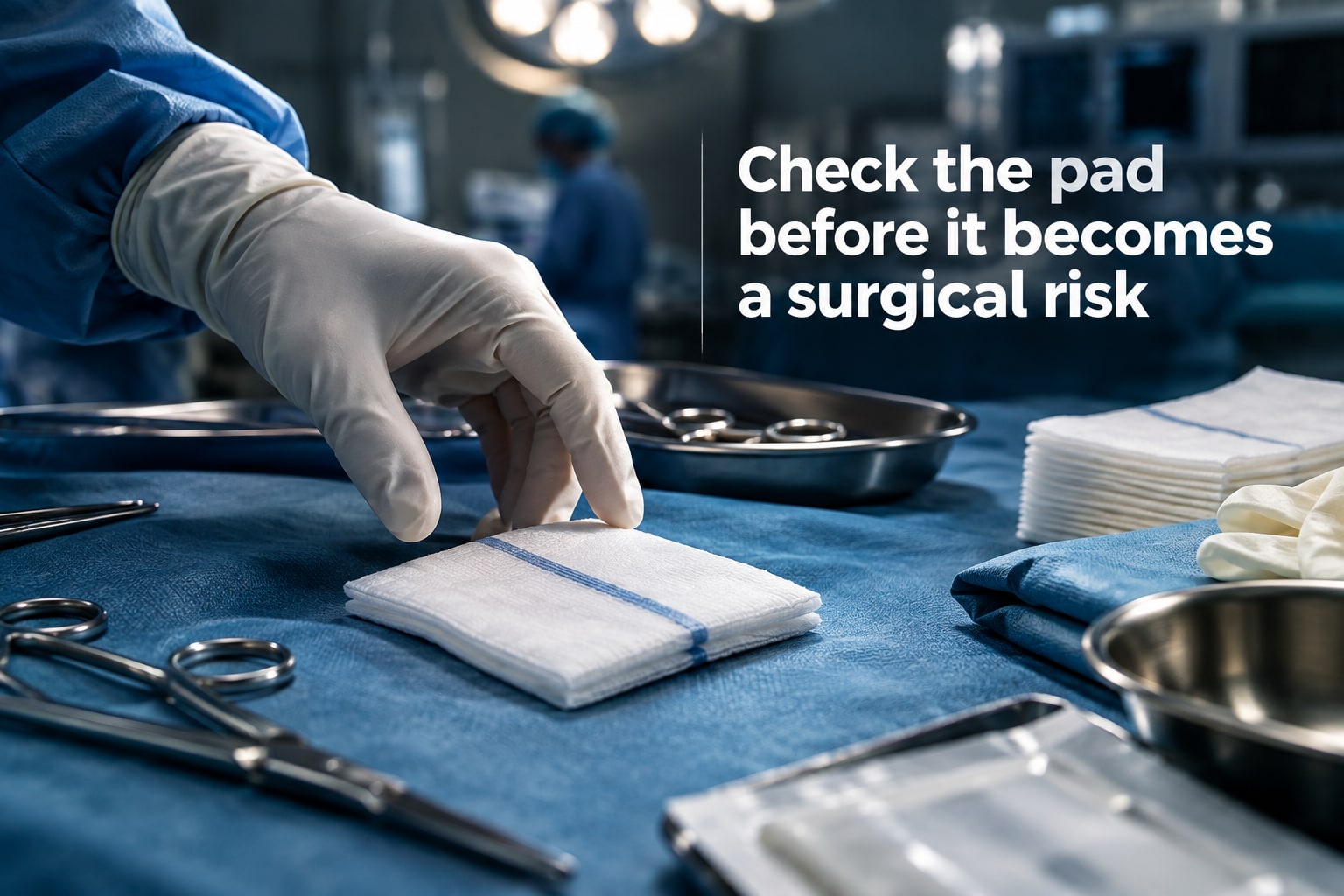
An abdominal pad can fail through lint, leakage, poor fluid retention, sticking, fraying, incorrect placement, or a mismatch between the product and the wound. By the end, you will know how to inspect and specify pads, count operative sponges, handle dressing failures, and choose the right absorbent layer for each clinical setting.
Key takeaways
- Reject pads with frayed edges, loose fibres, damaged packaging, or unclear counts.
- Check absorbency, dimensions, radiopaque markers, sterility, and batch details before use.
- Use a documented sponge count before incision, during closure, and after the procedure.
- Do not pull a stuck pad; moisten it and escalate removal to the surgical team.
Which abdominal pad problems create the greatest risk?
The greatest risk comes from an abdominal pad that hides worsening drainage, damages tissue during removal, or creates pressure instead of protection. Fibre or lint shedding, edge fraying, weak absorbency, strike-through, leakage under pressure, sticking to moist tissue, and hidden saturation can all delay recognition or leave material on the wound.
An external abdominal pad covers a closed or draining wound; it is usually a secondary absorbent layer, not automatically the wound-contact layer. A laparotomy sponge is a controlled-operative-field item intended for use inside a body cavity, with counting controls and a radiopaque marker.
Treating them as interchangeable can cause wrong sizing, construction, sterility, or loss of count visibility.
| Pad type | Main purpose | Major risk |
|---|---|---|
| External abdominal pad | Absorb drainage outside the wound | Conceals saturation or increases pressure when folded |
| Laparotomy sponge | Controlled use inside an operative field | Retention if counting and marker checks fail |
Use a low-adherence primary dressing when cotton or cellulose fibres could attach to granulation tissue; dry removal can tear tissue and cause bleeding. A thick folded pad does not automatically improve protection: over a drain, bony prominence, pressure-sensitive wound, or immobilized patient, it can concentrate load and obstruct drainage.
Review the exudate trend, wound edges, pain, odour, fever, and surrounding skin, not only whether the pad looks wet. Incorrect placement, leakage beneath the pad, or a hidden saturated centre can worsen the wound while the outer surface appears acceptable.
How should you inspect and specify an abdominal pad before use?
Reject the abdominal pad if its package is torn, seal open, damp, crushed, or printed so unclearly that you cannot read its identity or traceability details. Packaging integrity and traceability are safety controls, not cosmetic details.
1. Inspect the pouch or wrap before opening. Confirm the sterile label when sterile wound care or operative use is intended, expiry date, lot or batch number, and correct size. A sterile abdominal pad and nonsterile abdominal pad are not interchangeable: use a nonsterile pad outside the sterile field only when local protocol permits it.
2. Examine the pad itself under good light. Check intact edges, secure seams, and no loose, pulled, or damaged threads. Discard it if fibres shed freely, the material is stained or damp, or crushing has altered its shape.
3. If a radiopaque marker is specified, confirm that it is firmly attached and visible on the imaging system used by your facility. The marker supports detection; it does not replace counting or make the pad suitable for every operative use.
4. Put the purchase specification in measurable terms. Ask for material, dimensions, ply, basis weight, edge finish, lint generation, wet strength, fluid retention under compression, strike-through time, packaging, and intended wound contact. State whether the product is an external dressing or a laparotomy sponge, and whether direct contact with the wound is intended.
A gauze swab, external abdominal pad, and operative sponge require separate specifications; treating their names as interchangeable invites the wrong construction or use.
How do teams prevent a retained sponge during an operation?
A retained sponge is prevented by a documented count, not by a radiopaque strip alone. Use one approved product configuration and one counting method for each case; mixing visually similar items with different sizes, folds, or marker locations creates avoidable errors.
1. Before incision, establish and record the baseline count for laparotomy sponges, folded pads, gauze swabs, towels, needles, and instruments.
2. Record every addition during the procedure, including opened packages and items passed into the operative field. Keep used items in designated locations.
3. Before closing a body cavity, stop and perform the cavity count. Reconcile the number with the baseline and recorded additions.
4. Repeat the complete count at skin closure, then complete the final count before the patient leaves the operating room.
5. Confirm the result during the WHO surgical-safety checklist sign-out, which calls for instrument, sponge, and needle counts before the patient leaves the operating room.
A radiopaque strip supports detection on imaging, but it does not make a sponge safe without a documented count and reconciliation. The strip must remain attached and visible on the relevant imaging system.
If any count is wrong, stop closure or transfer according to facility policy. Recount packages and waste, then search the operative field, floor, linen, kick buckets, and disposal containers. Notify the surgeon and operating-room lead. Obtain imaging when the discrepancy remains unresolved, and document the reconciliation.
What should you do when a pad is saturated, stuck, or falling apart?
Treat a saturated, slipping, adherent, or damaged abdominal pad as a change in wound-care conditions, not a minor dressing fault. Check the wound and drainage trend rather than judging safety by the pad’s outer appearance alone.
1. Replace a saturated pad before strike-through reaches clothing, bedding, gloves, or the surrounding environment. Add an appropriate fluid-resistant outer layer when drainage exceeds the pad’s retention capacity; do not improvise with ordinary bandage cloth.
2. Stabilize a slipping pad with suitable fixation and repositioning. Do not tighten the dressing over a drain, suture, bony prominence, or pressure-sensitive area, because extra compression can obstruct drainage or injure skin.
3. If the pad adheres to the wound, moisten it with the solution directed by the clinical team. Allow time for the fibres to release, then lift slowly from one edge while supporting the surrounding skin. Never pull dry material from granulation tissue.
4. Stop removal and call the clinical team if bleeding starts, tissue comes away, pain is severe, the material breaks apart, fibres remain embedded, the wound opens, or a drain or suture is displaced.
5. Cover and escalate a pad that fragments, causes bleeding, develops odour, or reveals increasing drainage. Do not conceal a worsening wound with another layer; report changes in wound edges, pain, fever, surrounding skin, and exudate.
How do you compare pads, gauze, rolls, and other absorbent materials?
Compare absorbency with what happens under pressure: specify retention under compression, strike-through time, lint, wet strength, cushioning, conformability, edge integrity, sterility, radiopacity, and intended location—not absorbency alone.
| Material | Comparison | Intended use |
|---|---|---|
| Gauze swab | Smaller, versatile; moderate absorbency, conformability, and wiping control; piece count rises when several replace one pad | Small wounds, wiping, limited drainage |
| Abdominal pad | Larger coverage and fluid load; assess compression retention, strike-through, lint, wet strength, and edge integrity | External secondary dressing over a closed or draining wound |
| Combine dressing pad | High external absorption and cushioning; check bulk, wet strength, and strike-through | Heavy external drainage |
| Soft bandage roll | Adds cushioning and coverage over a dressing; conformable but not a primary fluid reservoir | Padding, fixation, or coverage |
| Ordinary sponges | Limited absorption or wiping; verify lint and wet handling | Minor absorption or cleaning |
| Laparotomy sponge | Operative-field item requiring correct count and radiopacity; not an external dressing | Controlled intracavity use only |
Replacing one abdominal pad with many gauze swabs increases overlap, bulk, piece count, disposal mistakes, and opportunities for a missing item. Never substitute an external dressing for a laparotomy sponge. “Bandage cloth” is too vague; specify fibre, dimensions, ply, basis weight, finish, sterility, and performance.
For purchasing, ask for samples and:
- Test wet handling, compression retention, strike-through, lint, and edge shedding.
- Verify the sterile barrier, lot documentation, and intended wound contact.
- Confirm marker type, visibility, and radiopacity requirements.
Komal Health Care Pvt Ltd can help buyers compare orthopaedic dressings when the written specification matches the clinical location.
Related products
 | Surgical Disposable ₹60 We manufacture a wide range of Lap Sponge (Abdominal Pad)s, gauze sponge that finds application in operation theatres for bleeding control & other... View product → |
 | Surgical Dressing ₹65 We offer a quality range of Combination dressing pads, combine dressing pad where high absorbency is required to handle heavy drainage, promote... View product → |
Frequently asked questions
Which abdominal pad problems create the greatest risk?
The highest-risk problems include hidden saturation, strike-through, leakage under pressure, fibre shedding, edge fraying, and sticking to moist tissue. These defects can obscure blood loss, damage tissue during removal, or leave material in the wound.
How should you inspect and specify an abdominal pad before use?
Inspect the sterile pack, seal, pad dimensions, fabric integrity, absorbency, radiopaque marker, batch number, and expiry date. Specify the required size, ply, marker, sterility status, packaging, and absorbency performance.
How do teams prevent a retained sponge during an operation?
Use a standardised sponge count before incision, during the procedure, at wound closure, and after closure. Keep used and unused sponges separated, record discrepancies immediately, and perform a methodical wound search when counts do not match.
What should you do when a pad is saturated, stuck, or falling apart?
Replace a saturated pad promptly and assess whether bleeding or leakage has worsened. Moisten a stuck pad before removal rather than pulling it dry. Remove fragments, report shedding, preserve the packaging, and escalate any count discrepancy immediately.
How do you compare pads, gauze, rolls, and other absorbent materials?
Compare intended use, dimensions, ply, absorbency, wet strength, lint shedding, edge construction, radiopaque detection, sterility, packaging, and counting controls. Choose the material that matches the wound, fluid volume, pressure, and retention risk.