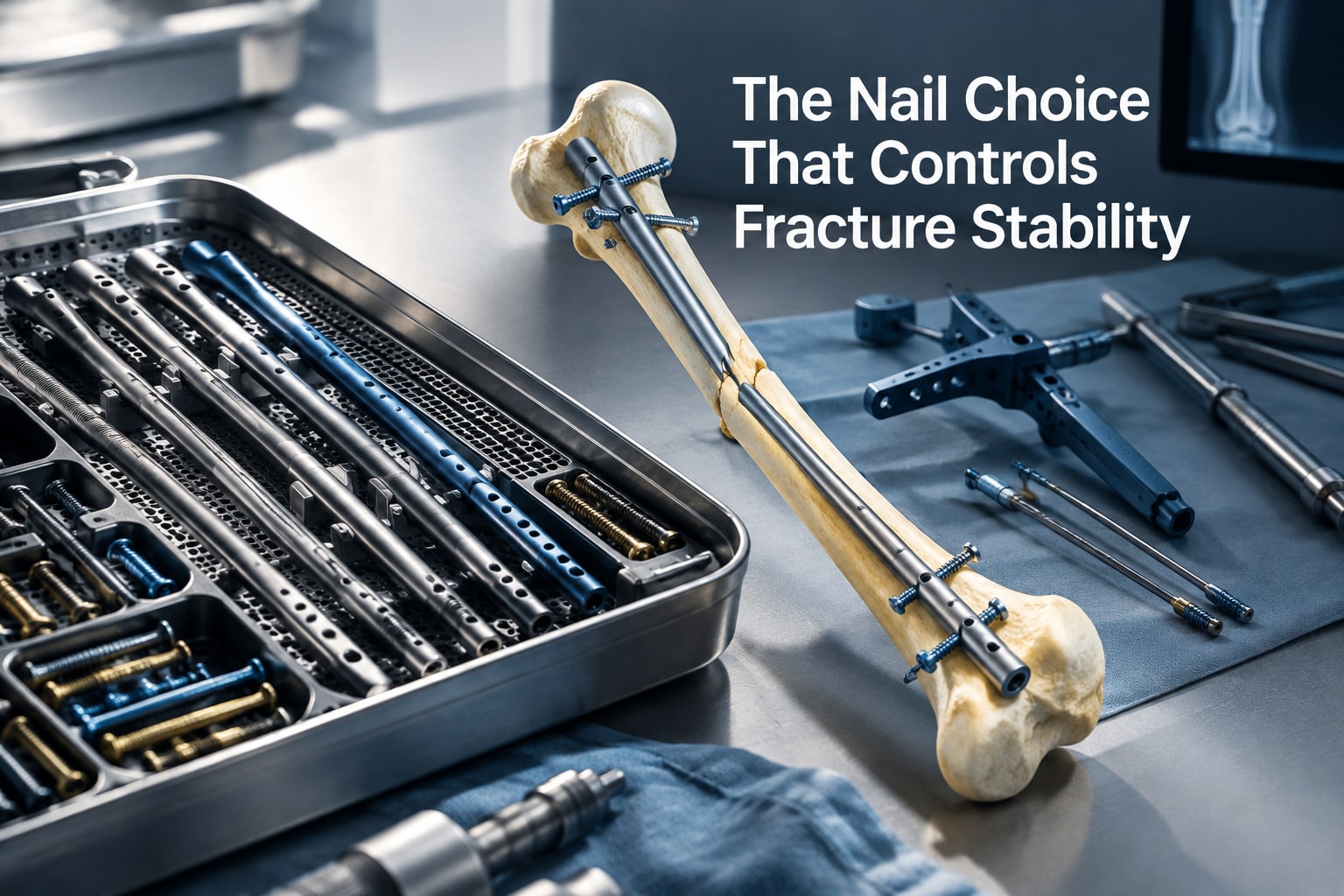
Choosing a nail for a complex fracture requires more than matching a bone name to a catalogue image. You will be able to compare standard, recon, expert and hyper designs by fracture location, usable bone segment, locking control, material, canal fit and the evidence required from a supplier.
Key takeaways
- Match nail length and design to fracture level and fragment length.
- Use distal and proximal locking to control rotation, length and alignment.
- Check canal diameter, fracture biology and implant material before selection.
- Reject nailing when anatomy, short fragments or constraints prevent secure fixation.
Which nail design matches the fracture pattern and anatomical level?
Match the nail design to the fracture level and fragment length, not to the product label. A standard nail fits many diaphyseal fractures when solid proximal and distal segments provide reliable locking; it is a poor match when the fracture leaves only a short metaphyseal fragment.
| Option | Fracture pattern or location | Defining control feature |
|---|---|---|
| Standard | Length-stable or many diaphyseal fractures | Conventional proximal and distal locking |
| Recon | Selected subtrochanteric, proximal femoral and shaft–neck fractures | Proximal screws aimed toward the femoral neck and head |
| Expert | Distal femur, proximal tibia and distal tibia with short metaphyseal fragments | Altered bends, end-segment locking and multiple screw trajectories |
| Hyper or multiplanar | Short, wider or angulated end segments | Several locking planes; assess the actual entry point, bend and screw paths |
An expert or hyper design does not replace reduction or adequate bone stock. Compare the usable nail beyond the fracture, plus the number, orientation and separation of locking screws.
A femoral antegrade nail is not interchangeable with a retrograde nail: entry point, bend, intercondylar clearance, instruments and hip or knee risks differ. Identify whether the system is antegrade or retrograde, universal or left/right specific, and whether its geometry matches the bone.
In humeral nails, shoulder and rotator-cuff effects influence antegrade choice, while distal screw paths require radial-nerve awareness. This is the practical basis of an interlocking nail comparison for complex fractures and a useful orthopaedic nail comparison.
How do canal fit, fracture biology and material change the choice?
Select nail diameter and length from the patient’s anatomy, not from nominal catalogue sizes. Use full-length radiographs to estimate overall length, canal diameter and fracture position. Order CT when comminution, joint extension or a retained implant obscures the geometry.
Templating must test the entire construct before reaming:
- Confirm the entry point and the metaphyseal flare.
- Check how much nail remains beyond the fracture.
- Confirm adequate distal bone for separated locking screws.
- Use intraoperative measurement, reaming information and a depth gauge to verify the plan.
A larger diameter substantially increases bending stiffness because circular-section stiffness varies approximately with the fourth power of diameter. Do not oversize: the nail must fit the canal, preserve cortical bone and match the reaming strategy. Reaming can allow a larger nail and improve fatigue resistance.
In the SPRINT trial, reamed nailing reduced reoperations compared with unreamed nailing in closed tibial fractures; that advantage was not shown in open tibial fractures.
Material changes the balance between flexibility, compatibility and later procedures.
| Material | Mechanical and practical effect | Compare before selection |
|---|---|---|
| Titanium alloy | Lighter and more flexible for the same geometry | Alloy specification, fatigue data and imaging artefact |
| Stainless steel | Higher stiffness for the same geometry | Heat treatment, corrosion requirements and screw or instrument compatibility |
Treat the nail and screws as one validated fracture fixation implant system. Compare cost, revision implications and manufacturer compatibility data; the final choice must balance stability, biology and later procedures.
Which locking configuration controls length, rotation and alignment?
Compare locking by the motion you need to prevent: static locking preserves length and rotation, while dynamic locking allows planned axial motion or compression.
| Configuration | Control provided | What to verify |
|---|---|---|
| Static | Limits shortening and rotation | Screws on both sides of the fracture; suitable for comminuted, segmental or length-unstable patterns |
| Dynamic | Allows controlled axial motion or compression | Which slotted hole provides the mode and whether later screw removal is needed for dynamization |
| Multiplanar or oblique | Improves control of short metaphyseal segments | Screw separation, direction and adequate bone stock, not merely the number of holes |
| Poller or blocking screw | Narrows a wide metaphyseal canal and guides the nail away from translation or angulation | Use as an adjunct to reduction, the correct entry point and locked fixation |
For distal femur, proximal tibia and other short end segments, usable nail beyond the fracture matters more than total nail length. Separated locking screws with different orientations can control a short fragment better than several screws clustered in one plane.
Record these dimensions before comparing systems:
- Proximal and distal hole positions, directions and separation
- Screw diameter, length and available bone stock
- Nail diameter, material, hole geometry and the resulting working length
- Fracture gap and the expected weight-bearing load
Assess the complete fatigue construct. A stiff nail may protect alignment, but stress concentrated around a locking hole or across a long unsupported zone can cause breakage before union. A tight screw count does not correct poor reduction, inadequate end-segment purchase or excessive load across the fracture.
When do special anatomical and implant constraints rule out a nail?
A nail is the wrong option when its geometry cannot control the fracture safely, even if its catalogue diameter and length appear suitable. In tibial fractures, compare the entry point, canal diameter, metaphyseal flare, distal segment length and number of distal locking trajectories.
Check these constraints before choosing the implant:
- In the proximal tibia, distal femur or distal tibia, confirm that enough nail remains beyond the fracture for separated screws placed in adequate bone.
- In an open injury, assess soft-tissue loss, contamination, vascular status and fracture biology. A result from a closed fracture does not transfer automatically to an open one.
- With poor bone quality or heavy expected loading, demand adequate screw purchase, a suitable working length and clear weight-bearing instructions.
- For periprosthetic or interprosthetic fractures, check hip or knee stems, existing plates, nail overlap and whether the nail tip would sit beside another implant as a stress riser.
| Constraint | What to verify | When a nail becomes the wrong option |
|---|---|---|
| Short metaphyseal segment | Usable nail beyond the fracture, separated screw paths and bone stock | Screws cluster in weak bone or cannot control alignment |
| Existing implant | Canal clearance, overlap and locking access | A stem blocks passage or the nail tip creates a stress riser |
| Humeral approach | Rotator-cuff exposure, radial-nerve location and nearby structures | Antegrade shoulder damage or unsafe distal anterior-to-posterior screw paths outweigh the benefit |
| Complex construct | Nail–screw compatibility and plate assistance | A plate-assisted construct offers safer control |
These checks expose constraints that a generic diameter comparison hides.
What should a hospital verify before buying an interlocking nail system?
Do not approve a catalogue number until it matches the fracture patterns your surgeons treat and the instruments they can use accurately. Ask an interlocking nail manufacturer for evidence tied to the exact configuration, not a brochure describing a product family.
- Request device and instrument identifiers, available diameters and lengths, left/right or universal design, bend geometry, locking-hole map, screw diameters and lengths, end caps, reamers, targeting guides and extraction tools.
- Confirm whether compression or dynamization is supported, which holes provide each mode and whether dynamization requires later screw removal.
- Record sterile or non-sterile supply, shelf life, packaging-validation evidence, biological evaluation, material specification and the quality-management certificate.
- Require the compatibility matrix and instructions for use. Mixing nails, screws or guides can cause thread, locking-angle, diameter, material or targeting mismatches.
| Evidence to compare | Purchasing question | Consequence if missing |
|---|---|---|
| Validated construct | Which nail–screw combinations are tested? | An apparently suitable screw may not lock correctly or resist fatigue. |
| Procedure support | What targeting accuracy, training, replacement instruments and revision support are provided? | A difficult lock can increase operative time and malalignment. |
| Clinical trade-off | How does the system address alignment, controlled load transfer and fracture biology? | “Stronger” may still increase stiffness, infection exposure or later implant failure. |
ISO 13485 identifies a medical-device quality-management system; it does not prove equivalent clinical performance for every nail geometry. An interlocking nail supplier Chile hospitals consider, including Komal Health Care Pvt Ltd, should answer these configuration-specific questions.
Choose among validated systems by fracture control, infection risk and the likelihood of dynamization, exchange nailing or failure—not marketing strength alone.
Related products
 | Bone Nails Our range of interlocking nail, intramedullary nail, fracture nail are can be used in 35 different cases of complex fractures. View product → |
 | Othopedic Implants Hyper Interlocking Nail For Tibia bone We ARe The manufacturer of Hyper Interlocking Tibia Nail For Bone, Size is in Diameter 8mm , 9mm , 10 mm , 11mm in length 260mm to 380mm Given... View product → |
Frequently asked questions
Which interlocking nail design matches a complex fracture pattern?
Choose the design according to fracture level and fragment length. Standard nails suit diaphyseal fractures with sufficient proximal and distal bone for reliable locking, while short metaphyseal fragments require a design with appropriate fixation options or another method.
How do canal fit, fracture biology and material affect nail selection?
Compare the nail diameter with the medullary canal, then assess how much stability and biological preservation the fracture needs. Material affects strength, stiffness, corrosion resistance and compatibility with the intended fixation strategy.
Which locking configuration controls length, rotation and alignment?
Use locking screws and their positions to prevent shortening, rotational movement and angular displacement. The number, direction and proximity of screws must match the available bone on each side of the fracture.
When can anatomical or implant constraints rule out an interlocking nail?
A nail is a poor choice when the canal is too narrow or deformed, the fracture leaves an insufficient locking segment, the entry point is inaccessible, or the implant cannot meet the required alignment and stability.
What should a hospital verify before buying an interlocking nail system?
Verify the available diameters and lengths, locking screw sizes, targeting instruments, radiographic compatibility, sterilisation status, traceability documents and whether the system covers the fracture levels treated by the hospital.