A Santiago theatre can receive a quotation labelled “gauze” and still be offered the wrong product, with unsuitable dimensions, no radiopaque marker, unclear sterility status or an unworkable pack count. By the end, you will have a practical specification, sample-testing plan and supplier checklist for comparing laparotomy sponges safely and at their true delivered cost.
Key takeaways
- Put size, layers, radiopaque thread and pack quantity in every quotation request.
- Require radiopaque visibility and a documented count for every open-cavity procedure.
- Inspect seals, labels, sterility status and damage before accepting each pack.
- Compare Chilean delivery, documentation and traceability—not only the carton price.
Specify the laparotomy sponge before comparing quotations
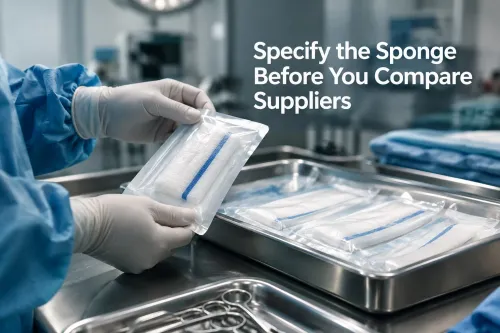
Put the same product specification in every request for quotation: laparotomy sponge, also called an abdominal lap sponge or lap sponge, for open-cavity use. “Gauze sponge for operation theatre” is too broad; it can return small swabs, gauze rolls, abdominal pads or dressings that are not equivalent.
Ask each supplier to state these exact attributes:
- Finished dimensions in centimetres, 100% cotton or named fibre composition, and the number of plies.
- Absorbency or fluid-retention performance, tensile strength, linting limit and edge construction, including whether the edges are folded or overlocked.
- Radiopaque-marker material and construction, with the marker’s position shown in the product specification.
- Sterile or non-sterile status, sterilisation method where applicable, individual-pack integrity, and whether the sponge is single-use.
- Quantity per inner pack and carton, lot number, expiry date, and the number of complete abdominal packs supplied.
Require a drawing or product data sheet, not just “large gauze.” A supplier quoting 10 × 10 cm swabs against another quoting 45 × 45 cm laparotomy sponges is not offering a meaningful price comparison.
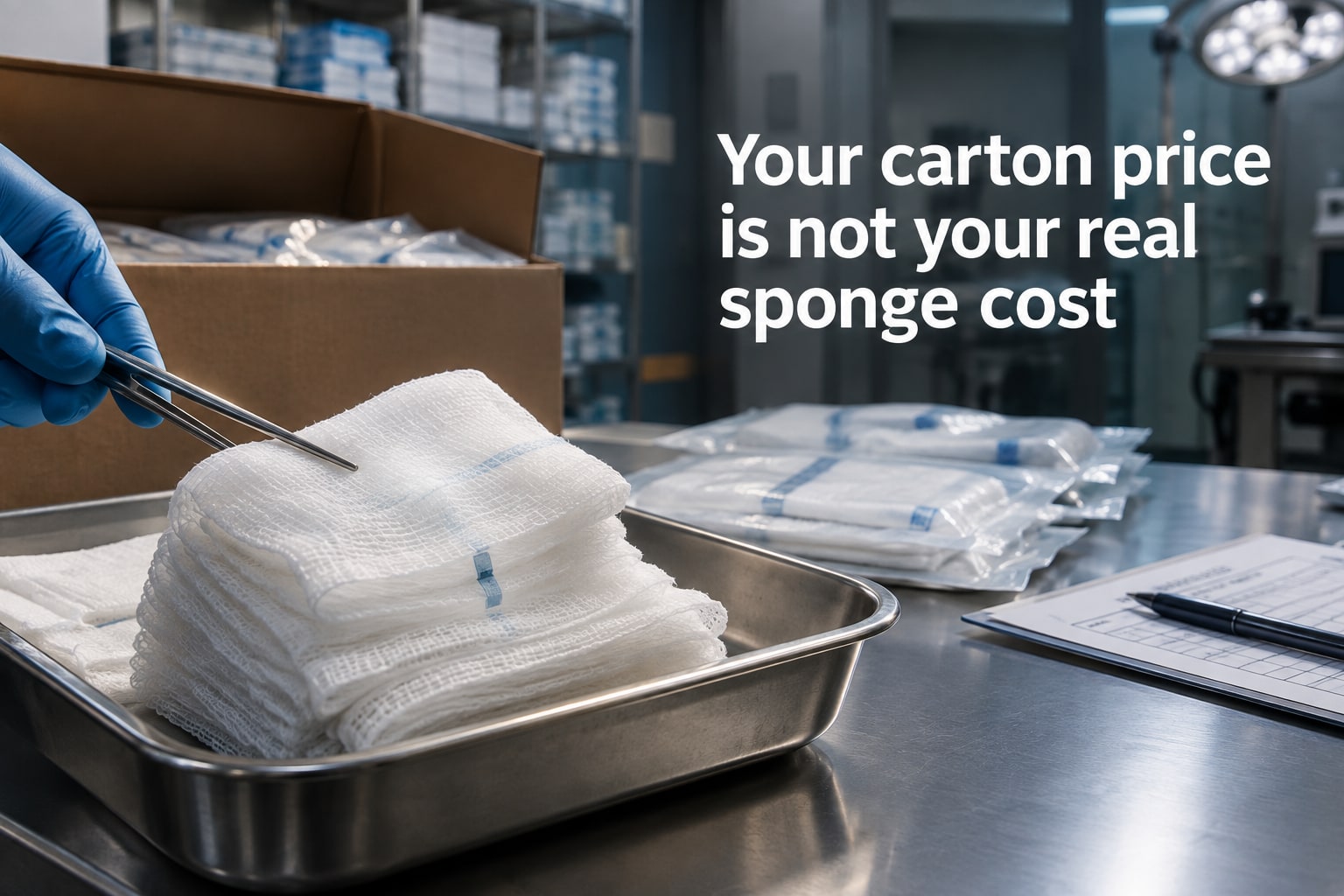
Compare the delivered cost per usable sponge or complete abdominal pack. A cheaper carton becomes expensive when it contains fewer sponges, lacks sterile individual packaging, or uses a different marker configuration. Reject quotations that omit any required field; missing dimensions or ply count can conceal a smaller, weaker product.
Require radiopaque visibility and a documented sponge count
Require every laparotomy sponge for open abdominal use to contain a radiopaque marker or another validated X-ray-detectable element. Specify how the marker is integrated into the sponge, then verify visibility on the hospital’s imaging system; a catalogue photograph is not evidence.
The marker supports postoperative detection of a retained sponge, but it never replaces a count.
Put these controls in the operating-theatre procedure:
- Two designated staff members count sponges together before the incision, recording the result on the operative record or count sheet.
- Repeat the count whenever additional sponges enter the sterile field. Record the quantity added and the running total.
- Count all sponges before wound closure, including those in the field, on the instrument table and in disposal receptacles.
- Complete and document a final count at the end of the procedure, before the patient leaves the theatre.
- If the two counts disagree, stop closure and search the field, trolley, waste and linen. Escalate the discrepancy to the surgeon and theatre lead; never correct the record by assumption.
- Require a countable unit format, clear pack quantity and lot identification so staff can reconcile opened packs with used and unused sponges.
- Reject samples that shed fibres, lose edge integrity when wet or have a marker that cannot be readily located on imaging.
Choose sterile or non-sterile stock and inspect every pack
A sterile single-use laparotomy pack suits an operation that needs a ready-to-open sponge in the sterile field. Non-sterile bulk stock belongs in a facility with a validated sterilization process and documented preparation workflow; it must not enter an open abdominal cavity straight from the carton.
If you buy abdominal lap sponges in santiago, compare the delivered cost per usable sponge, not the carton price.
| Stock format | Appropriate use | Main control |
|---|---|---|
| Sterile, individually or pack packaged | Immediate theatre use | Check sterile barrier, expiry and lot before opening |
| Non-sterile bulk | On-site sterilization before use | Follow the manufacturer’s sterilization instructions and release the load before distribution |
Receiving staff should quarantine any pack that fails a visual or documentary check. Verify:
- The label says laparotomy sponge, abdominal lap sponge or lap sponge, with the quoted dimensions, ply, material, radiopaque element and unit count.
- The outer carton and inner wrapper are dry, sealed and free from punctures, tears, crushed corners or opened seams.
- The lot or batch number, expiry date, manufacturer and storage instructions are readable and match the delivery documents.
- Sterile packs carry the stated sterility information; do not accept a broken barrier, even if the sponge looks clean.
- The count and configuration match the purchase order, and samples from the same configuration pass pack opening without tearing or shedding lint.
Do not open sterile packs in advance for convenience. Once opened, treat them as used stock, not recoverable inventory.
Check the Chilean supply route, not just the carton price
A carton price is not a comparable price until you know the sponge count, configuration and delivered cost to Santiago. Ask every abdominal lap sponge supplier in Chile for the price per usable sponge and per complete abdominal pack, including freight, import charges, local delivery and any minimum order.
Ask the supplier to identify:
- The legal manufacturer, manufacturing site, Chilean importer or local responsible party, and the party handling complaints, recalls and post-market communication.
- The product’s applicable Instituto de Salud Pública (ISP) route, supporting documents and any registration, notification or import records required for that configuration. “Medical device” and “CE marked” alone do not prove Chilean compliance.
- Delivery terms to your hospital, confirmed lead time, minimum order, remaining shelf life at receipt, batch documentation and the procedure for damaged or temperature-affected shipments.
- The Santiago stock location, replenishment schedule and contingency plan for backorders. Ask how many weeks of supply are held locally and whether the quoted configuration can be reserved for recurring orders.
- The delivered price after reconciling dimensions, ply, sponge count, radiopaque-marker configuration and sterile or non-sterile status.
Treat a lap sponge manufacturer in Santiago as a different procurement category from an importer holding local stock. Local inventory does not prove local manufacture.
Apply the same questions to a quotation from Komal Health Care Pvt Ltd; comparing its documents, landed cost and replenishment plan against Chilean suppliers keeps availability—not the lowest carton figure—as the basis for approval.
Related product
 | Surgical Disposable We manufacture a wide range of Lap Sponge (Abdominal Pad)s, gauze sponge that finds application in operation theatres for bleeding control & other... View product → |
Approve the exact configuration through samples and traceability records
Do not approve a recurring order from a catalogue photograph. Test a sealed sample from the exact quoted configuration, including size, ply, material, radiopaque marker, sterility status, unit count and packaging.
1. Request samples bearing the proposed product code, lot number and expiry date. Reject a sample supplied in a different pack count or size, because similar cartons can conceal a different sponge.
2. Measure the finished dimensions and confirm the stated ply, fibre composition and edge or seam construction. Pull and handle the sponge when dry and wet; loose edges, seam failure or rapid tearing disqualify it.
3. Place the radiopaque marker under the operating theatre’s own X-ray or imaging system. Record whether the marker is clearly visible at the distances and angles used during an abdominal procedure.
4. Open the individual pack using the normal theatre technique. Record seal integrity, ease of opening, lint released during handling and whether the sponge retains fluid without falling apart.
5. Request a lot-specific certificate of analysis or conformity, plus the lot number, manufacturing site, legal manufacturer, Chilean importer or responsible party, sterility method and expiry basis. A generic brochure does not prove that the tested sample matches later deliveries.
Keep the approved sample, test record and signed acceptance criteria with the purchase file. Before closure and at the procedure’s end, require a documented count by two people; escalate any discrepancy instead of assuming the count is correct. Subsequent lots must match the approved configuration and remain traceable.
Frequently asked questions
What should you specify when buying abdominal lap sponges in Santiago?
Name the product as a laparotomy sponge or abdominal lap sponge for open-cavity use, then specify its dimensions, layers, radiopaque feature, sterility status, pack quantity and intended configuration.
Why do abdominal lap sponges need radiopaque visibility?
A radiopaque marker helps the surgical team identify a retained sponge during imaging. Confirm that the marker is present and visible in the product documentation and sample.
How should you inspect sterile lap sponge packs?
Check the seal, wrapper, label, expiry information, lot or batch identification and visible damage. Quarantine packs with torn packaging, unclear labels or compromised sterility.
What should you compare beyond the carton price in Chile?
Compare freight, delivery time to Santiago, minimum order, import or distributor responsibilities, documentation, replacement procedures and lot-level traceability.