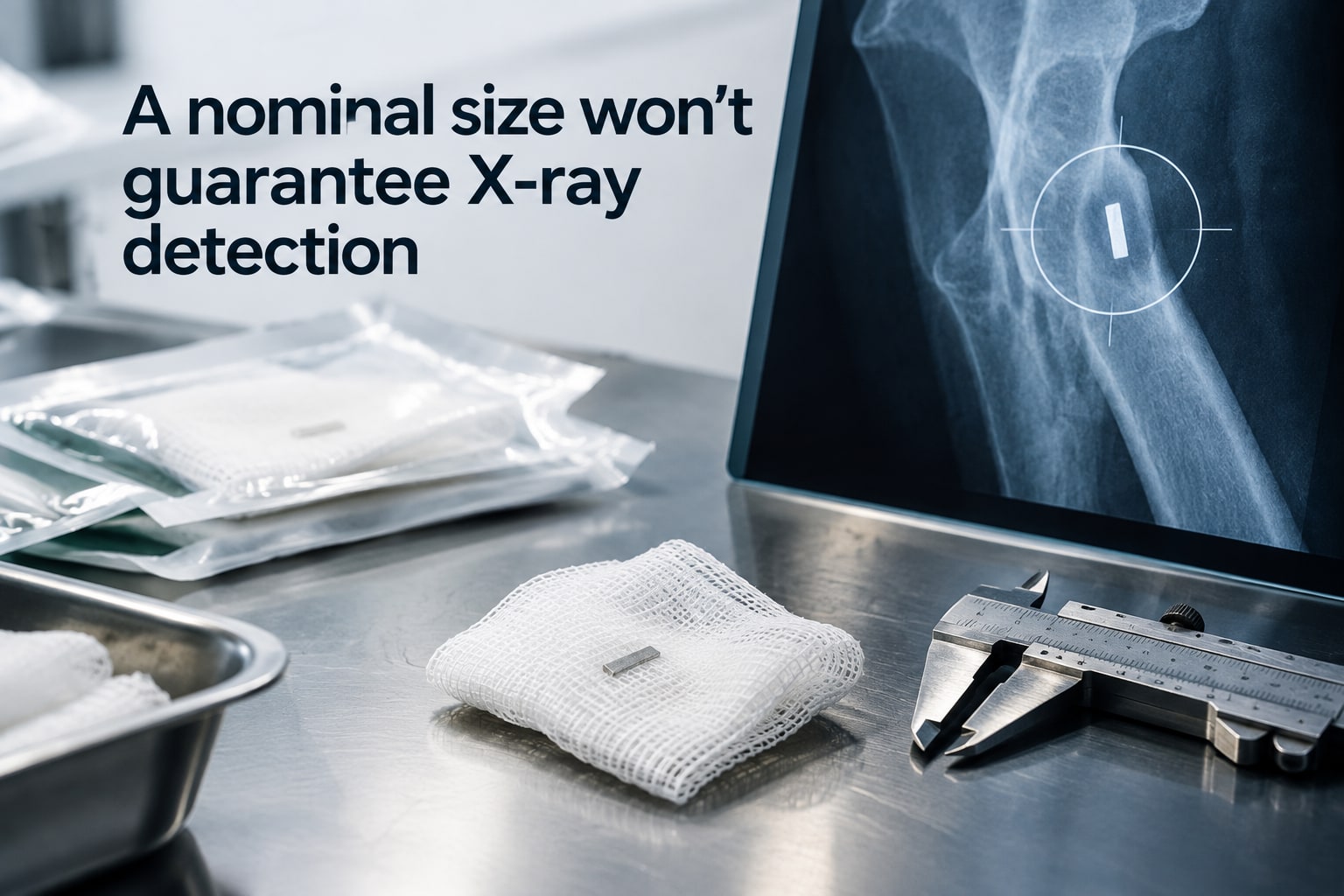
A size such as 10 × 10 cm does not tell you how much absorbent material a swab contains, whether its radiopaque marker will remain visible after folding and saturation, or how the units are controlled in the operating room. Use the specifications below to compare cotton gauze and non-woven swabs, verify supplier evidence, and define receiving checks before approval.
Key takeaways
- Define open size, folded size, plies, construction, tolerances and basis weight.
- Specify marker material, placement, dimensions and radiographic detectability.
- Confirm identity before use with packaging labels, marker checks and count controls.
- Require sterility, packaging, traceability and supplier evidence for the exact configuration.
Define the finished swab, not just its nominal size
“10 × 10 cm” is only the nominal cut size. A procurement specification must define the finished gauze swab in the form supplied and used: open dimensions, folded dimensions, dimensional tolerances, ply count, fabric construction or thread count, and basis weight.
Without those values, two swabs with the same size label can differ in bulk, absorbency, and handling strength.
Good X-ray detectable gauze swab specifications state the acceptance method as well as the target value. Specify:
- Material composition and construction, including cotton or nonwoven content, ply count, thread count, and basis weight.
- Open and folded dimensions, with tolerances for length, width, thickness, and fold alignment.
- Absorbency capacity and test method, rather than the word “absorbent” alone.
- Wet strength and resistance to tearing during grasping, soaking, compression, and removal.
- Edge construction, including folded or stitched edges, loose-thread limits, and marker attachment resistance.
- Lint or particle-shedding limit, plus visual acceptance criteria for holes, incomplete folds, and exposed threads.
- Radiopaque marker material, lead-free status, number, dimensions, and position as part of the finished swab configuration.
- Sterile or non-sterile status, packaging configuration, and lot identification.
Require testing on the completed swab, not fabric cut before folding. The specification must also identify whether dimensions apply before or after sterilization, because shrinkage can turn a compliant nominal size into a nonconforming finished product.
Specify the marker so detection does not depend on luck
A radiopaque thread at one corner is not enough: fold or compress the swab and the marker can disappear behind gauze. Define the marker as a controlled feature of the finished x ray detectable gauze swab, not as a claim that the cotton or nonwoven material will appear on an image.
Require the specification to state:
- Construction: barium-sulphate-impregnated tape, radiopaque thread, or radiopaque filament; identify the material and declare whether it is lead-free.
- Quantity and size: number of markers, marker width, thickness, length, and dimensional tolerances.
- Route: specify whether each marker crosses the full swab, runs through its centre, or follows an edge.
- Position: fix the distance from the edge and the location relative to the folded configuration, so the marker remains predictable after folding.
- Visibility: require identification when the swab is folded, rolled, overlapped, compressed, and saturated with blood or fluid.
Require a documented radiopacity test on the finished, packaged product. The report must name the X-ray exposure settings, marker orientation, detector type, test configuration, and pass/fail acceptance criterion; do not accept “X-ray detectable” as the entire result. Set the criterion against a visible reference or defined image threshold that your retained-item protocol can recognise.
A visible marker supports recovery; it does not replace sponge counting. Specify the unit count, packaging configuration, and lot identification for every pack of sponges, because a marker can be obscured by another swab or missed on a low-contrast image.
Check identity before the swab reaches the operating field
A gauze swab can look identical to an ordinary cotton swab, so do not identify it by colour, weave or folded size. Confirm the product code and “X-ray detectable” claim on the outer package, then match the marker description and unit count to the approved specification.
1. At receiving, check the label for product identity, lot number, pack quantity, sterile or non-sterile status, and expiry date where applicable. Reject packs with missing identification, broken seals or a count that does not match the purchase order.
2. Open a designated inspection pack only when your procedure permits it. Confirm that the radiopaque thread or tape is present, in the specified position and continuous through the folded swab; an ordinary gauze swab has no such marker. Record discrepancies against the lot, not just against one piece.
3. Keep X-ray-detectable swabs in a clearly marked, separate stock location. In the operating room, place them in a dedicated sponge-count group and prevent substitution with ordinary gauze or unmarked sponges.
4. Count each swab as a defined unit at opening, during use and at closure. Reconcile unused, used and discarded units before the patient leaves; the marker supports imaging and recovery but does not replace counting.
Sterility remains a separate identity check. Verify the sterile claim, sterilization method, package configuration and shelf life independently from radiopacity, and quarantine any pack whose label or seal cannot confirm those attributes.
Match sterility, packaging and traceability to the configuration
Decide whether the product is sterile or non-sterile before approving the pack. A non woven swab labelled “NON-STERILE” must not carry a sterility claim; a sterile swab needs a validated sterilization method, validated packaging system and an expiry date supported by shelf-life data.
Require these details in the purchase specification and on every sales unit:
- Sterile or non-sterile status, sterilization method, sterility claim, expiry date and storage conditions.
- Primary barrier, outer packaging, seal configuration, package quantity and unit count; specify packaging integrity after sterilization and transport.
- Product name, finished and folded dimensions, marker description, quantity, lot number, manufacture date and expiry date on the label.
- Lot traceability from fabric and radiopaque marker materials through assembly, sterilization, release testing and shipment.
- A documented radiopacity result for the finished, packaged configuration, using named imaging conditions and the agreed acceptance criterion.
Do not accept a sterile claim based only on a sterilization certificate for the textile. The process validation must cover the loaded package, while packaging validation must show that seals, barrier properties and opening presentation remain effective through the stated shelf life.
Keep lot boundaries tight enough to isolate one fabric or marker-material change. Your x ray detectable gauze swab specifications should also require retained samples and records linking each carton, pouch and unit count to its lot. That control supports sponge accounting; the marker does not replace counting or operating-room protocol.
Request evidence before approving a supplier
Do not approve a supplier from a catalogue claim alone. Request the controlled x ray detectable gauze swab specifications, a finished-product sample, and records showing that the packaged swab—not merely its marker thread—meets the purchase specification.
- Ask for the material, ply, finished and folded dimensions, basis weight, absorbency, wet strength, edge construction, marker composition and dimensions, sterility status, sterilization method, shelf life, lot traceability, and lint or particle-shedding test.
- Require a radiopacity report identifying the finished packaged swab, X-ray view, detector, exposure conditions, marker orientation, folded or compressed state, and acceptance criterion. “Visible on X-ray” without these details is not a reproducible claim.
- For sterile supply, request packaging validation to ISO 11607, sterilization validation to ISO 11135 for ethylene oxide, ISO 11137 for radiation, or ISO 17665 for moist heat, plus bioburden and sterility records under ISO 11737.
- Request the manufacturer’s ISO 13485 certificate, batch release record, change-control procedure, and a risk assessment covering marker detachment, edge failure, lint, and misidentification.
| Comparison question | Evidence to compare | Why it matters |
|---|---|---|
| Does the marker remain visible folded, soaked, and compressed? | Finished-swab radiopacity images and results | Matches the retained-item protocol |
| Is the marker lead-free and secure? | Material declaration and attachment or pull-test record | Separates safe construction from appearance |
| How does it differ from a non woven swab or ordinary gauze? | Label, colour code, count control, and receiving sample | Prevents the wrong item entering the field |
| Are results comparable across lots? | Same method, limits, and trend data | Exposes inconsistent manufacture |
Komal Health Care Pvt Ltd should answer these questions with configuration-specific records, not a certificate covering unrelated sponges.
Related products
 | Surgical Disposable ₹4 We offer a superior range of sterile gauze swabs which are in high demand among our Indian and international clients. View product → |
 | Gauze Roll ₹38 We produce and supply to our clients, a wide range of Gauze Rollthat are hygienically made so that they are safe to use in various medical... View product → |
Frequently asked questions
What should an x-ray detectable gauze swab specification include?
Define the finished swab’s open and folded dimensions, dimensional tolerances, ply count, fabric construction or thread count, and basis weight.
How should buyers specify the x-ray marker?
State the marker material, dimensions, placement, attachment method and detection requirements so identification does not depend on chance.
How can staff check gauze swab identity before use?
Compare the pack label with the purchase specification, inspect the seal and marker, and verify the supplied count before the swab enters the operating field.
What packaging and traceability details should buyers request?
Match sterile or non-sterile status, packaging format, expiry or sterilisation information, lot number and other traceability records to the supplied configuration.
What evidence should a supplier provide before approval?
Request a controlled specification, sample or drawing, test records for marker detectability, sterility evidence where applicable, packaging details and lot traceability documents.
Related products
 | Surgical Dressing ₹18 Our OT Gauze Swabs, cotton swabs are available in different folds and can also be customized as per client's requirement. View product → |
 | Surgical Disposable ₹60 We manufacture a wide range of Lap Sponge (Abdominal Pad)s, gauze sponge that finds application in operation theatres for bleeding control & other... View product → |