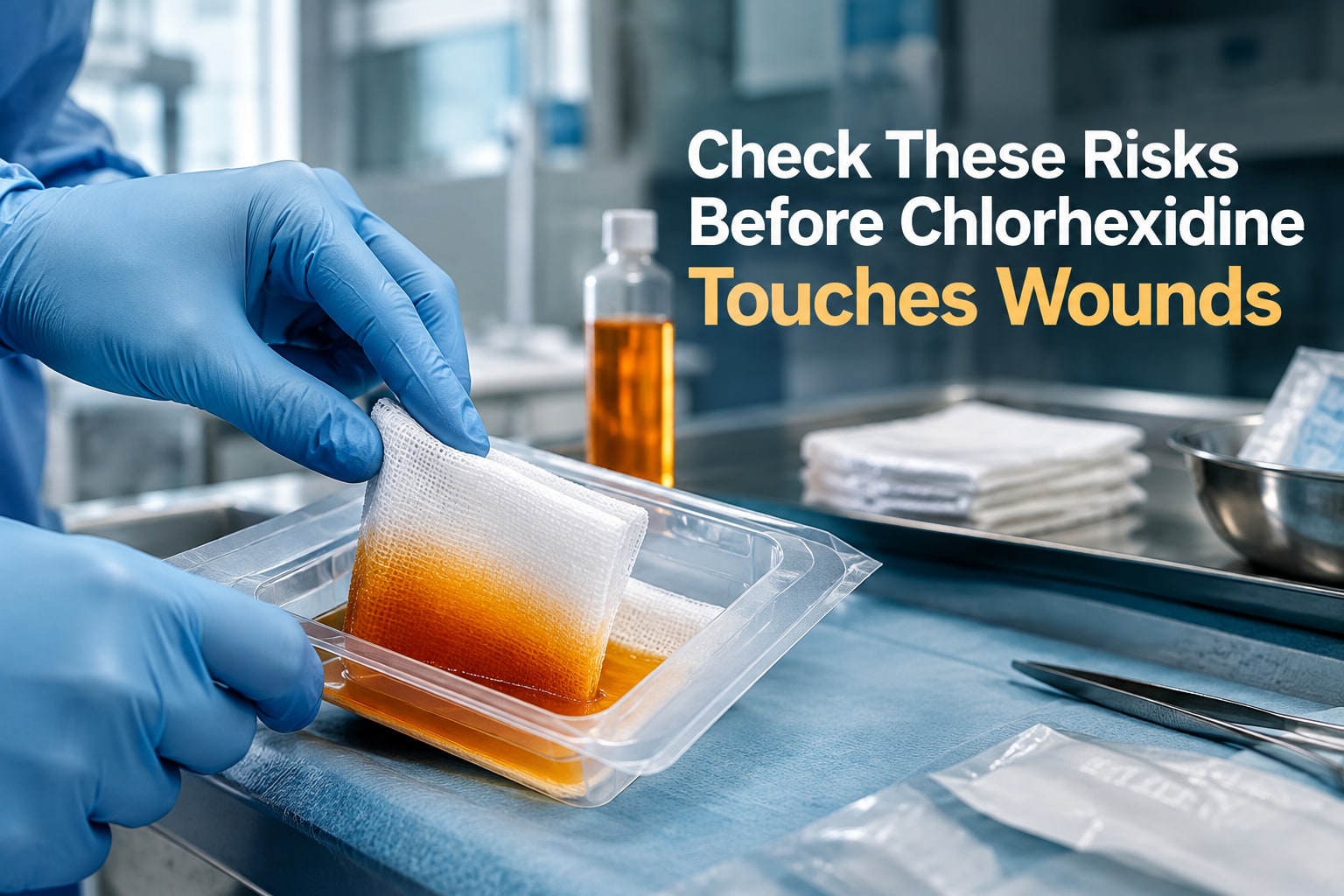
A chlorhexidine-impregnated dressing can cause skin injury, allergic reactions, maceration or delayed healing when staff use it on the wrong wound, leave antiseptic pooled beneath it or overlook a previous chlorhexidine reaction. By the end, hospital teams will have a practical check for patient suitability, wound type, product instructions, application technique, monitoring and escalation.
Key takeaways
- Match the product to the patient, wound and labelled indication before opening.
- Treat sharply outlined burning redness as possible irritant injury, not automatic infection.
- Prevent pooled solution, wet edges and contact with intact skin.
- Stop exposure, escalate worsening reactions and record the product batch number.
Separate irritation from allergy before the reaction becomes dangerous
Burning and sharply defined redness that matches the gauze outline, or a pool of trapped solution, points to irritant injury. It can cause weeping, blistering, erosions and blistering; treating it as infection while continuing the dressing can enlarge the chemical injury.
1. Irritant injury: Look for a precise dressing-shaped border, burning, wound-edge whitening, weeping, blistering or erosions. Remove the dressing, stop chlorhexidine exposure and obtain clinical review if pain worsens, colour changes, redness spreads, exudate increases or tissue breaks down.
2. Allergic contact dermatitis: Redness, itching and swelling can extend beyond the contact area and worsen after repeated exposure. Earlier uneventful use does not exclude allergy; chlorhexidine in skin preparations, lubricating gels, dressings and coated devices can sensitise a patient.
3. Severe immediate allergy: Hives, rapidly increasing swelling, facial or airway swelling, wheezing, dizziness, hypotension or collapse require urgent emergency treatment under hospital protocol. Remove the dressing and stop exposure when clinically safe; escalate immediately for breathing difficulty, collapse or rapidly progressive swelling.
Record chlorhexidine gauze complications as a possible chlorhexidine allergy until assessed. Do not simply observe the patient more closely, because the next exposure can be more severe. Document the product, lot, concentration, site, application and removal times, preparation beneath it and exact symptoms.
These chlorhexidine dressing concerns need clinical review rather than an assumption of infection.
Confirm the patient, wound and labelled indication before opening the pack
Before opening the pack, confirm the patient, wound and labelled indication. Review the instructions for use for anatomical site, wound type, contact time, replacement interval, concentration, age limit and contraindications; a 0.5% w/w product is not automatically suitable for every wound.
Treat known or suspected chlorhexidine allergy, or a previous reaction to chlorhexidine preparations, lubricating gels, coated devices or dressings, as a selection stop. Place a prominent allergy alert in the patient record and medication system.
| Product label | Suitability check | Do not assume |
|---|---|---|
| Catheter insertion site | Use only when the label names that site and patient age | It is suitable for packing a wound |
| Other wound care | Confirm the wound type, wear time and contraindications | It treats deep, open, heavily exuding, granulating or infected wounds |
| Burn, donor, chronic or surgical wound | Obtain a wound-specific indication | Catheter dressing evidence applies to every incision or wound |
| Paediatric patient or neonate | Check age and gestational-age restrictions | Adult practice applies to premature infants or neonates |
| Eye, ear, mucosal surface or deep cavity | Use only if the instructions expressly permit it | Gauze belongs in these sites |
Premature infants and neonates face greater chemical-injury risk from thin, immature skin, especially under prolonged or occlusive exposure. Erythema, blistering, erosions and burns are reported; pooled antiseptic increases exposure. These chlorhexidine gauze dressing problems, and wider antiseptic gauze problems, warrant a different product or clinical review rather than substitution by habit.
Apply it without creating chemical injury or a false sense of infection control
A suitable product becomes a wound-care hazard when antiseptic remains trapped beneath it. Common gauze dressing wound care issues include chemical injury, macerated wound edges, loss of adhesion and restricted circulation.
1. Follow the approved skin-preparation method before applying the dressing. Let the antiseptic dry fully, wipe away excess liquid, and check skin folds for pooling before placing gauze or an occlusive cover.
2. Keep gauze away from the eyes, ears and mucous membranes when the instructions prohibit contact. Lay it over the intended surface; never pack it into a deep cavity.
3. Wrap securely, not tightly. Tight fixation can restrict circulation or trap moisture. Wet, bleeding, oily or heavily exuding sites can loosen the dressing, saturate it and macerate wound edges, so reassess the site rather than assuming the covering remains protective.
4. Check every soap, detergent, cream and ointment used beneath or beside the dressing. Anionic products can reduce chlorhexidine activity without removing its irritation risk; change the preparation sequence or product only under the approved wound-care protocol.
5. Treat the dressing as an antimicrobial adjunct, not sterilization. It does not replace aseptic technique, approved skin antisepsis or clinical treatment of an infected wound, and it is not a universal solution for every wound.
These chlorhexidine dressing concerns belong in the application check, not after injury appears. Stop and obtain clinical review for worsening pain, spreading redness, colour change, increasing exudate or tissue breakdown.
Inspect the site, dressing and replacement decision at every review
At every review, inspect skin beyond the visible gauze edge and compare it with baseline. Look for:
- New burning or itch; sharply bordered redness, hives, blistering or erosions; wound-edge whitening, maceration or tissue breakdown
- Increasing pain, colour change, new or increasing exudate, odour, catheter or wound movement, saturation or loose adhesion
- Moisture trapped beneath the dressing or antiseptic pooled around the site
An over-wet dressing, trapped chlorhexidine and prolonged contact can delay healing or cause chemical injury. These are gauze dressing wound care issues, not reasons to leave the dressing in place until a routine date.
Follow the product’s labelled wear time and replacement interval; no universal interval from another dressing applies. Remove or replace it promptly when the indication ends, adhesion fails, saturation occurs or a reaction is suspected. Remove it gently, account for every layer and piece, and document any gauze left in a wound or cavity.
When comparing products from manufacturers and exporters such as Komal Health Care Pvt Ltd, request the exact instructions for use, lot traceability, intended site, age restrictions, formulation details and replacement guidance—not merely “CHG gauze.” This prevents chlorhexidine gauze dressing problems caused by treating non-interchangeable products as identical.
Related product
 | Dressings Chlorhexidine Gauze Dressing (Antiseptic Tulle Dressing) ₹120 Chlorhexidine dressing and antiseptic tulle dressing B.P. Consists of fabric of Leno weave of cotton, which has been impregnated with white soft... View product → |
Stop exposure, escalate care and record the event clearly
Stop the dressing at once when harm is suspected. Remove it when clinically safe, cleanse or manage the site according to the wound-care plan, and obtain prompt clinical review for spreading redness, worsening pain, colour change, increasing exudate, tissue breakdown or suspected chemical injury.
- Treat wheezing, airway swelling, widespread hives, dizziness, hypotension or collapse as potential anaphylaxis. Activate the hospital’s emergency protocol immediately.
- Record chlorhexidine as a prominent allergy or adverse reaction when suspected; do not rely on closer observation during the next exposure.
- Document the product name, lot number, concentration, anatomical site, application time, removal time, preparation used underneath and exact symptoms.
- Photograph the site according to policy, noting the dressing outline, pooled fluid, blistering, erosions, exudate and tissue breakdown.
Infection-control and procurement teams should investigate repeated chlorhexidine gauze complications by product, lot, ward, patient age, wound type and application technique. Compare the timing and photographs with the use of adhesive, irritant injury, pooled antiseptic, anionic cleanser, retained gauze and genuine infection; precise records can separate these causes.
Do not extend a central-line practice to every wound: benefit shown in some central-line populations does not justify routine use elsewhere. Review antiseptic gauze problems as a product-selection and wound-care issue, not proof that stronger antimicrobial exposure is safer.
Frequently asked questions
How can you distinguish chlorhexidine irritation from an allergy?
Burning with sharply defined redness matching the gauze outline or pooled solution points to irritant injury. Escalate suspected allergy when the reaction extends beyond contact areas or includes systemic symptoms.
What should hospitals confirm before opening chlorhexidine gauze?
Confirm the patient, wound, product label, antiseptic concentration, expiry date and labelled indication before opening the pack.
How should chlorhexidine gauze be applied safely?
Follow the product label, prevent solution from pooling, keep wet edges off intact skin and do not treat the dressing as a substitute for infection-control practice.
When should staff stop using a chlorhexidine dressing?
Stop exposure when burning, sharply outlined redness, blistering, weeping or erosions develop, then escalate care and document the product and batch number.