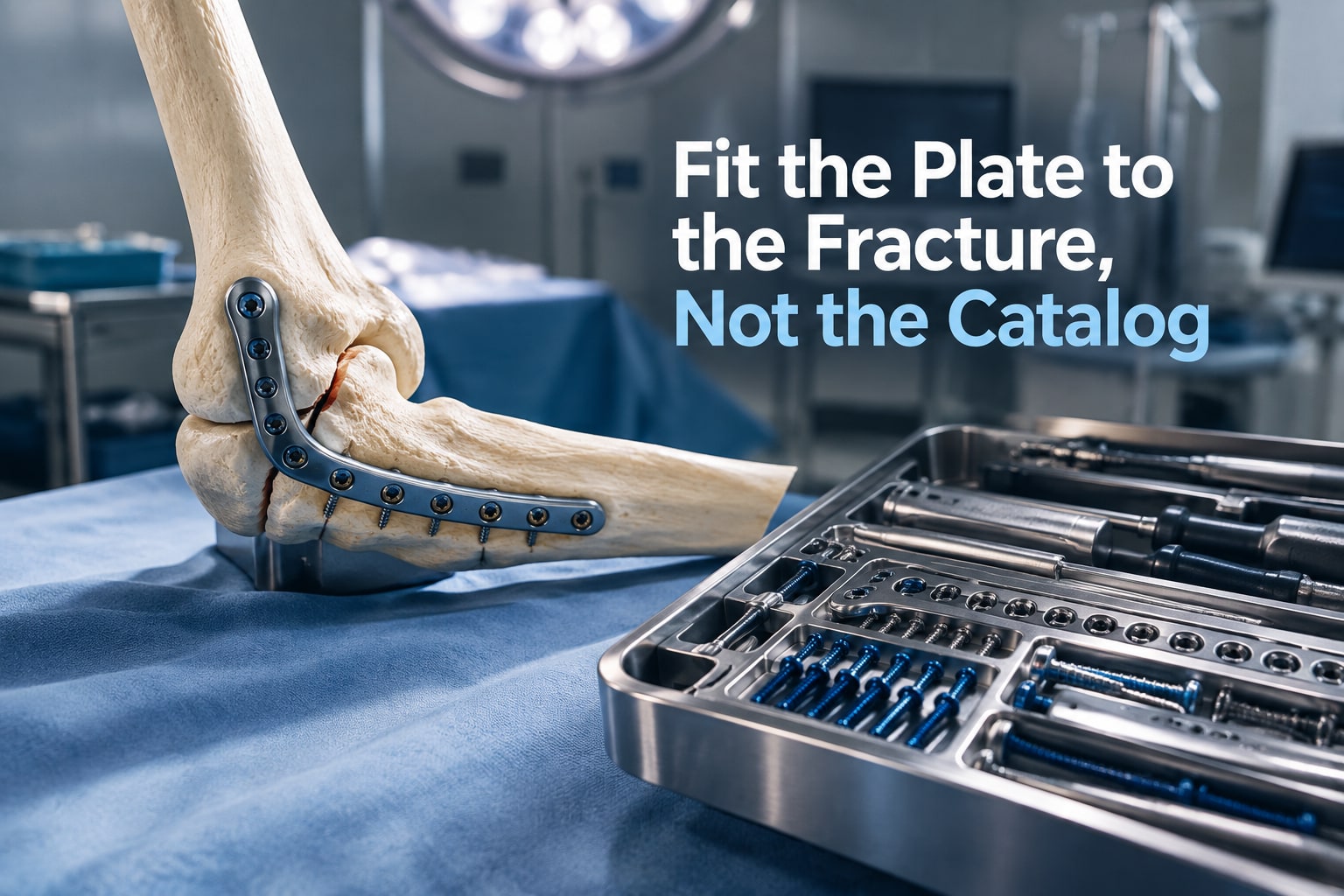
Choosing an olecranon implant involves more than selecting titanium or counting holes. You need to match fixation to the fracture pattern, protect the triceps insertion and ulnar nerve, control screw depth near the joint, and confirm that the complete plate-and-screw system fits your instruments and regulatory requirements.
Key takeaways
- Choose plating when reduction must restore elbow alignment and triceps extension strength.
- Match plate length, hole count, contour, and screw options to the fracture pattern.
- Check titanium grade, imaging needs, packaging, traceability, and regulatory documents before purchase.
- Ask a Mexico supplier for samples, technical files, batch records, and delivery terms.
When an Olecranon Plate Is the Better Fixation Strategy
Plate fixation is the better strategy when an olecranon fracture cannot maintain joint alignment and extension strength after reduction. The olecranon is subcutaneous posteriorly, so implants have little soft-tissue cover; it also receives the triceps insertion and acts as the elbow extensor lever.
Plate contour and proximal extension therefore matter more than the word “locking” alone.
Simple transverse fractures with good bone contact may suit tension-band wiring because compression converts triceps pull into stability. Oblique fractures, unstable fragments, fracture-dislocations, comminuted articular fractures, and fractures extending into the proximal ulna favour a plate when direct compression cannot control the pattern.
An LCP can bridge comminution, support the proximal fragment, and accept multiple fixed-angle screws in osteoporotic bone, but poor fit or inadequate proximal purchase still causes failure. Among titanium orthopaedic plate benefits are low mass and corrosion resistance; material does not replace reduction quality or sound fixation.
| Option | Best fit | Main limitation |
|---|---|---|
| Tension-band wiring | Simple, compressible transverse fracture | Poor control of comminution or unstable fragments |
| Plate fixation | Comminution, fracture-dislocation, osteoporotic bone, proximal-ulna extension | Posterior prominence and demanding screw-length control |
| Intramedullary fixation | Selected patterns with adequate proximal fragment and contained joint surface | Limited control when the fragment is small, articular surface is fragmented, or rotation and congruity demand precision |
| Nonoperative care | Stable, minimally displaced fracture with acceptable joint surface and functioning extension mechanism | Unsuitable for displacement, instability, or loss of active extension |
Fixation choice follows reduction, soft-tissue condition, bone quality, and surgeon assessment—not the label titanium elbow fracture implant alone.
How the Team Uses an LCP During Olecranon Fixation
The team exposes the olecranon, identifies and protects the ulnar nerve, and preserves the triceps insertion. Remove clot or interposed tissue, restore the articular surface, and realign the proximal ulna before provisional fixation with clamps or K-wires.
- Secure the key proximal fragment with a clamp or K-wires.
- Trial-position the titanium elbow fracture implant over the posterior olecranon and proximal ulna. Check contour, triceps clearance, and posterior prominence with fluoroscopy.
- Place a suitable distal screw to control length, rotation, and proximal-ulna alignment.
- Complete compression or locking fixation according to the fracture pattern.
- Verify every critical screw length in multiple fluoroscopic views; a screw entering the trochlear notch or joint can damage cartilage and restrict motion.
Compression and locking are different functions:
| Mode | Screw action | Best use |
|---|---|---|
| Conventional cortical screw in compression portion | Pulls the plate toward bone and can compress the fracture | Simple fracture with anatomically reducible fragments |
| Locking screw in threaded hole | Engages the plate threads to create a fixed-angle construct without pulling the plate onto bone | Osteoporotic bone, metaphyseal comminution, or unstable proximal fixation |
For comminution, use bridge fixation: let the plate span the fragmented zone while preserving its biology. For a simple fracture, direct compression is preferable when reduction is anatomical. Do not force a poorly contoured plate against bone; it can alter reduction, impinge on the triceps, or create avoidable posterior prominence.
What Titanium Changes in Weight, Imaging, and Implant Handling
Titanium’s lower density is an operating-room advantage: common titanium alloys measure about 4.4–4.5 g/cm³, versus 7.8–8.0 g/cm³ for stainless steel. Their elastic modulus is about 105–120 GPa, compared with 190–200 GPa for stainless steel.
| Material | Practical effect | Limitation |
|---|---|---|
| Titanium | Lighter implant, high corrosion resistance, established biocompatibility, lower radiographic density and magnetic susceptibility | Still far stiffer than cortical bone; stress shielding remains possible; visible on radiographs and not artefact-free on MRI |
| Stainless steel | Higher stiffness, familiar handling, strong screw and plate availability, often lower cost | Heavier, denser on radiographs, and more prone to imaging artefact than titanium |
Those figures explain genuine titanium orthopaedic plate benefits: less implant mass and less obstruction around follow-up imaging. They do not guarantee easier surgery. Titanium can be less forgiving during contouring, while handling depends on the alloy, plate thickness, and design; stainless steel remains competitive when predictable bending, instrument familiarity, availability, or cost matters.
Neither material solves posterior prominence. The olecranon has little soft-tissue coverage, so a prominent plate or screw can remain painful after union and require removal. A poorly fitting titanium lcp olecranon plate can irritate the triceps just as readily as steel.
Do not mix metals without written manufacturer compatibility data. Galvanic-corrosion risk depends on the specific plate, screw, surface finish, and body environment; searches for titanium lcp olecranon plate benefits mexico should lead to system-level evidence, not the material name alone.
How to Match Plate Fit, Length, Hole Count, and Screws to the Fracture
Confirm left versus right before opening the sterile package by matching the patient’s radiographs or CT to the implant. Identify the posterior olecranon, trochlear notch, proximal ulna, and the plate’s proximal contour.
Use a sterile trial or unsterile matching sample to check that the plate follows the bone without forcing reduction or adding avoidable posterior prominence.
Choose plate length and hole count from the fracture extent, proximal-fragment size, comminution, bone quality, and the number of secure screws required on each side of the fracture. Do not select a hole count because it is familiar. Ask the LCP olecranon plate manufacturer for:
- Exact plate thickness, available lengths, screw diameter range, and locking or cortical screw options.
- Drill-guide type, torque-limiting driver setting, and approved bicortical trajectories.
- A preoperative instrument check covering compatible guides, taps, depth gauges, drivers, and backup screws.
Plan every screw against the proximal-ulna anatomy. Confirm adequate purchase without entering the trochlear notch or elbow joint, use fluoroscopic views suited to the proximal ulna, and measure every critical screw.
| Decision | Base the choice on | Stop or change when |
|---|---|---|
| Side and fit | Imaging, contour, and trial position | The plate sits reversed, rocks, forces reduction, or increases prominence |
| Length and holes | Fracture span and secure screw requirement | Extra holes add exposure without fixation value |
| Screw configuration | Fragment size, bone quality, and safe trajectories | Purchase is short or the trajectory approaches the joint |
How to Evaluate a Titanium Olecranon Plate Supplier in Mexico
A quotation does not prove that a complete implant system is clinically or legally usable. For a titanium olecranon plate supplier in Mexico, request evidence for the exact plate-and-screw system:
- Titanium grade or alloy designation and applicable implant standard
- Plate and screw compatibility statement, dimensional drawings, fatigue or mechanical test results, and biocompatibility data for the finished device
- Validated cleaning and sterilization instructions, shelf-life data, batch traceability, and instructions for contouring, handling, and torque control
| Check | Quotation alone | Evidence to require |
|---|---|---|
| Screw pairing | Lists titanium or steel screws | Written compatibility data before mixing metals |
| Surgical use | Names an LCP plate | Instrument compatibility, approved trajectories, and screw-control instructions |
| Mexico supply | Shows an export price | Actual device, importer or distributor, labeling, intended use, and COFEPRIS authorization or registration pathway |
Confirm whether the supplier provides titanium screws, stainless-steel screws, or both. A company’s export capability does not establish Mexican authorization.
When assessing Komal Health Care Pvt Ltd as a lcp olecranon plate manufacturer, request these documents for the specific system. Compare delivery reliability, instruments, technical support, and complaint handling alongside price. The useful titanium LCP olecranon plate benefits in Mexico come from predictable fit, documented screw control, and traceability—not the lowest quote.
Related product
 | Orthopedic Implants ₹4200 We are The Manufacturer of LCP OLECRANON PLATES , Which are Size From 2 Holes TO 14 Holes , In Difference Of 2 Holes & Available in LEFT & RIGHT... View product → |
Frequently asked questions
When is an olecranon plate better than another fixation strategy?
Plate fixation suits fractures that cannot maintain joint alignment and triceps extension strength after reduction, especially comminuted or unstable patterns.
How does a surgical team use an LCP during olecranon fixation?
The team reduces the fracture, positions the contoured plate over the posterior olecranon, confirms fit, and selects conventional or locking screws for stable fixation.
What does titanium change in an olecranon implant?
Titanium reduces implant weight compared with steel and affects imaging appearance, instrument handling, contouring limits, and soft-tissue considerations.
How should you evaluate a titanium olecranon plate supplier in Mexico?
Review plate fit options, hole configurations, screw compatibility, material documentation, batch traceability, packaging, regulatory records, and technical support.