A distal humerus fracture is difficult to stabilize because the elbow joint sits between two narrow bony columns and the distal fragment may offer little room for secure screw purchase. By the end, you will be able to match locking fixation to the fracture pattern, distinguish single-plate from dual-plate strategies, and assess the implant system and documentation before use or procurement.
Key takeaways
- Choose locking fixation when distal fragments offer limited conventional screw purchase.
- Use fixed-angle screws to support the distal articular block and maintain alignment.
- Fix both columns when the fracture disrupts medial and lateral column stability.
- Verify plate fit, screw compatibility, instruments, and traceability documents before purchase.
Which distal humerus fractures benefit most from locking fixation?
Locking fixation is most useful when a distal humerus fracture leaves little reliable bone for conventional screw purchase. The medial and lateral columns connect the distal articular block to the humeral shaft; the trochlea forms the medial joint surface, the capitellum forms the lateral surface, and the olecranon fossa provides posterior clearance for elbow motion.
| Fracture pattern or bone | Why locking helps | Key concern |
|---|---|---|
| Intra-articular fracture | Multiple fixed-angle screws can capture a divided trochlea or capitellum | Restore the joint surface before plate fixation |
| Supracondylar fracture with a short distal fragment | Divergent or convergent screws can secure the small articular block | Confirm adequate purchase without entering the joint |
| Comminuted, osteoporotic fracture | Fixed-angle support reduces reliance on weak cancellous thread purchase | Preserve both columns and avoid excessive stiffness |
| Simple, well-reduced fracture | A locking construct may add little clinical benefit over a properly applied non-locking plate | Base the choice on bone quality and fragment stability |
An intra-articular fracture benefits when the articular block is too small or fragmented for dependable conventional screws. A comminuted metaphyseal fracture benefits when neither column offers a solid bed for compression. Osteoporotic bone creates the same problem even when the fracture line appears simple.
These are the key distal humerus implant benefits, not universal advantages of every elbow fracture fixation plate. Choose locking fixation from bone quality, fragment size, comminution and column involvement; a simple, well-reduced fracture may not gain a meaningful advantage over a sound non-locking construct.
How fixed-angle screws support the distal articular block
A locking screw turns the plate into a fixed-angle scaffold: its head engages the threaded plate hole, so stability depends less on pressing the plate tightly against bone. That connection helps preserve alignment when the distal fragment is short, comminuted or osteoporotic, where conventional screw purchase is unreliable.
| Construct | Mechanical connection | Main implication |
|---|---|---|
| Locking plate | Screw head locks into the plate hole at a defined angle | Multiple screws can support weak distal bone without relying on plate-to-bone compression |
| Conventional compression plate | Screw threads grip bone and pull the plate against it | Stability depends more on bone purchase and friction beneath the plate |
| Locking plus lag screws | Fixed-angle support combines with interfragmentary compression | Useful when an articular fragment requires direct compression before neutralisation |
Divergent or convergent locking screws can capture different parts of the distal articular block, but a locking construct does not reduce a displaced joint fragment. Perform direct reduction and add lag-screw or interfragmentary compression when indicated; fixed-angle screws cannot make an inadequately aligned fracture stable.
Parallel and orthogonal plating are both accepted arrangements. Choose between them from fragment geometry, available screw trajectories, soft-tissue conditions and whether both columns are captured, not from a universal claim that one is superior.
These are the key distal humerus implant benefits of an elbow fracture fixation plate when bone quality and fragment size limit conventional fixation.
When one plate is enough, and when both columns need fixation
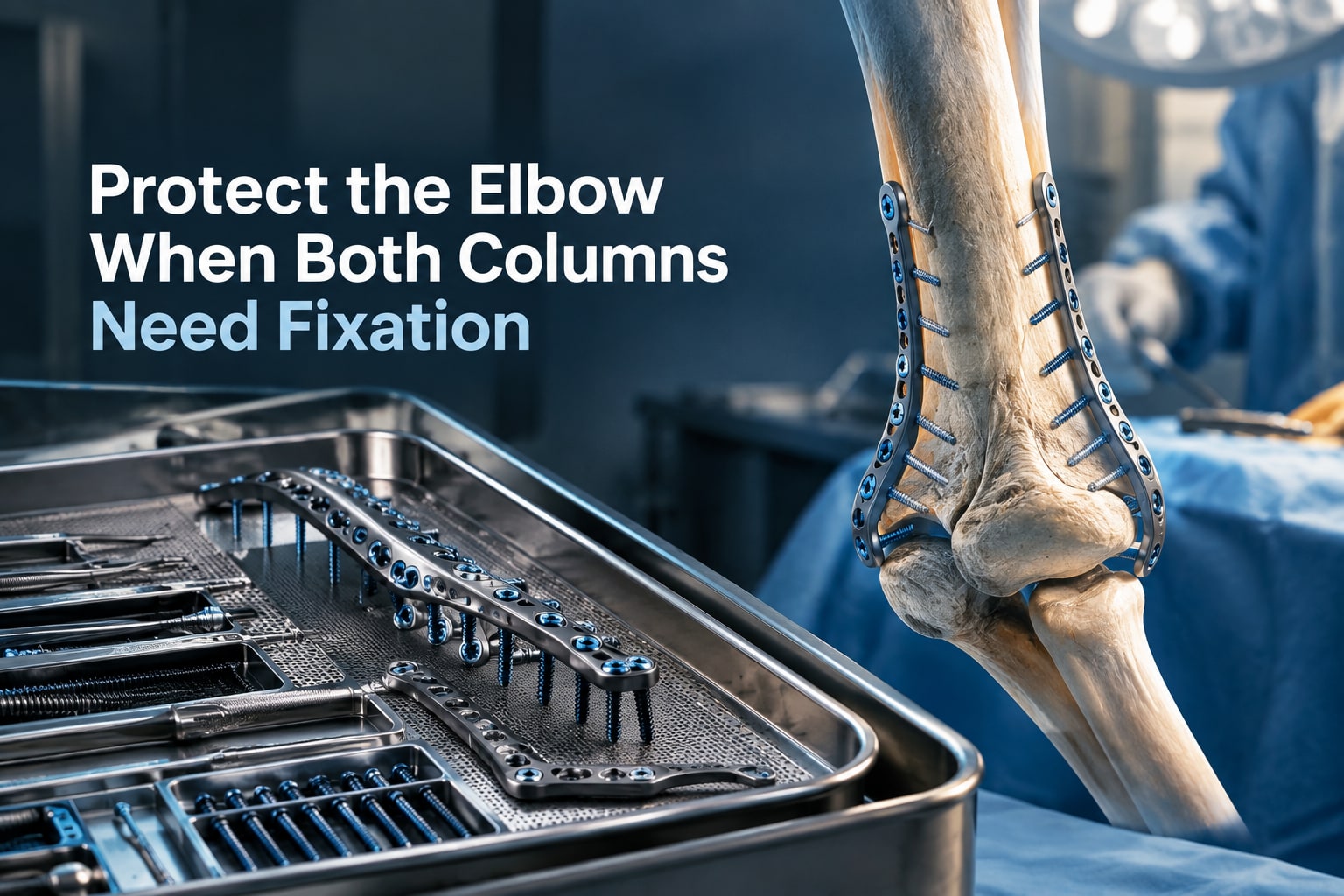
A single dorsolateral plate is enough when it securely captures the lateral column and distal articular block while the medial column remains stable. It is not enough when the fracture disconnects both columns or leaves the distal block without a reliable bridge to the humeral shaft.
| Configuration | Selection logic | Main concern |
|---|---|---|
| Dorsolateral plate alone | Stable medial column; lateral column and distal block accept secure screws | Loss of alignment if medial support is inadequate |
| Medial plus lateral or dorsolateral plates | Both columns are disrupted, or varus/valgus forces threaten fixation | More dissection, hardware and soft-tissue demands |
| Bridge-plating construct | Selected metaphyseal comminution is preserved rather than compressed | Reduction and working length require careful control |
Choose an elbow fracture fixation plate length and hole count from the fracture level, comminution, bone quality, available proximal fixation and planned working length—not by filling every hole. A construct that is too short or too stiff can concentrate stress at the plate end and reduce useful motion at the fracture.
Bridge plating leaves selected metaphyseal fragments undisturbed while the plate spans the zone.
The clearest locking distal humerus plate benefits mexico discussions should focus on the indication: fixed-angle screws help maintain a short distal block in weak or comminuted bone, but they do not replace reduction or create stability when one plate cannot control both columns.
A simple, well-reduced fracture may not gain a meaningful advantage over a properly applied conventional construct. Choose bicolumnar fixation when column stability, not the implant label, demands it.
How plate position and screw planning protect the elbow
Plate fit turns distal humerus implant benefits into safe fixation. The surgeon contours and seats the plate against the distal humerus, keeping its edges clear of the olecranon prominence and protecting the ulnar nerve pathway. A plate that sits proud can irritate soft tissue and leave prominent hardware.
- Measure each distal screw’s length with a depth gauge; select a trajectory that avoids penetration into the trochlea, capitellum and olecranon fossa.
- Confirm screw tips and fracture reduction with fluoroscopy in appropriate anteroposterior, lateral and oblique views. Fixed-angle or variable-angle holes do not replace this check.
- Aim screws toward dense portions of the distal fragment and around fracture lines when that improves purchase without entering the joint.
- Use only the compatible drill guide and a validated screw-angle range; freehand angulation can compromise locking engagement or drive a screw into the articular surface.
A search for locking distal humerus plate benefits mexico should focus on these surgical safeguards, not the label alone. Stable fixation can permit earlier controlled elbow motion after reduction and soft-tissue healing allow, but it does not eliminate stiffness, heterotopic ossification, ulnar neuropathy, infection, nonunion, malunion or prominent hardware.
What to verify when choosing a locking distal humerus plate system in Mexico
A useful comparison starts with the complete fixation system, not the plate alloy. Ask a distal humerus plate supplier Mexico for implant drawings, anatomic contour data, distal hole positions, screw diameters, locking-angle data and trial-fit information.
- Confirm compatible locking and nonlocking screws, drill guides, depth gauges and targeting instruments.
- Verify left/right and medial/lateral versions, clearance around the olecranon fossa, and trajectories that avoid the joint.
- Request revision components, sterilization status, shelf-life statement, lot traceability and packaging records.
- Confirm the applicable COFEPRIS sanitary registration, import records and Mexican distribution documentation.
| Option | What to compare | Why it matters |
|---|---|---|
| Plate-only quote | Material, hole count and price | Does not prove screw or instrument compatibility |
| Complete system | Plate, screws, guides, gauges, targeting tools and trials | Supports validated engagement, trajectory and measurement |
| Revision-ready system | Replacement plates, screws and documented availability | Reduces delays when fixation fails or surgery changes |
A humerus locking plate manufacturer must validate these components as one system. Mixing screws or instruments from another system can compromise locking engagement, screw angle or depth measurement. Request the system-level technical file from Komal Health Care Pvt Ltd if assessing it as a Mexico supplier, rather than comparing plate material alone.
For searches using locking distal humerus plate benefits mexico, treat marketing language as a starting point, not evidence. COFEPRIS documentation, drawings and instrument compatibility decide whether the claimed benefit is usable in your operating room.
Related products
 | Orthopedic Implants Locking Distal Humerus Plate , DorsoLateral ₹4200 We Are Manufacturer Locking Distal Humerus Plate , DorsoLateral . Sizes is done From 3 Hole To 14 Hole , Difference of 1 hole in Left & Right Sides . View product → |
 | Orthopedic Implants Locking Distal Humrus Plate . DorsoLateral With lateral Support ₹4200 We Are Manufacturer Of Locking distal Humrus Plate , DorsoLateral With lateral Support . Size Is From 3 Hole To 14 Holes & 1 Hole Difference . View product → |
Frequently asked questions
Which distal humerus fractures benefit most from locking fixation?
Locking fixation benefits fractures with small distal fragments, comminution, poor screw purchase, or disrupted medial and lateral columns.
How do fixed-angle screws support the distal articular block?
Fixed-angle screws lock into the plate, creating a stable scaffold that supports distal fragments when the available bone is limited.
When is one plate enough, and when do both columns need fixation?
One plate can be enough when one column remains stable and the fracture pattern permits secure fixation. Use medial and lateral plates when both columns are disrupted or the articular block lacks reliable support.
How should plate position and screw planning protect the elbow?
Contour and position the plate to avoid joint penetration, preserve soft tissue, and leave clearance for the olecranon fossa. Plan screw trajectories under imaging before final tightening.
What should you verify when choosing a locking distal humerus plate system in Mexico?
Confirm the plate matches the fracture pattern, screws and instruments are compatible, sizes cover the patient’s anatomy, and the supplier provides traceability and packaging documentation.