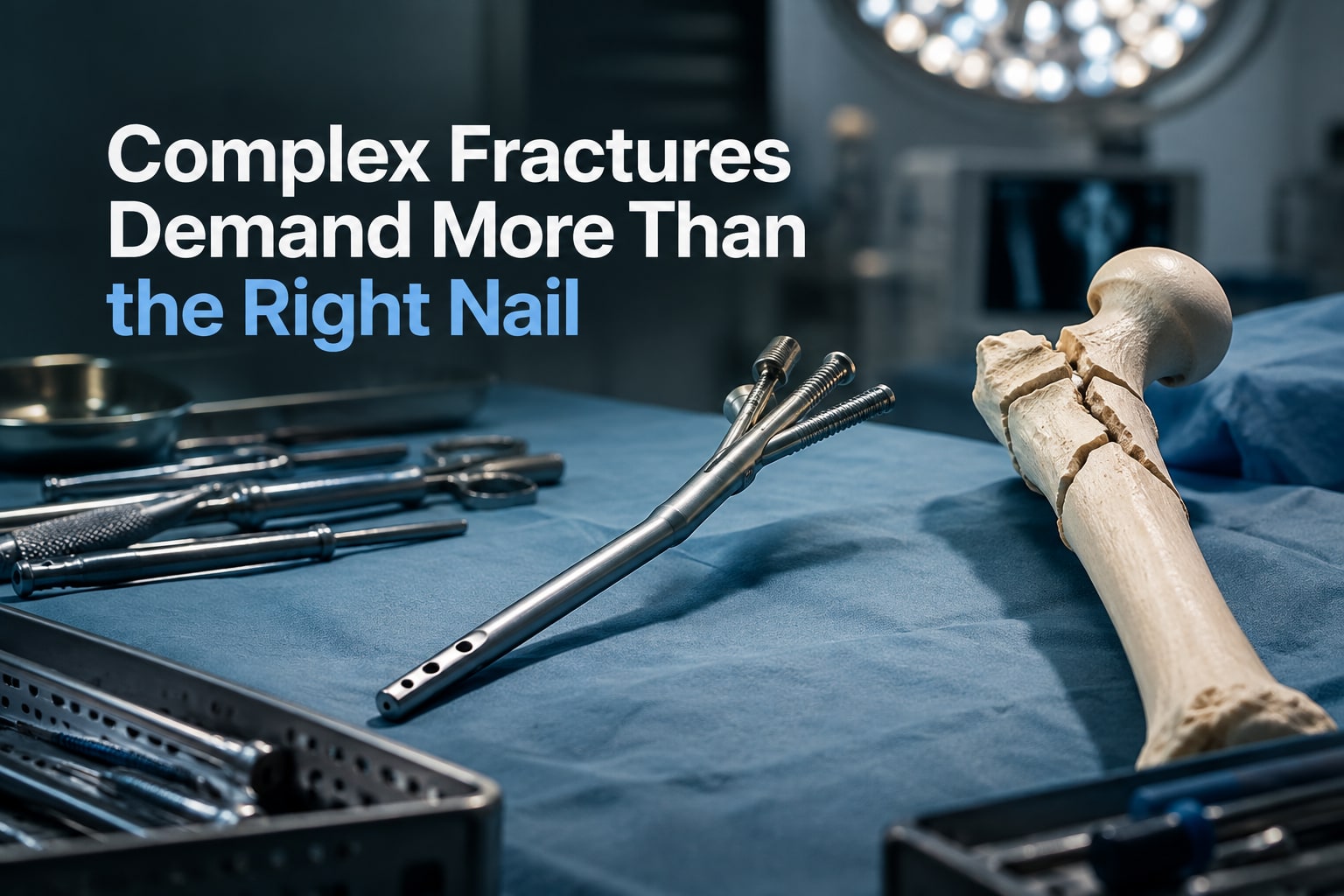
Complex proximal femur fractures fail when the implant cannot control varus, rotation, length or a weak femoral head, not simply because the nail lacks strength. You will be able to match proximal geometry, nail dimensions and fixation strategy to the fracture, then check the clinical and purchasing evidence before choosing a device.
Key takeaways
- Match nail length and diameter to the femur and fracture level.
- Restore alignment before locking cephalic screws.
- Treat screw position and reduction quality as technique-dependent benefits.
- Verify COFEPRIS documentation, ISO 13485 evidence and lot traceability before purchase.
How does a hyper proximal design help in unstable fracture patterns?
A hyper proximal femoral nail is defined by its actual proximal bend, cephalic-element trajectory and targeting geometry—not by a universally accepted implant classification.
Compared with a standard proximal femoral or cephalomedullary nail, its proximal geometry may place the bend and head-neck element to improve access to the femoral head and control of a short proximal fragment. Confirm this in the drawing; the label alone proves nothing.
That distinction matters when support is unreliable in:
- Unstable intertrochanteric fractures with a compromised lateral wall
- Reverse-obliquity fractures that transmit load laterally
- Subtrochanteric fractures with posteromedial or calcar comminution
The nail creates a load-sharing construct inside the femur, with a shorter bending moment arm than a lateral plate. It can therefore control the proximal fragment when a sliding hip screw lacks dependable lateral-wall, posteromedial-cortex or calcar support.
These proximal femur nail benefits depend on centered cephalic purchase, rotational control and avoidance of varus, especially when limited proximal bone stock leaves little margin for error.
Treat the device as a hip fracture fixation implant, not a reduction tool. A nail inserted into poor alignment preserves poor alignment and cannot compensate for inadequate reduction. If a drawing shows “130 mm,” ask whether it identifies the proximal bend, neck-shaft angle, working length or another dimension before comparing implants.
How are nail size, reduction and screw position selected?
1. Start with corrected AP and lateral radiographs. Measure the medullary canal, fracture level, femoral neck angle, anterior femoral bowing and distal anatomy; add CT when fracture extension or anatomy remains uncertain. Before surgery, ask the femoral fracture nail manufacturer to confirm left/right versions, targeting guides and available distal locking options.
2. Choose a diameter that fits the canal without forcing the nail. Select a length that spans the fracture without anterior cortical impingement or distal perforation.
A short nail suits fractures without major shaft extension; a long nail is preferable when the fracture extends subtrochanterically or distally, when distal stress-riser protection matters, or when femoral curvature supports its use.
3. Place the guidewire through the planned entry point, then use a joystick, bone hook, clamp, traction or blocking screw to obtain temporary reduction. Add cerclage or adjunctive fixation for multifragmentary patterns. Insert the nail only after restoring length, rotation and medial calcar support; otherwise, it preserves malreduction.
4. Aim the proximal lag screw or helical blade along the femoral neck axis into a centered or inferior-center head position. Check for no varus, controlled blade or screw prominence and a tip-apex distance below 25 mm.
Confirm reduction, head-element depth and distal locking on corrected AP and lateral fluoroscopic views; inspect the anterior cortex and distal tip before closure.
Which clinical benefits depend on technique rather than the label?
The genuine proximal femur nail benefits come from mechanics, not the phrase “hyper proximal.” An intramedullary nail shares load and reduces the plate-like bending demand created by a lateral construct, while proximal geometry can resist varus collapse and control rotation. Those gains require anatomic alignment, medial support and secure cephalic purchase.
A helical blade compacts cancellous bone around itself in an osteoporotic femoral head; that is different from separate lag screws, which can migrate in a Z-effect or reverse Z-effect pattern.
| Feature | Mechanical point | Limitation |
|---|---|---|
| Helical blade | Compacts cancellous bone and improves rotational purchase | Fails with superior placement, excessive tip-apex distance or prominence |
| Separate lag-screw system | Allows independent proximal elements | One screw can migrate laterally while the other migrates medially |
| Load-sharing nail | Shortens the bending moment arm compared with a plate | Cannot correct varus malreduction or poor purchase |
Early weight bearing is a postoperative judgment based on reduction quality, fracture stability, bone quality, implant security and follow-up radiographs, not an automatic promise. Obtain staged AP and lateral radiographs, review rehabilitation, and advance loading only as healing permits and the surgeon instructs. Track these failures:
- Varus malreduction, superior head placement and tip-apex distance of 25 mm or more.
- Blade cut-out, cut-through, nonunion and implant breakage.
- Anterior cortical impingement and distal locking errors.
When should another fixation method or arthroplasty be considered?
The hyper proximal nail is not automatically the best hip fracture fixation implant. Its proximal bend, cephalic trajectory and targeting geometry suit unstable patterns, but a DHS locking plate remains effective when the lateral wall and medial support permit controlled sliding. Neither option fits every fracture.
| Option | Main trade-off | When it applies |
|---|---|---|
| Hyper proximal nail | Load sharing, shorter plate-like bending arm and proximal fragment control | Unstable intertrochanteric, reverse-obliquity or subtrochanteric fractures with unreliable lateral-wall, calcar or posteromedial support |
| DHS locking plate | Controlled collapse, but depends on lateral-wall and medial-column support | A reducible fracture with those supports intact |
| Standard proximal femoral nail | Familiar intramedullary fixation with less specialised proximal targeting | Fracture geometry that does not require the hyper proximal trajectory |
| Short cephalomedullary nail | Often less operative time and blood loss | Trochanteric fractures without substantial shaft extension |
| Long cephalomedullary nail | Spans subtrochanteric or shaft extension and reduces distal stress-riser concern | Extension that reaches the shaft, provided the nail matches femoral bowing; expect more fluoroscopic work |
| Plate fixation | Direct buttress and contouring, with greater bending demand and soft-tissue exposure | Fractures unsuitable for a canal-based implant or requiring direct reconstruction |
Choose another method when you find infection, severe canal deformity, unsuitable fracture lines, inadequate proximal purchase or unreconstructible comminution. A plate or staged treatment may be safer than forcing a nail into poor biology or alignment.
For a displaced intracapsular femoral-neck fracture in an older adult, hemiarthroplasty or total hip arthroplasty may be preferred because avascular necrosis, nonunion, osteoporosis and fixation failure threaten fixation. Reserve fixation for fractures with reconstructible patterns, adequate bone purchase and a viable femoral head.
What should a Mexican hospital verify before buying the implant?
Before approving a purchase, demand a technical file that lets your surgeons and engineers verify fit, use and traceability—not a catalogue label. Treat “hyper proximal femoral nail benefits Mexico” as a search phrase, not evidence.
- Request drawings and tolerances identifying the 130 mm measurement, proximal neck-shaft angles, blade or lag-screw options, left/right versions, diameter and length choices, distal locking configuration, end caps, targeting guides and every compatible instrument.
- Request the material grade, fatigue results, corrosion or surface-treatment data, sterilisation method, shelf-life, packaging-integrity criteria, radiographic visibility, surgical technique and training requirements.
- Verify ISO 13485 certification as evidence of manufacturing controls, not clinical superiority. Check documentation for non-active surgical implants and intramedullary fixation devices, including applicable material, fatigue, packaging and sterilisation evidence.
- Confirm the COFEPRIS sanitary-registration status, legal manufacturer, authorised representative, Spanish-language labels and instructions, import records, and the complete lot or batch traceability pathway.
Compare suppliers against the same evidence. Komal Health Care Pvt Ltd belongs in that comparison only after its documents and instrument compatibility are checked.
| Supplier comparison | Verify | Purchasing consequence |
|---|---|---|
| Proximal femoral nail supplier Mexico | Registration, stock, lead time and instruments | Lower inventory risk only if records are complete |
| Femoral fracture nail manufacturer | Drawings, tests, quality controls and traceability | Confirms technical accountability |
| Any supplier | Blade options, guides, training and support | Prevents incompatible surgery and avoidable delays |
Do not rely on supplier location or the phrase “hyper proximal.” Compare documents, compatibility, inventory burden, lead times and instrument support.
Related products
 | Othopedic Implants ₹2950 We Are The Manufacturer Of Hyper Proximal Fumural Nail Size Is in 130 x 9mm / 10mm / 11mm in Length Of 180mm To 240mm . View product → |
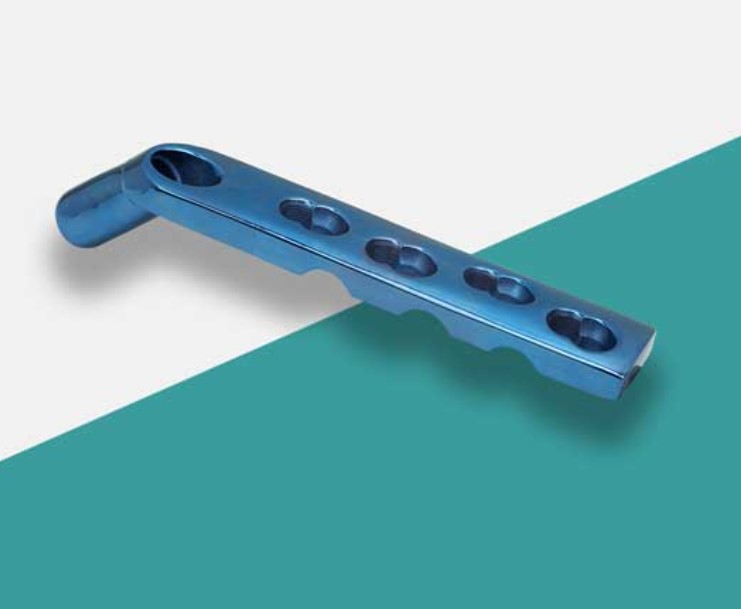 | Bone Plate Dhs Locking Plate Manufacturer DHS (Dynamic Hip Screw) locking plate manufacturers produce specialized orthopedic implants used in the surgical treatment of proximal femur... View product → |
Frequently asked questions
How does a hyper proximal design help in unstable fracture patterns?
Its proximal bend, cephalic-element trajectory and targeting geometry can support fixation of short proximal fragments, provided reduction and implant placement are accurate.
How are nail size, reduction and screw position selected?
Use radiographs or CT to assess fracture level, canal diameter, femoral length and alignment, then select nail dimensions and cephalic screw positions that achieve stable purchase without joint penetration.
Which clinical benefits depend on surgical technique rather than the nail label?
Control of varus, restoration of length and rotation, correct entry point, appropriate depth and accurate screw placement depend on planning and execution rather than the product name.
When should another fixation method or arthroplasty be considered?
Consider a plate, another nail design or arthroplasty when the fracture geometry, bone quality, femoral head viability or patient factors prevent reliable nail fixation.
What should a Mexican hospital verify before buying the implant?
Request the supplier's COFEPRIS documentation, ISO 13485 evidence, sterile-pack details, lot and batch traceability, surgical instrumentation list and local post-sale support.