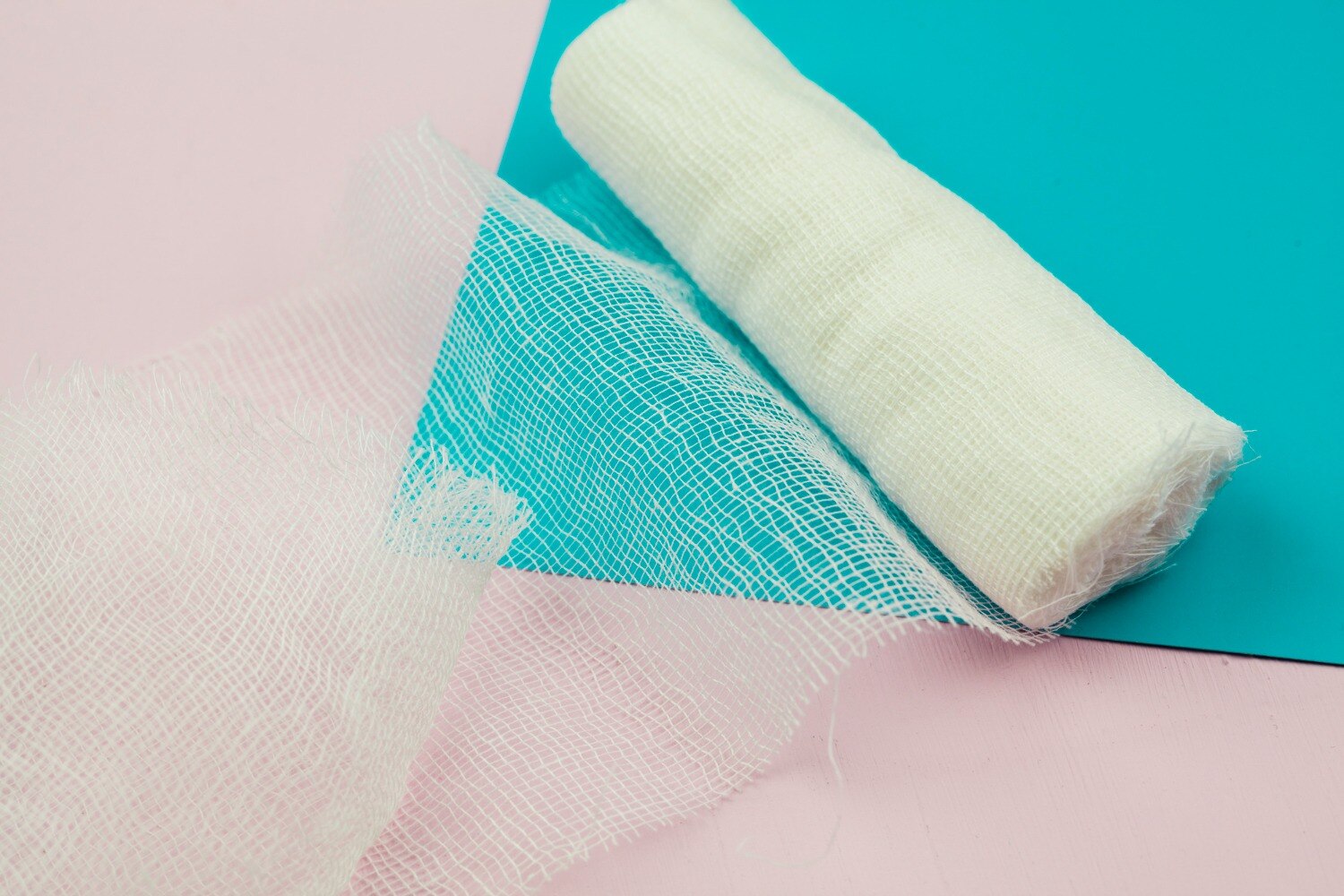
A hospital order for a “large” crepe bandage is incomplete: width, usable length, measurement method, packaging and intended body site all affect whether the roll works in practice. By the end, you will be able to match sizes to anatomy, estimate consumption, write a clearer specification and check a Mumbai shipment before clinical use.
Key takeaways
- Stock four core widths before adjusting for the dressing and clinician’s order.
- Match bandage width to limb circumference and roll length to coverage needed.
- Check skin colour, warmth, sensation and pulse after applying the bandage.
- Put width, length, material, packaging and batch details in every purchase order.
Cotton Crepe Bandage Sizes: A Practical Hospital Size Chart
Start stores with four cotton crepe bandage sizes, then adjust selection to the dressing and clinician’s order.
| Size | Intended use | Anatomical site | Patient group | Width × relaxed length | Sterile status | Packaging unit | Reorder unit |
|---|---|---|---|---|---|---|---|
| 5 cm | Dressing retention or light support | Fingers, hands, small paediatric limbs | Children and small sites | 5 cm × 4 m | Non-sterile unless labelled otherwise | Individual roll | Carton of individually packed rolls |
| 7.5 cm | Dressing retention or light support | Wrists, ankles, smaller forearms | Children and adults | 7.5 cm × 4 m | Non-sterile unless labelled otherwise | Individual roll | Carton of individually packed rolls |
| 10 cm | Dressing retention or light support | Adult forearms, elbows, lower legs | Adults and larger adolescents | 10 cm × 4 m | Non-sterile unless labelled otherwise | Individual roll | Carton of individually packed rolls |
| 15 cm | Dressing retention or light support | Thighs and larger limb areas | Adults and larger limbs | 15 cm × 4 m | Non-sterile unless labelled otherwise | Individual roll | Carton of individually packed rolls |
Treat these as procurement starting points, not replacements for a clinician’s dressing or compression order. A 5 cm roll can need many turns on an ankle; a 15 cm roll can fold and lose contour on a wrist.
Specify width and usable length in centimetres, never only “small,” “medium” or “large.” State whether width is flat or relaxed, or measured stretched. State whether roll length is relaxed, measured at a defined extension, or measured at full stretch; otherwise two suppliers can quote 4 m rolls containing different usable material.
Include the measurement condition in the purchase specification.
How to Match Width and Roll Length to the Limb
Choose the width from the limb’s circumference and contour, not from patient height or weight. Measure the limb around the dressing and record the dressing’s length and width; select a roll that follows the shape without excessive turns, folds or gaps.
- A narrow roll needs more turns and concentrates pressure at its edges.
- An overly wide roll is difficult to contour around ankles, elbows, wrists and knees.
- Fingers, hands and small paediatric limbs usually suit 5 cm; wrists, ankles and smaller forearms suit 7.5 cm; adult forearms, elbows, feet, knees and lower legs often suit 10 cm; thighs and larger limbs may need 15 cm when the dressing or clinical order supports it.
| Site | Starting width | Measure before selecting |
|---|---|---|
| Fingers, hands, small paediatric limbs | 5 cm | Circumference around the dressing and finger or hand length |
| Wrists, ankles, smaller forearms | 7.5 cm | Circumference at the widest point and contour changes |
| Adult forearms, elbows, feet, knees, lower legs | 10 cm | Circumference, dressing dimensions and required layers |
| Thighs and larger limb areas | 15 cm | Circumference, limb length and dressing coverage |
Plan consumption with this formula: required length equals the number of turns multiplied by effective coverage per turn, plus extra length to secure the end. With half-width overlap, a 10 cm roll contributes about 5 cm of new coverage per turn. Circumference, limb length, dressing size, layers and overlap all change usage.
To choose cotton crepe bandage sizes in Mumbai, also compare relaxed usable length: the same nominal width can be sold in materially different lengths, and stretched measurements can overstate coverage.
Application, Tension and Circulation Checks After Sizing
1. Start at the distal part of the limb when the clinical order calls for that direction, then wrap toward the proximal area. Keep the roll aligned with the limb and maintain roughly half-width overlap; a 10 cm roll should add about 5 cm of new coverage per turn.
2. Use even, light tension for support or dressing retention. Smooth each turn as you go, avoiding wrinkles, folds and gaps that concentrate pressure or leave the dressing exposed. Do not pull harder to compensate for an unsuitable width.
3. Treat fasteners separately in the specification during hospital crepe bandage buying. Clips, hooks, ties or adhesive fixation must hold during movement without creating a hard pressure point or snagging gloves.
4. Cotton crepe support is not equivalent to graduated medical compression. Therapeutic compression requires a defined pressure profile, an application protocol and product-specific classification; do not use this guidance to replace clinician direction for compression therapy or suspected vascular disease.
5. After application, check circulation and ask the patient about symptoms. Remove the bandage and follow hospital protocol or obtain immediate clinical review for numbness, tingling, increasing pain, cold or pale fingers or toes, colour change, swelling beyond the bandage or worsening discomfort. Recheck after movement and whenever symptoms change.
How to Compare a Cotton Crepe Bandage Supplier in Mumbai
Approve a supplier only after matching its quotation to measurable product evidence, not catalogue wording. Ask every cotton crepe bandage supplier in Mumbai to state relaxed width, relaxed length, extension and recovery data, fibre composition or an accepted cotton-percentage range, sterile or non-sterile status, disposable or validated-reuse status, packaging unit and reorder unit.
Request a retained sample and compare:
- Weave uniformity, crimp, edge stability, lint or loose fibres, absorbency and odour.
- Roll curling, telescoping, extension and recovery during handling.
Cotton content alone does not predict performance. A blend can behave differently during stretching, laundering and repeated application.
| Evidence to check | Accept when | Hold or reject when |
|---|---|---|
| Dimensions and performance | Representative rolls meet stated width, length, extension and recovery | Substantial variation from the quotation |
| Construction and cleanliness | Uniform crimp, stable edges, no contamination, fraying, unexpected seams or splices | Loose fibres, visible soil, damaged edges or unexplained joins |
| Packaging and labels | Paper wrapping or other packaging is dry, intact, sealed and marked with a readable lot label | Mumbai monsoon moisture uptake, soiling, torn wrapping, damaged seals or missing lot details |
| Intended service | Performance remains acceptable after the specified application or laundering cycles | The supplier cannot support the claimed disposable or reuse status |
Komal Health Care Pvt Ltd can be assessed through this retained-sample and representative-lot process, giving procurement a defensible comparison beyond product descriptions.
Related product
 | Surgical Disposable ₹36 The range of medical bandage, gauze bandages available with us is known for its woven fast edges, thick fabric, better elasticity and controlled,... View product → |
What to Put in the Purchase Order and Receiving Checklist
Prevent the wrong roll from entering clinical stock by making every purchase order identify the product, measurement condition, clinical use and pack basis.
1.
Specify the bandage separately: “Cotton crepe bandage, 10 cm × 4 m, dimensions measured relaxed, non-sterile, single-use disposable, individual protective pack, 12 rolls per carton, for adult forearm, elbow and lower-leg dressing retention.” For hospital crepe bandage buying, change the fields to match the order: 5 cm for fingers, hands and small paediatric limbs; 7.5 cm or 10 cm for mid-sized regions; 15 cm for larger limbs only when the dressing or clinician’s order supports it.
2. Define “cotton” quantitatively, such as “100% cotton” or an accepted fibre-composition range. Request the supplier’s technical data and test documentation confirming fibre composition, relaxed width, usable length, stretch and recovery, and intended disposable or validated-reuse status.
3. State the fastener separately: “Supplied fastener: two blunt-ended, corrosion-resistant clips; no safety pins.” Do not let an included clip alter the bandage specification.
4. At receipt, match width, usable length, lot number, manufacture or expiry information where supplied, sterility statement, pack count and seal condition against the purchase order. Quarantine or reject rolls with wet or torn wrapping, contamination, missing labels, unexpected splices or substantial dimension differences.
If the requirement is adhesive fixation, choose an adhesive bandage; use a soft roll for padding or a defined compression product for therapeutic compression. Cotton crepe bandage sizes do not replace those products.
Frequently asked questions
Which cotton crepe bandage sizes should a Mumbai hospital stock?
Start with four core widths, such as 5 cm, 7.5 cm, 10 cm and 15 cm, then adjust the order to the dressing, body site and clinician’s instructions.
How do you match cotton crepe bandage width and roll length to a limb?
Use narrower widths for fingers, hands and small joints, medium widths for arms and lower legs, and wider rolls for thighs or larger areas. Choose roll length based on the limb’s circumference, the number of turns and the required overlap.
What circulation checks should follow cotton crepe bandage application?
Check colour, warmth, sensation, swelling, pain and distal pulse after application. Loosen and reassess the bandage if toes or fingers become pale, blue, cold, numb or increasingly painful.
How should you compare a cotton crepe bandage supplier in Mumbai?
Compare stated width and length, fabric composition, edge finish, stretch consistency, individual packaging, batch traceability, delivery performance and replacement handling.
What belongs in a hospital cotton crepe bandage purchase order?
Specify width, stretched or unstretched length, material, pack quantity, packaging condition, batch and expiry information where provided, delivery location, inspection criteria and the process for rejecting damaged rolls.