Choosing between titanium and stainless steel requires more than comparing the words on a catalogue page. By the end, you will be able to weigh stiffness, weight, fatigue performance, imaging, patient factors, plate design, fit, component compatibility and Argentine regulatory documentation before requesting a product or planning fixation.
Key takeaways
- Material alone does not predict union or reoperation.
- Match plate geometry and screw configuration to the fracture pattern.
- Check orientation, working length, screw purchase and system compatibility.
- Ask Argentine suppliers for licences, certificates, testing and traceability documents.
How titanium and stainless steel differ mechanically and biologically
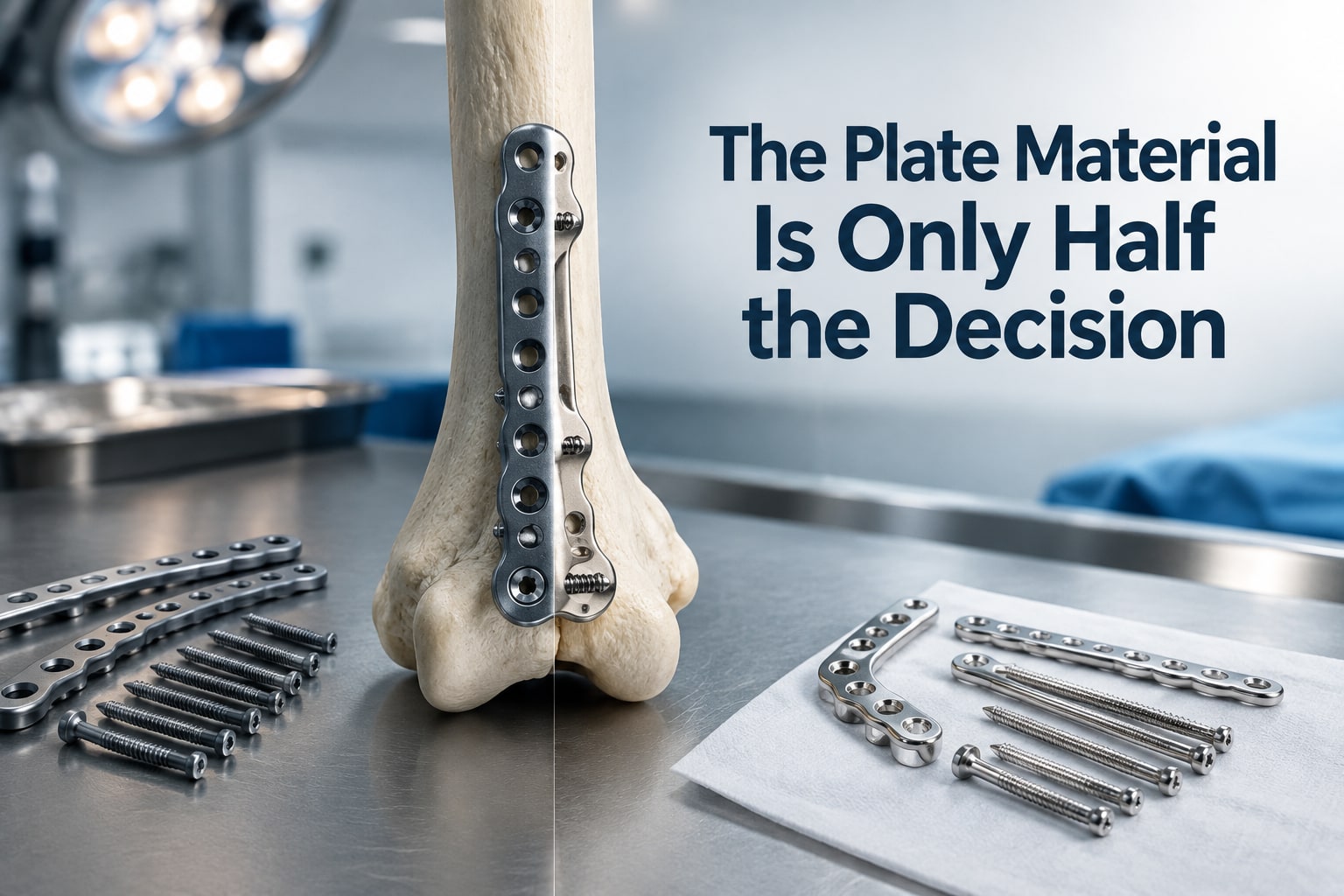
A titanium plate is lighter and less stiff; a stainless steel plate is denser and usually stiffer. The material name alone does not predict union or reoperation: fracture pattern, plate geometry, screw configuration, bone quality and rehabilitation matter more.
A search for titanium versus stainless steel humerus plate Argentina options should begin with the alloy standard, not the label.
| Property | Titanium, commonly Ti-6Al-4V ELI ASTM F136 | Stainless steel, commonly wrought 316L ASTM F138 |
|---|---|---|
| Stiffness and weight | Elastic modulus about 110 GPa; density about 4.4 g/cm³, reducing implant weight and stress shielding | Elastic modulus about 190 GPa; density about 8.0 g/cm³, producing a stiffer, heavier construct |
| Strength and fatigue | Strong with appropriate geometry; fatigue performance depends on surface finish, notching and screw design | High strength and established fatigue performance; sharp bends, scratches and overload still initiate fatigue cracks |
| Corrosion and biology | Stable oxide film; avoid stainless screws unless system documents compatibility | Stable oxide film, but contains about 13–15% nickel under ASTM F138; investigate documented nickel hypersensitivity |
| Imaging and MRI | Less magnetic susceptibility and usually less MRI artifact | Greater artifact; neither material is automatically MRI safe without device-specific field and SAR conditions |
| Surgical handling | Resists corrosion but can gall and needs compatible instruments | Easier to contour and handle; heavier and stiffer |
For a distal humerus implant comparison, titanium offers the better weight, stress-shielding and imaging combination when its system is validated. Stainless steel remains a sound choice where stiffness, familiar handling and documented construct fatigue evidence dominate. Do not mix metals without written compatibility, and never infer clinical superiority from material alone.
When patient and fracture factors should influence the material choice
A documented nickel hypersensitivity is the clearest patient-specific reason to favour a titanium humerus plate. Wrought 316L stainless steel under ASTM F138 contains approximately 13–15% nickel; a history of skin allergy alone does not prove implant intolerance, so confirm the history before excluding stainless steel.
| Decision factor | Favour titanium | Stainless steel remains practical |
|---|---|---|
| Bone quality | When a lower-stiffness construct is desirable and the system provides adequate locking support | When plate geometry, screw purchase and fixation strategy offer stronger support for the actual fracture |
| Soft-tissue coverage | When reduced imaging artefact or a lighter implant helps postoperative assessment | When coverage is adequate and the available stainless system fits the anatomy |
| Allergy history | Documented nickel hypersensitivity after clinical evaluation | No confirmed nickel-related concern |
| Planned revision | When the selected titanium system matches the anticipated revision plan | When existing implants, screws and instruments are stainless steel and compatible |
| Fracture complexity | When the titanium design has validated fatigue and construct data for the loading pattern | When the stainless design offers the surgeon better column support or screw options |
Do not choose from the material name alone. Fracture morphology, bone quality, reduction, plate position and rehabilitation influence failure more than “titanium” or “stainless steel” on a label.
Before choosing either material, verify the exact alloy, screw pairing and instrument system. Do not combine titanium and stainless-steel components unless the manufacturer specifically permits that combination.
Match the plate design and fixation method to the fracture
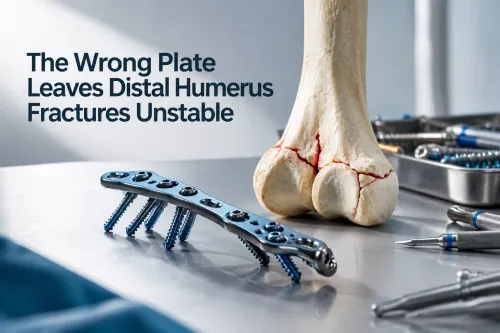
A plate should follow the failed column and the available distal bone, not the material label. In a useful distal humerus implant comparison, fracture reduction and secure screw purchase matter more than choosing titanium or stainless steel alone.
| Design | Fracture pattern | Fixation logic |
|---|---|---|
| Dorso-lateral | Posterolateral or lateral-column fractures with a usable distal lateral fragment | Supports the lateral column; combine with a medial plate for unstable intra-articular or bicondylar patterns. |
| Dorso-lateral with lateral support | Lateral-column comminution, capitellar involvement, or limited distal bone for screw purchase | Adds lateral buttress and more distal fixation points; use locking screws when fragment size or bone quality limits conventional purchase. |
| Medial metaphyseal | Medial-column fractures, medial comminution, or a construct tending toward varus collapse | Buttresses the medial column; pair with a lateral or dorso-lateral plate when both columns are unstable. |
| Extra-articular | Metaphyseal fractures that do not enter the joint surface | Spans the fracture while preserving the articular block; choose length and screw position to avoid the joint. |
For comminuted intra-articular fractures, two plates in parallel or orthogonal configuration usually provide column control. Use non-locking screws for compression when the fragment permits it, then locking screws for fixed-angle support; a locking screw does not pull the plate onto bone.
- Restore the joint surface before final screw tightening.
- Obtain several secure distal screws without penetrating the articular surface.
- Expose and protect the ulnar nerve while positioning the medial plate.
Check orientation, working length, screw purchase and system compatibility
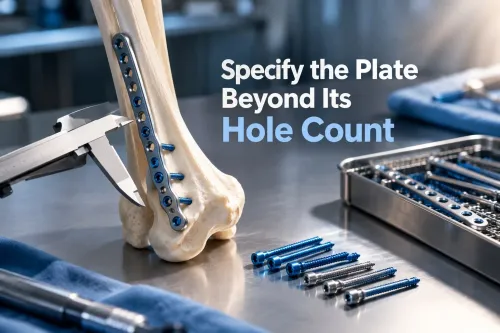
A plate can look correct on an X-ray yet fail because its orientation, working length or screw trajectory does not match the patient’s distal humerus. Confirm the fit on calibrated radiographs and CT when comminution or articular extension obscures the columns; use the manufacturer’s templates or a sterile trial plate before opening the implant.
- Confirm the plate is intended for the left or right humerus and for the chosen medial or lateral column. Seat it against the bone without forcing the contour; a gap, edge lift or contact with the olecranon fossa signals poor fit.
- Choose a working length that bridges the fracture while leaving enough intact bone for fixation on both sides. Avoid concentrating every screw directly beside the fracture, where stress can rise and the construct can fail.
- Check each planned screw length and trajectory with a depth gauge and fluoroscopy. Obtain secure purchase in available cortical bone, use locking screws when the system and bone quality call for them, and stop short of the joint surface.
- Protect the ulnar nerve during medial placement and verify that distal screws do not enter the articular surface.
- Match plate holes, screw diameter, thread, head design and driver to one manufacturer’s system. A titanium humerus plate paired with stainless-steel screws is acceptable only when that system explicitly permits it; apply the same rule to a stainless steel humerus plate.
- Confirm the tray contains the correct drill guides, depth gauge, taps, torque limiter and bending tools. Do not improvise instruments from another system.
What Argentine buyers should request before ordering
An orthopedic implant manufacturer Argentina buyers shortlist must identify the complete implant specification, not merely state “titanium,” “316L,” or “CE-marked.” Request these records before comparing price or availability:
- Material certificate naming Ti-6Al-4V ELI to ASTM F136 or wrought 316L to ASTM F138, including the heat or batch number.
- Mechanical evidence covering dimensions, tensile properties, fatigue testing, and construct testing when claimed.
- Drawing or technical file showing plate dimensions, hole geometry, screw trajectories, tolerances, and left/right orientation.
- Compatibility statement naming approved screw alloys, instruments, locking screws, and any prohibition on mixing titanium with stainless steel.
- Sterilization status, validated method, packaging configuration, shelf life, and sterile-barrier integrity.
- MRI conditions stating the tested field strength, spatial gradient, specific absorption rate, scan duration, heating, and image artefact limits.
- Certificate of analysis and lot-level inspection records linking the supplied implant to its label and batch number.
| Material comparison | Document to request | Why it matters |
|---|---|---|
| Ti-6Al-4V ELI | ASTM F136 certificate and fatigue evidence | Confirms alloy identity rather than a generic titanium claim |
| 316L stainless steel | ASTM F138 certificate with nickel content | Nickel is approximately 13–15% in this wrought implant alloy |
| Either material | ANMAT registration, registration holder, labeling, importer or manufacturer records, and applicable certificates | Confirms lawful representation and traceability in Argentina |
For a titanium versus stainless steel humerus plate Argentina hospital, Komal Health Care Pvt Ltd should be asked for the same complete evidence package, allowing a material comparison on documented performance rather than catalogue wording.
Related products
 | Orthopedic Implants Locking Distal Humerus Plate , DorsoLateral We Are Manufacturer Locking Distal Humerus Plate , DorsoLateral . Sizes is done From 3 Hole To 14 Hole , Difference of 1 hole in Left & Right Sides . View product → |
 | Orthopedic Implants Locking Distal Humrus Plate . DorsoLateral With lateral Support We Are Manufacturer Of Locking distal Humrus Plate , DorsoLateral With lateral Support . Size Is From 3 Hole To 14 Holes & 1 Hole Difference . View product → |
Frequently asked questions
How do titanium and stainless steel distal humerus plates differ?
Titanium is lighter and less stiff; stainless steel is denser and usually stiffer. Plate geometry and fixation configuration also affect performance.
When should patient and fracture factors influence material choice?
Consider fracture pattern, bone quality, soft-tissue condition, expected rehabilitation and patient-specific risks alongside the material.
How should you match a distal humerus plate to the fracture?
Select plate design, orientation, working length and screw configuration according to the fracture lines, column involvement and available bone for fixation.
What should Argentine buyers request before ordering?
Request the supplier’s licence information, implant specifications, material details, sterilisation status, batch traceability, compatibility data and supporting quality documents.
Related products
 | LCP Methaphyseal Plates For Distal , Medial Humerus We Are Manufacturer Of LCP Methaphyseal Plates For Distal , Medial Humerus . Size Are From 3 Hole To 14 Hole , Difference Of 1 Hole . View product → |
 | Orthopedic Implants LCP Extra Articular Distal Humerus Plate We Are Manufacturer Of LCP Extra Articular Distal Humerus Plate . Size Is from 4 Hole To 14 Holes , Difference of 1 hole . View product → |