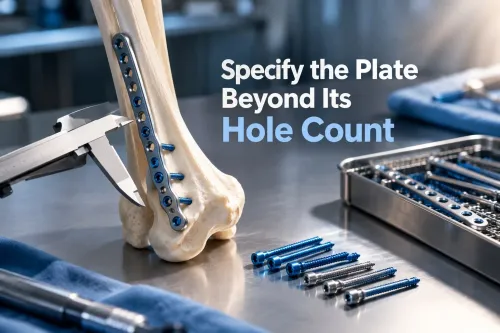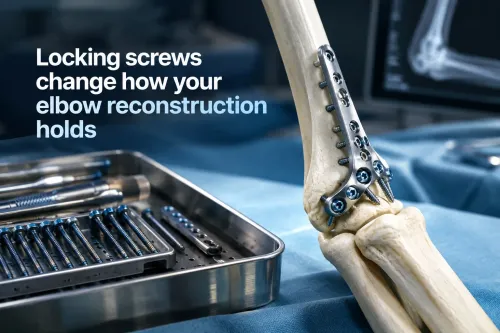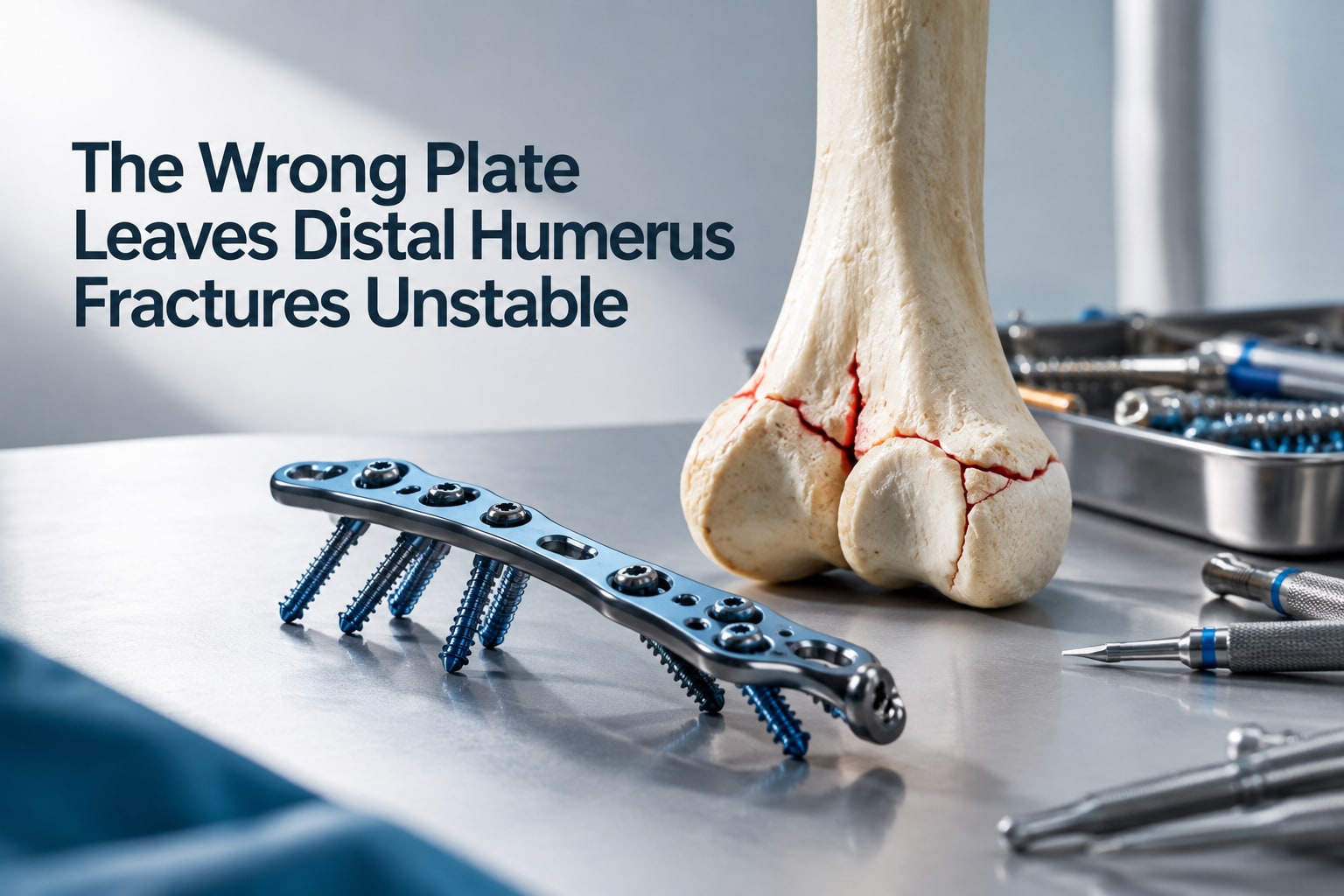
The key choice is not whether one plate is universally stronger: it is whether the implant can capture the fracture’s distal fragments, restore the articular block and preserve alignment in the patient’s bone. By the end, you will be able to compare fixed-angle and conventional fixation, match plate geometry to fracture anatomy, identify the main surgical risks and check the documentation needed when sourcing implants in Argentina.
Key takeaways
- Use locking screws when short distal fragments or weak bone threaten screw purchase.
- Choose distal humerus-specific plates for fractures near the elbow joint or across both columns.
- Match medial, lateral, dorsolateral or dual-column coverage to the fracture pattern.
- Compare screw trajectories, plate fit, documentation and supply support before buying in Argentina.
How fixed-angle locking differs from conventional plate compression
The mechanical problem is loss of fixation when short distal fragments or weak metaphyseal bone cannot provide reliable screw purchase. A locking distal humerus plate addresses this by making each locking screw engage threads in the plate, so the screw maintains a fixed angle even when the plate is not pressed tightly against bone.
That reduces dependence on plate-to-bone friction and helps preserve alignment after reduction.
| Construct | How stability is created | Mechanical limitation |
|---|---|---|
| Locking plate | Threaded screw heads lock into threaded plate holes, creating a fixed-angle connection | Locking screws do not compress the fracture gap by themselves |
| Standard non-locking plate | Tightening the screw pulls the plate against the cortex; friction between plate and bone shares the load | Stability falls when cortex is comminuted or screw purchase is poor |
A conventional plate can work well in good bone with a simple fracture, where plate compression and an independent lag screw provide the needed stability. It becomes less forgiving when comminution removes a continuous cortical surface or the distal fragments are too short for secure screw purchase.
A useful humerus fracture plate comparison therefore examines more than whether the implant is labelled locking. Check the distal hole trajectories, plate contour, and options for separate lag-screw compression. A locking construct still requires accurate reduction; it preserves the position you create but cannot restore a malpositioned joint surface.
Filling every hole can also create unnecessary rigidity rather than better fixation.
Which fracture patterns justify distal humerus-specific fixation
A locking distal humerus plate is preferable when the fracture leaves short distal fragments, metaphyseal comminution, poor bone quality, or limited cortical purchase. These conditions are common in intercondylar and bicondylar fractures, where fixation must capture an articular block and both columns rather than simply bridge the shaft.
| Pattern | Locking distal humerus plate | When a standard plate may be adequate |
|---|---|---|
| Intercondylar or bicondylar | Multiple convergent or divergent distal screws support the medial and lateral columns | Rarely adequate unless fragments are large, reducible and supported by independent lag screws |
| Supracondylar with short distal segment | Fixed-angle screws preserve alignment despite weak distal purchase | Adequate with good bone, sufficient distal length and reliable screw purchase |
| Capitellar or trochlear fragment | Distal trajectories help capture small articular fragments | A conventional plate may work when lag screws obtain stable independent fixation |
| Extra-articular distal fracture | Useful with metaphyseal comminution or osteoporotic bone | Conventional compression and lag-screw techniques can work for a simple fracture with intact cortices |
A standard plate is therefore not defined by its shaft length alone. If it cannot place enough screws into both columns, it may leave the distal segment unstable even when the plate fits the humerus. For an unstable intra-articular pattern, compare parallel and orthogonal dual-column constructs; evidence does not establish one orientation as universally superior.
Choose the arrangement that captures the reconstructed columns without excessive prominence or conflict with the ulnar-nerve corridor.
Choosing medial, lateral, dorsolateral or dual-column coverage
Radiographs and CT scans should determine plate position by showing which column is intact, comminuted, displaced, or lacking screw purchase. AP and lateral views reveal alignment and column continuity; CT defines the articular block, capitellum, trochlea, fracture lines, and the distal bone available for screw capture.
| Option | Imaging finding | Construct implication |
|---|---|---|
| Medial | Medial-column fracture, distal medial comminution, or loss of medial support | Add medial fixation; check plate contour, prominence, and the ulnar-nerve corridor during exposure. |
| Lateral | Predominantly lateral-column or capitellar fracture with a stable medial column | Use lateral support when distal lateral fragments accept sufficiently long, well-directed screws. |
| Dorsolateral | Posterolateral or capitellar fragments needing a posterior-to-anterior trajectory | Choose a dorsolateral plate only when its screw paths capture the fragments without entering the joint. |
| Dual-column | Bicondylar, intercondylar, or both-column metaphyseal disruption | Use a locking distal humerus plate construct with separate medial and lateral fixation, often in parallel or orthogonal orientation. |
CT should confirm whether distal screws can converge or diverge into the articular block without colliding, and whether an independent lag screw is needed for compression. Do not select a single lateral plate simply because the shaft looks intact on an X-ray; an unrecognised medial-column gap can leave the construct unstable.
Parallel plates can align with the columns and provide useful distal screw trajectories; orthogonal plates can address fragments that a parallel arrangement misses. Reviews have not shown one orientation to be consistently superior, so choose the arrangement that captures the CT-defined fragments while preserving ulnar-nerve clearance and avoiding excessive prominence.
Fit, screw trajectory and the complications that checks must prevent
A plate can be long enough for the shaft yet fail to capture the distal fragments. Safe fit depends on distal hole count, convergent or divergent screw trajectories, plate length and contour, and left- or right-sided availability. The design must address the articular block and both columns, not merely provide holes along the humerus.
In a humerus fracture plate comparison, confirm these points before surgery:
- Distal holes reach the medial and lateral columns without directing screws into the ulnohumeral or radiocapitellar joints.
- The plate offers sufficient length and contour for the patient’s anatomy, with manageable medial-column prominence.
- The system accepts the planned locking and compression screws, dedicated drill guides and compatible instruments.
- Independent lag screws are available when the fracture requires interfragmentary compression.
- The surgical technique identifies bone-quality limits, supported fracture patterns and the correct screw lengths.
- Radiographs show the plate and screws clearly enough for intraoperative and postoperative assessment.
Use CT to map the articular block, metaphyseal comminution and each column’s available bone corridor. Plan exposure around the ulnar nerve; a prominent medial plate or a distal trajectory crossing its corridor can cause neuropathy. Measure every screw, then check it in orthogonal and oblique fluoroscopic views.
A screw that looks safe on the anteroposterior image can penetrate the joint on the lateral view. These checks prevent intra-articular screws, loss of distal purchase, nerve irritation, stiffness from malalignment, and fixation failure.
What Argentine buyers should compare before selecting an implant system
Ask for a device-specific technical file, not only a catalogue, and verify its ANMAT status before comparing quotes. A locking distal humerus plate comparison in Argentina is incomplete if it compares “locking” and material but ignores fragment capture, screw paths, and intended use.
Request these records from each supplier:
- Surgical technique guide showing distal hole trajectories, medial-column coverage, compression options, lag-screw use, and parallel or orthogonal dual-column applications.
- Technical drawing stating plate length, contour, hole count, left/right configuration, screw diameters, locking and compression-hole compatibility, and radiographic markers.
- Material and biocompatibility documentation identifying titanium alloy or stainless-steel grade, sterilisation status, and any applicable mechanical or fatigue testing.
- ISO 13485 certificate for the manufacturer and ISO 14971 risk-management evidence. These support quality-system comparison; neither proves Argentine registration or clinical equivalence.
- ANMAT registration or authorization identifying the product, intended use, model or reference number, and traceability details, plus proof that the Argentine importer or responsible establishment is authorised.
| Document type | What to compare | What a gap means |
|---|---|---|
| Technical file | Screw trajectory, contour, independent lag-screw option, and surgical indications | The plate may not capture distal or articular fragments safely |
| Quality records | Manufacturer identity, ISO 13485, ISO 14971, material and testing records | Quality claims cannot be tied to the supplied implant |
| Regulatory file | ANMAT status, reference number, importer and lot traceability | The device may not be authorised for sale in Argentina |
For a distal humerus plate manufacturer in Argentina, ask for revision-controlled documents matching the supplied reference. Komal Health Care Pvt Ltd can be evaluated by the same checklist when a distributor compares orthopedic humerus implants in Argentina.
Related products
 | Orthopedic Implants Locking Distal Humerus Plate , DorsoLateral We Are Manufacturer Locking Distal Humerus Plate , DorsoLateral . Sizes is done From 3 Hole To 14 Hole , Difference of 1 hole in Left & Right Sides . View product → |
 | Orthopedic Implants Locking Distal Humrus Plate . DorsoLateral With lateral Support We Are Manufacturer Of Locking distal Humrus Plate , DorsoLateral With lateral Support . Size Is From 3 Hole To 14 Holes & 1 Hole Difference . View product → |
Frequently asked questions
How does fixed-angle locking differ from conventional plate compression?
Locking screws thread into the plate and maintain a fixed angle without requiring the plate to press tightly against bone. Conventional screws rely on plate-to-bone compression and friction.
Which fractures justify a distal humerus-specific plate?
Use a distal humerus-specific system when the fracture leaves short distal fragments, involves the articular region, compromises one or both columns, or affects weak metaphyseal bone.
How do you choose medial, lateral, dorsolateral or dual-column coverage?
Base coverage on the involved column, fragment location, fracture extension and the stability required. Dual-column constructs address fractures affecting both medial and lateral columns.
What checks help prevent complications with a locking distal humerus plate?
Check plate fit, screw length, thread engagement, screw trajectory and joint clearance. Confirm that screws do not enter the articular surface or obstruct opposing fixation.
What should Argentine buyers compare before selecting an implant system?
Compare implant dimensions, alloy and finish, locking compatibility, instrument completeness, traceability documents, regulatory documentation, delivery terms and local technical support.
Related product
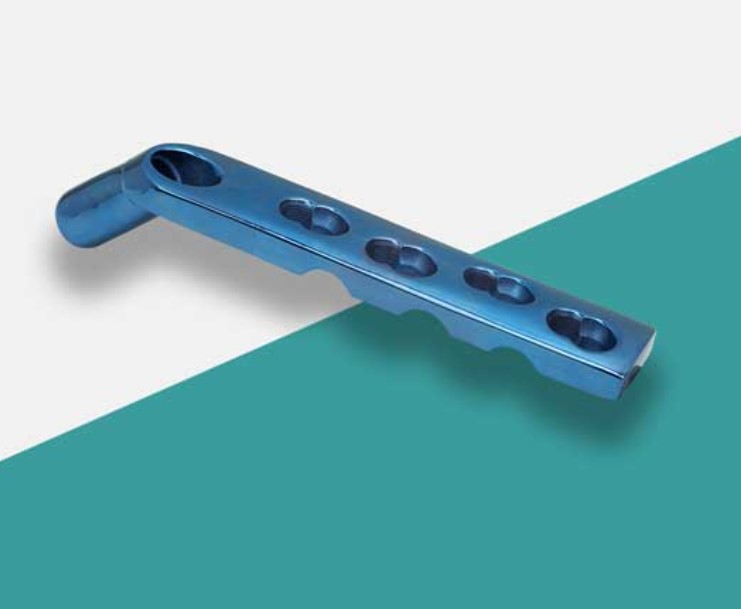 | Bone Plate Dhs Locking Plate Manufacturer DHS (Dynamic Hip Screw) locking plate manufacturers produce specialized orthopedic implants used in the surgical treatment of proximal femur... View product → |