Distal humerus fractures leave a small articular block, separated medial and lateral columns, and little room for secure screw purchase. By the end, you will be able to match locking fixation to fracture morphology, judge when a dorsolateral or dual-column construct is appropriate, and verify the implant, instruments, and evidence before surgery or procurement.
Key takeaways
- Use locking fixation for short distal fragments, metaphyseal bone, or osteoporosis.
- Match plate contour to the distal humerus before selecting screw lengths and trajectories.
- Protect early elbow motion; locking fixation does not permit unrestricted loading.
- Compare locking plates with nonlocking screws, dual plating, or replacement when fixation is unsuitable.
Which elbow fracture patterns benefit from locking fixation?
Locking distal humerus plates are most valuable when short distal fragments, metaphyseal bone, or osteoporosis leave conventional screws with limited purchase. Locking screws create a fixed-angle connection that resists toggle and plate lift-off, helping preserve reduction under load. These elbow fracture plate benefits support early protected elbow motion, not unrestricted use.
| Pattern | How locking fixation is used | Main concern |
|---|---|---|
| Intra-articular | Supports reconstructed capitellar or trochlear fragments after reduction and lag-screw compression | The plate cannot correct anatomic incongruity |
| Supracondylar | Bridges metaphyseal comminution and stabilizes the distal segment | Capture and spread enough distal screws |
| Intercondylar | Supports a reduced articular block while medial and lateral columns are rebuilt | One plate may not control separated columns |
| Column | Reinforces a lateral, medial, or both-column reconstruction | Dual-column fixation may be necessary |
| Comminuted | Provides fixed-angle bridging where individual fragments cannot accept reliable compression | Excessive stiffness can impair healing |
Locking fixation does not replace anatomic reduction, interfragmentary compression, lag screws, or adequate reconstruction of both columns. Use lag screws or eccentric conventional screws when a reconstructible articular or metaphyseal line requires compression; use the plate as fixed-angle neutralization or bridging support.
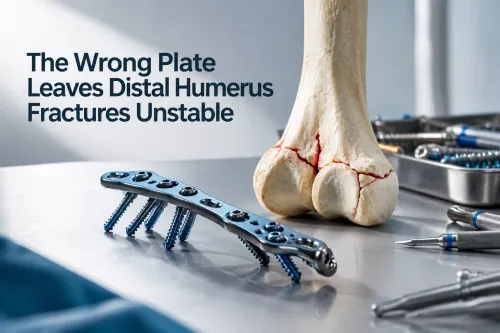
The trade-off is substantial. Stability can enable protected motion, but stiffness, nonunion, malunion, infection, heterotopic ossification, ulnar neuropathy, hardware irritation, screw penetration, and implant failure remain possible. Inadequate distal purchase, poor reduction, or screws that fail to capture both columns can cause loss of fixation despite an intact locking mechanism.
How do locking screws change the fixation construct?
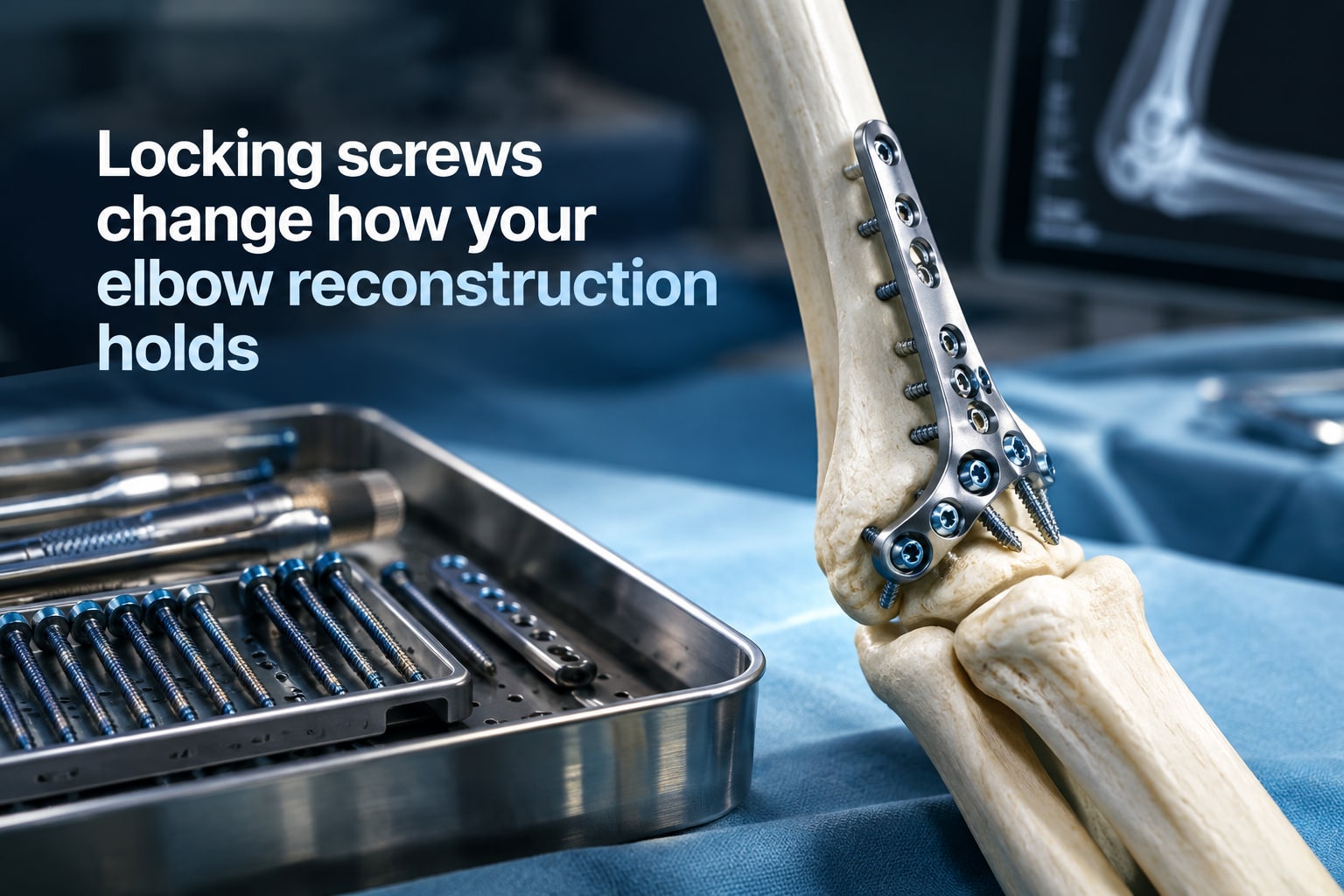
Locking-screw threads engage matching threads in the plate hole, creating a fixed-angle plate-screw relationship. Conventional compression plating depends more on screw purchase and pulling the plate tightly against bone. In weak metaphyseal or osteoporotic bone, the locked interface reduces screw toggle and plate lift-off. It does not automatically compress a fracture.
| Construct | Mechanical role | Appropriate use |
|---|---|---|
| Lag screw or eccentric conventional screw | Compresses an interfragmentary line | Reconstructible articular or metaphyseal fractures |
| Locking plate | Provides fixed-angle neutralization or bridging | Short distal fragments, comminution, or poor bone purchase |
| Hybrid construct | Combines compression with fixed-angle support | Lag screws or eccentric screws plus locking fixation when reduction permits |
A single dorsolateral plate can support the lateral column and distal articular block when fracture morphology, distal screw spread, and available bicortical or divergent purchase provide adequate control. Medial-and-lateral dual-column plating is more appropriate when columns are separated or one plate cannot capture the distal block.
Parallel plates place the implants on similar planes; orthogonal plates use roughly perpendicular planes. Neither configuration is universally superior.
Choose based on column separation, comminution, bone quality, fragment size, and the surgeon’s ability to obtain long, well-spread distal fixation—not on the locking feature alone. Variable-angle systems can direct screws around the joint, but verify every trajectory and length directly or with fluoroscopy; a locking screw can still penetrate the capitellum or trochlea.
These are the practical locking distal humerus plate benefits in buenos aires; a search for distal humerus plate argentina options should still focus on construct mechanics, not the label.
How should you assess plate fit and choose the screw pattern?
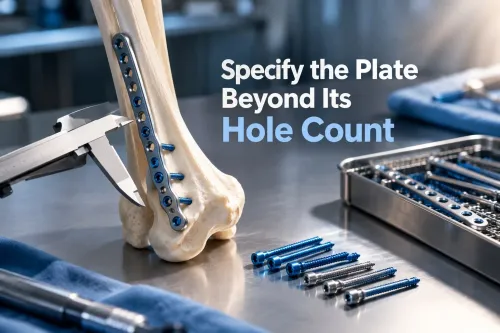
Plate fit starts with the fracture, not the catalogue’s 3-to-14-hole range. Match left or right orientation to the patient, then assess distal humerus anatomy, column alignment, capitellum, trochlea, olecranon fossa, and ulnar-nerve course. Choose a length that spans the fracture without creating an abrupt stress concentration.
- Map every distal screw trajectory and length with direct or fluoroscopic views. Confirm capitellar and trochlear fragment capture, olecranon-fossa clearance, and no joint penetration.
- Add lateral support when small lateral-column, capitellar, trochlear, or distal articular fragments lie outside a standard lateral plate’s control. The extension must capture useful bone, not merely add metal.
- Relate hole count and configuration to fracture length, comminution, bone quality, planned exposure, and the need for dense, widely spread distal screws. A longer plate and fewer working holes can reduce stress concentration; short plates can fail at the fracture.
- Avoid wrong-side selection, inadequate distal purchase, missed column capture, and over-contouring a locking plate. Reduction remains the surgeon’s task; the implant cannot replace anatomic reconstruction.
| Construct choice | Planning priority | Main risk if mismatched |
|---|---|---|
| Single dorsolateral | Lateral column and accessible distal purchase | Medial column remains unsupported |
| Lateral support | Small lateral or articular fragments | Screws miss viable bone |
| Dual-column | Separated columns or severe comminution | More exposure and soft-tissue burden |
| Dense distal spread | Short or osteoporotic fragments | Pullout, loosening, or loss of reduction |
For a “distal humerus plate argentina” search, compare radiographic fit and screw options, not hole count alone.
When is locking plating the wrong choice, and what alternatives should you compare?
Locking plating is a poor choice when the fracture cannot support stable fixation, bone loss prevents meaningful screw purchase, or infection is present. It is also the wrong reconstruction when patient age, bone quality, low functional demand, fracture destruction, or inability to comply with rehabilitation makes total elbow arthroplasty more appropriate.
Elbow fracture plate benefits disappear when fixation cannot support healing and protected motion.
| Option | Main strength | Compare when |
|---|---|---|
| Non-locking or precontoured conventional plate | Compression and contour-based fixation | Use when screw purchase and reconstructible fragments permit compression; it may offer simpler, lower-cost instrumentation |
| Intramedullary device | Load-sharing alignment | Compare for selected extra-articular patterns; it offers less direct control of small articular fragments |
| External fixation | Damage-control or infection-compatible stability | Compare with severe soft-tissue injury, contamination, or staged reconstruction |
| Total elbow arthroplasty | Immediate joint reconstruction | Compare when fixation is not durable or patient and fracture factors favour arthroplasty |
| Titanium versus stainless steel | Titanium is lighter and creates less imaging artefact; stainless steel is stiffer and often less costly | Check instrument compatibility, cost, stiffness needs, and galvanic compatibility when dissimilar metals meet |
Do not infer performance from the material label. Confirm plate dimensions, thickness, hole geometry, bendability, locking mode, screw diameters and lengths, drill guides, radii, surface finish, mechanical testing, biocompatibility records, sterilisation status, and packaging.
Read clinical evidence for fracture-pattern details, union and reoperation rates, elbow range of motion, complications, follow-up duration, and comparison groups. A product claim without those details is not proof.
What should hospitals verify before buying a distal humerus plate?
A procurement file should prove more than a plate’s shape. For teams assessing locking distal humerus plate benefits in Buenos Aires, ask every humerus locking plate supplier or distal humerus implant manufacturer for evidence you can match to the exact catalogue number.
1. Record the legal manufacturer, manufacturing site, authorised representative, ISO 13485 certificate scope and validity, ANMAT registration or other Argentine regulatory documentation, and certificate of conformity.
2. Request material grade, dimensions, hole geometry, locking mode, screw diameters and lengths, variable-angle range, design drawings, mechanical-test reports, biocompatibility records, inspection records, and radiographic documentation.
3. Require lot and serial traceability, batch-release records, complaint handling, post-market surveillance contact, recall procedure, and named technical support. Komal Health Care Pvt Ltd should be evaluated against this same evidence-based file, not by name or certificate alone.
4. Obtain written compatibility confirmation for the plate, locking screws, drill guides, targeting instruments, and variable-angle system. A mismatched guide can produce a wrong trajectory or joint penetration.
5. Confirm whether each item is sterile or non-sterile; if sterile, record the method, packaging integrity controls, and expiry date. If non-sterile, obtain hospital reprocessing instructions, including validated sterilisation parameters.
6. Put lead time, minimum order quantity, replacement policy, local availability, and delivery responsibility in writing. Do not assume listed sizes are stocked in Argentina. Documentation does not establish superior clinical performance.
Related products
 | Orthopedic Implants Locking Distal Humerus Plate , DorsoLateral We Are Manufacturer Locking Distal Humerus Plate , DorsoLateral . Sizes is done From 3 Hole To 14 Hole , Difference of 1 hole in Left & Right Sides . View product → |
 | Orthopedic Implants Locking Distal Humrus Plate . DorsoLateral With lateral Support We Are Manufacturer Of Locking distal Humrus Plate , DorsoLateral With lateral Support . Size Is From 3 Hole To 14 Holes & 1 Hole Difference . View product → |
Frequently asked questions
Which elbow fracture patterns benefit from locking fixation?
Locking fixation helps complex intra-articular fractures, short distal fragments, metaphyseal comminution, and osteoporotic bone where conventional screw purchase is limited.
How do locking screws change the fixation construct?
Locking screws thread into the plate to create a fixed-angle connection, reducing screw toggle and plate lift-off while preserving the planned reduction.
How should you assess plate fit and choose the screw pattern?
Check medial and lateral column contour, distal fragment coverage, joint clearance, screw length, and intended screw trajectories before final fixation.
When is locking plating the wrong choice?
Compare alternatives when the plate cannot fit the anatomy, fragments cannot support screws, infection is present, or reconstruction requires arthroplasty or another fixation strategy.
What should hospitals verify before buying a distal humerus plate?
Verify implant dimensions, left-right and medial-lateral options, screw compatibility, material, sterilisation status, traceability documents, regulatory authorization, and instrument availability.