A hospital cannot procure a suitable implant by asking for a “locking plate” or by comparing hole counts alone. By the end, you will have a measurable specification for the plate, screws, instruments, fit checks, documentation, and supplier records needed to compare systems safely in Buenos Aires.
Key takeaways
- Request overall length, width, thickness, hole spacing, and cluster dimensions.
- Match distal screw options to fracture location and bone quality.
- Confirm left-right fit and plate contour before sterilisation and fixation.
- Check batch traceability, technical documents, and Argentine supplier records.
Specify the plate as a measurable implant, not a hole-count label
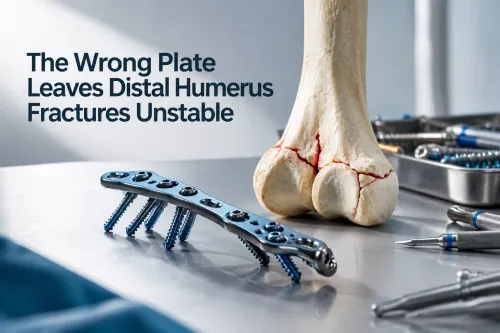
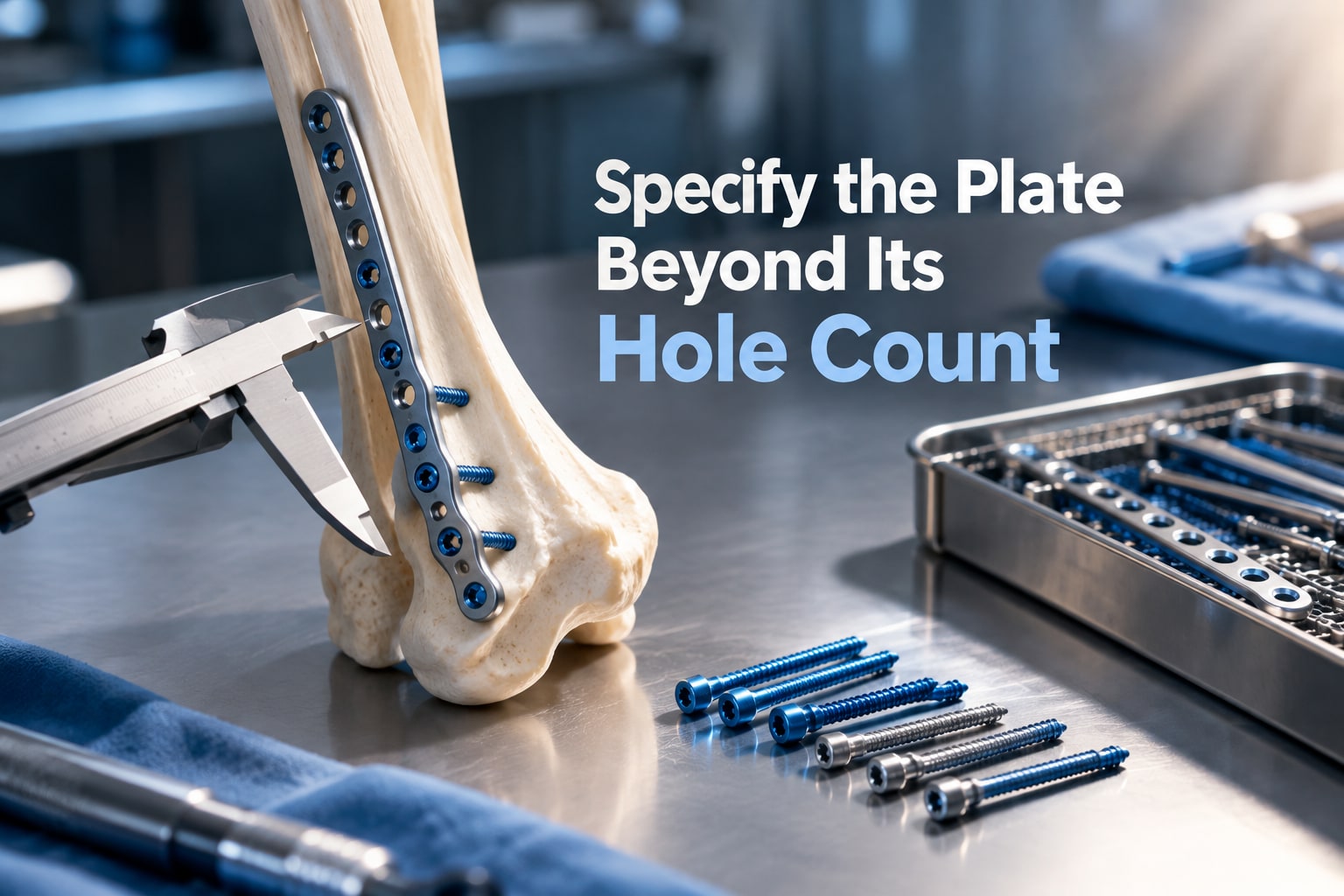
Request a left- or right-sided anatomical plate with measured dimensions, not simply a “six-hole” or “small” label. Lateral distal fibula plate sizes must state overall length in millimetres, shaft-hole count and spacing, distal-cluster dimensions, plate width, and plate thickness.
Hole count alone cannot identify the implant: two plates with six shaft holes can have different lengths and spacing.
For lateral distal fibula locking plate specifications in Buenos Aires, put these fields in the comparison sheet:
- Manufacturer, catalogue or reference number, side, material, sterile or non-sterile supply status, and single-use designation.
- Overall plate length, width, thickness, minimum usable distal fragment length, and a drawing showing the distal screw trajectories.
- Number and position of distal holes; fixed-angle or variable-angle design; the permitted angular range for variable-angle holes.
- Shaft-hole type: combination, round locking, or dynamic-compression; accepted screw diameter and whether each hole accepts cortical, cancellous, locking, or compression screws.
- Compatible screw diameters and lengths, including the locking-head design. A system using 2.7 mm distal screws and 3.5 mm shaft screws must state that pairing explicitly; do not substitute a nominally similar screw from another system.
- Instrument set required for drilling, depth measurement, tapping, insertion, and removal, plus the manufacturer’s compatibility matrix.
Record the plate reference and side on the purchase order. A generic straight plate is not an equivalent substitute for a contoured left or right distal fibula design.
Define the distal cluster, shaft holes, and compatible screws
A hole count is incomplete without the hole’s function, diameter, and position. A complete fibula locking plate hole configuration identifies the fixation system, left- or right-sided design, plate length, distal cluster, shaft section, material, sterile status, and compatible instrumentation.
Specify the distal cluster in measurable terms:
- Number and position of distal holes, including threaded fixed-angle or variable-angle design.
- For variable-angle holes, the permitted angular range in degrees and the approved screw trajectory.
- Screw diameter accepted in each distal hole, plus the available locking screw lengths and thread type.
- Number and position of shaft holes, identified as combination, round locking, or dynamic-compression holes.
- Whether each shaft hole accepts cortical, cancellous, locking, or nonlocking screws, and the diameter accepted by that hole.
A common system uses 2.7-mm locking screws in the distal cluster and 3.5-mm screws in the shaft, but this is not universal. Require the manufacturer’s plate-and-screw compatibility matrix; a similar-looking screw from another system is not an approved substitute.
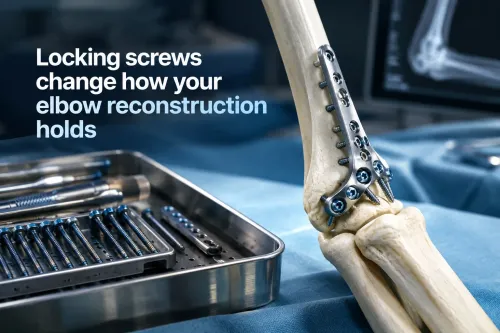
Do not label every threaded hole as a compression feature. A locking screw fixes to the plate but does not normally compress the fracture; compression requires a lag screw, a compression portion of a combination hole, or an independent technique.
Request the exact screw-length range, material, sterile supply status, and instrumentation needed to drill, measure, insert, and remove every listed screw.
Match the construct to fracture pattern and bone quality
A lateral locking plate is preferable when the distal fragment is short, comminuted, or osteoporotic and needs multiple fixed-angle purchase points. It is also useful for Weber C fractures requiring a longer bridge construct and for syndesmotic injuries when the plate leaves room for independent syndesmotic fixation.
| Option | Best fracture or bone condition | Why choose it | Main limitation |
|---|---|---|---|
| Lateral locking plate | Comminuted Weber B, Weber C, syndesmotic injury, or osteoporotic bone | A distal cluster with divergent locking trajectories supports a short or weak distal fragment; a longer plate can bridge comminution and accommodate syndesmotic screws | Locking screws do not compress the fracture; add a lag screw, compression hole, or independent compression technique |
| Hook plate | Small distal avulsion fragment or very distal fracture with limited screw purchase | Hooks capture the malleolar tip when ordinary distal screws cannot obtain adequate fixation | Hooks do not replace restoration of fibular length or stability in a long, comminuted, or proximal fracture |
| Lag screw plus neutralization plate | Simple oblique or spiral Weber B fracture with good bone contact | The lag screw provides interfragmentary compression while the plate protects it from bending and rotation | Poor choice when comminution prevents compression or bone cannot hold the lag screw |
| One-third tubular plate | Simple, well-reduced fracture with good bone quality and adequate distal fragment | Low-profile fixation can suffice when several locking trajectories are unnecessary | Offers fewer fixed-angle options and less resistance to pullout in osteoporotic or short distal bone |
Do not select a locking plate solely because it has many holes. Confirm the minimum usable distal fragment length, screw trajectories, and a construct that restores fibular length; add syndesmotic fixation when instability remains after reduction.
Choose plate length and confirm fit before fixation
Select the shortest lateral distal fibula plate that spans the fracture, leaves usable fixation above and below it, and does not place the proximal end beneath an irritated tendon.
Request lateral distal fibula plate sizes by overall length, shaft-hole count, distal-hole count, width, and thickness; hole count alone cannot predict length because spacing differs between designs.
- Confirm the implant is specifically left- or right-sided. Place the trial plate on the correct fibula and check its distal cluster against the lateral malleolus under fluoroscopy; a straight or opposite-sided plate is not an equivalent substitute.
- Check that the plate contour follows the lateral fibula without rocking, gapping, or excessive prominence. Do not force a mismatched contour into position, because it can displace the fracture or irritate the peroneal tendons.
- Overlay every planned screw trajectory on fluoroscopic views. Confirm distal screws remain in bone, avoid the ankle joint, and use the system’s stated diameter and angular range; obtain the manufacturer’s compatibility matrix rather than mixing nominally similar screws.
- For a syndesmotic injury, reserve a clear corridor for the planned syndesmotic screw or suture-button pathway and confirm it will not collide with distal locking screws.
- Assess the incision line and tendon coverage after provisional fixation. Reject a length or contour that leaves a prominent plate under thin skin.
| Check | Accept | Reject |
|---|---|---|
| Length | Fixation beyond the fracture with soft-tissue coverage | Unused prominence or inadequate purchase |
| Laterality | Correct left/right contour on fluoroscopy | Opposite or generic plate |
| Trajectories | Joint-free, bone-contained paths | Collision or joint penetration |
Turn the specification into an Argentine procurement and supplier check
A quotation for lateral distal fibula locking plate specifications in buenos aires is incomplete unless it identifies the exact fixation system, left or right side, plate length or hole count, screw diameters, material grade, sterile presentation, and compatible instruments. Require the following evidence before evaluation.
| Evidence to request | What it must identify | Procurement consequence |
|---|---|---|
| ANMAT file | Device family, intended use, registration number, local holder or importer, and approved label | Reject an unregistered or mismatched family |
| Manufacturer record | Legal manufacturer, full address, manufacturing country, and certificate of origin | Do not treat “distal fibula plate manufacturer argentina” as proof of local manufacture |
| Material and testing | Titanium or stainless-steel alloy designation, lot traceability, fatigue or mechanical test report, and applicable biocompatibility evidence such as ISO 10993 | Reject unnamed metal or unsupported performance claims |
| Sterility and instruments | Sterile or non-sterile status, packaging, sterilization method, single-use statement, reprocessing instructions, and instrument compatibility | Do not assume resterilization or universal guides |
The technical file must include the compatibility matrix: distal fixed-angle or variable-angle holes, permitted angular range, accepted screw diameter in each hole, shaft hole type, screw-length range, and instrument catalogue numbers. Require the surgical technique and confirm that trial plates, drill guides, depth gauges, drivers, and torque-limiting handles are available locally.
Komal Health Care Pvt Ltd should be assessed by the same dossier standard: separate its legal manufacturer details from any Argentine registration holder, importer, and distributor, then match every catalogue number on the quotation to the ANMAT documentation.
Frequently asked questions
What measurements should a lateral distal fibula locking plate specification include?
Request overall length in millimetres, plate width, plate thickness, shaft-hole count and spacing, distal-cluster dimensions, laterality, and the available screw sizes.
What should you check in the fibula locking plate hole configuration?
Check the number and spacing of shaft holes, the number and arrangement of distal holes, and whether each hole accepts locking screws, cortical screws, or both.
How do fracture pattern and bone quality affect plate selection?
Use the distal cluster to support short distal fragments, select enough shaft fixation for the fracture zone, and confirm screw options for osteoporotic or poor-quality bone.
How can you confirm that a lateral distal fibula plate will fit?
Compare the left or right contour with imaging and the exposed fibula, then verify plate length, distal position, screw trajectories, and clearance before fixation.
What should an Argentine hospital request from a supplier?
Request a dimensional drawing, material and screw specifications, sterilisation and packaging details, lot traceability, instructions for use, and the supplier documents required for procurement in Argentina.