Choosing between paraffin gauze and plain gauze depends on what the wound needs first: protection from sticking or direct absorption of fluid. By comparing construction, exudate handling, dressing changes, clinical limitations and purchasing criteria, you can select the right dressing system rather than judging two products by unit price alone.
Key takeaways
- Use paraffin gauze when minimising wound-bed adhesion matters.
- Choose absorbent secondary layers for wounds producing moderate or heavy fluid.
- Wet or loosen stuck gauze before removal; do not pull it dry.
- Compare the full dressing system, including contact layer, cover and change routine.
How Paraffin Gauze Differs from Plain Gauze
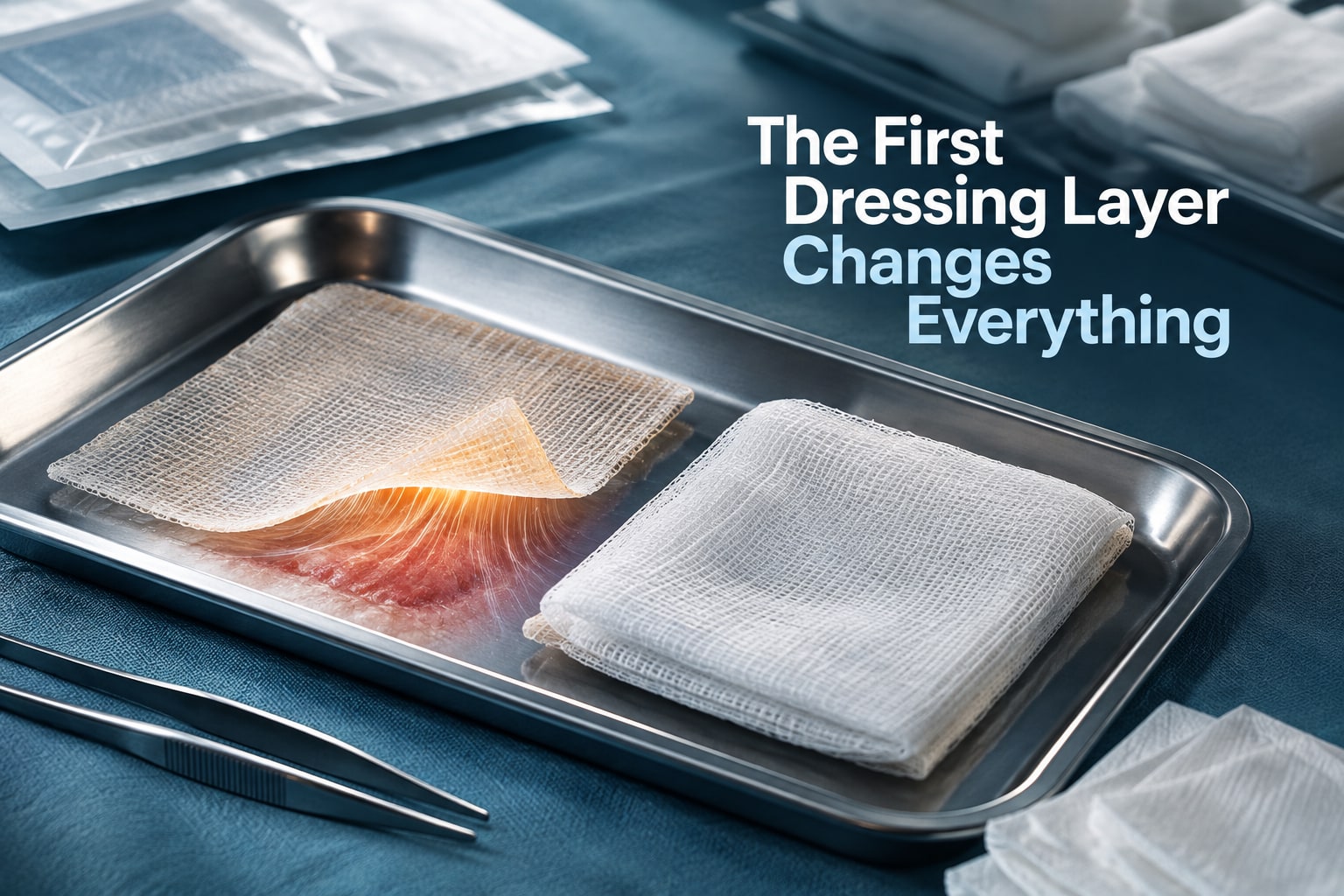
Replacing dry standard gauze with paraffin gauze changes the wound-facing surface from absorbent fibres to a lubricated contact layer. The open-weave gauze carries soft paraffin, which limits direct bonding between drying exudate and the wound bed; plain gauze has no such barrier and can stick as fluid dries.
Paraffin gauze versus gauze
| Feature | Paraffin gauze | Dry standard gauze |
|---|---|---|
| Wound contact | Smooth, paraffin-coated contact layer | Bare fibres touch the wound |
| Primary function | Protects the wound while limiting adherence | Absorbs fluid, protects or provides padding |
| Fluid handling | Passes exudate through to a secondary layer | Holds more fluid within its fibres |
| Removal | Usually causes less disruption to fragile granulation tissue | Dried exudate can pull tissue and increase pain |
| Complete system | Needs an absorbent pad over it and fixation | Can serve as the absorbent layer or sit over another dressing |
A fair non adherent dressing comparison therefore includes the added secondary pad, fixation, change interval and cost per completed change—not just the price of one sheet. Paraffin gauze is not an antimicrobial dressing unless the product contains a separately identified antiseptic or antimicrobial agent.
“Non-adherent” does not mean “never sticks.” Dried exudate can bind through the mesh or at the edges if the outer pad becomes saturated or the dressing stays on beyond its instructions.
Follow the product directions and clinical assessment when removing it; moistening or saturating the dressing may reduce trauma, but it does not replace proper wound review.
Choose the Dressing According to Wound Fluid and Surface
Choose paraffin gauze when the wound surface is superficial, denuded or fragile and preventing adhesion matters more than absorbing fluid. It suits superficial burns, abrasions, skin-graft donor sites, grafts and shallow wounds with low to modest exudate.
| Option | Surface and fluid | Suitable use |
|---|---|---|
| Paraffin gauze | Soft, open-weave contact layer; little useful absorbency | Fragile wound beds where dried exudate could bond to fibres |
| Plain absorbent gauze | Dry fibres that absorb and provide protection or padding | Wounds needing direct fluid uptake, especially with moderate exudate |
| Paraffin gauze plus absorbent pad | Non-adherent contact layer with a separate fluid-collecting layer | Superficial wounds that need surface protection and more absorption |
The practical advantage in a paraffin gauze versus gauze decision is easier removal. The paraffin limits direct bonding between dried exudate and the wound, while dry gauze can adhere as fluid dries and disturb new epithelium or fragile granulation tissue.
Do not use plain paraffin gauze alone on a moderately or heavily exuding wound. Fluid can remain against the wound, leak through the dressing and macerate surrounding skin; place a suitable secondary absorbent pad over it instead.
Plain absorbent gauze is the better choice when you need direct absorption, pressure, padding or support for bleeding control. Paraffin gauze is also the wrong choice when the wound requires a haemostatic, pressure-relieving, high-absorbency or antimicrobial dressing; paraffin itself does not provide antibacterial activity.
How to Apply, Cover and Remove Paraffin Gauze
Place paraffin gauze directly on the wound in a single layer, then cover it with an absorbent secondary dressing. Used alone, it can leave exudate pooled against the wound and wet the surrounding skin.
1. Clean your hands and inspect the wound. Follow the prescribed cleansing method, and remove loose exudate without scraping the wound bed.
2. Select a piece that covers the denuded surface without folding or packing it into a cavity. Lay it flat with gentle contact; do not press it into fragile granulation tissue.
3. Add a secondary absorbent pad large enough for the expected fluid. Keep the pad dry at application, and secure it to surrounding intact skin without placing adhesive on the wound.
4. Check the pad for saturation, leakage and wet surrounding skin. Change the outer dressing when it is saturated or when the product instructions and clinical assessment call for a change; leaving it too long lets dried exudate bind through the mesh.
5. Remove fixation and lift off the secondary pad slowly. If the paraffin layer resists, moisten or saturate it with the compatible solution specified in the product instructions, allow time for softening, then ease it away rather than pulling.
A paraffin layer can still stick at its edges or through dried exudate. A useful non adherent dressing comparison therefore includes removal pain, fluid handling, fixation, lint release and the complete cost of each dressing change—not the price of one sheet alone.
Compare the Complete Dressing System, Not One Sheet
A fair purchase compares the cost and performance of one completed dressing change, not one sheet. Include the contact layer, secondary absorbent pad, fixation, staff time, replacement frequency, removal discomfort and waste.
A cheap dry gauze sheet can become the costlier option if it sticks to the wound or requires extra layers and more frequent changes.
| Factor | Paraffin gauze system | Plain gauze system |
|---|---|---|
| Contact layer | Low-adherence surface; assess pain, fibre release and wound-bed disturbance at removal | Absorbent surface; assess sticking, lint and trauma when dry |
| Exudate control | Usually needs a separate absorbent pad; replace if saturated or displaced | May absorb directly, but can adhere as fluid dries |
| Fixation and labour | Add fixation and count the time needed to assemble layers | May need less assembly, depending on drainage and site |
| Completed-change cost | Contact layer, secondary pad, fixation and disposal | Gauze, fixation and disposal |
| Change interval | Follow the product instructions; do not promise seven days for every wound | Set by saturation, contamination, adherence and clinical assessment |
Record the number of layers, dressing-change minutes and rejected or wasted packs during a ward trial. Compare pain scores and bleeding at removal, not just acquisition price.
For a paraffin gauze dressing comparison argentina procurement file, verify sterile single-use packaging, seal integrity, lot traceability, expiry, instructions and ANMAT authorization information.
A surgical dressing distributor argentina, including Komal Health Care Pvt Ltd, should be assessed on those documents and on whether its plain paraffin product is clearly distinguished from chlorhexidine or other antimicrobial dressings.
Related products
 | Dressings Paraffin Gauze Dressings are used to dress denuded areas and hence these gauze are specially coated with soft paraffin jelly. View product → |
 | Surgical Disposable Our organization manufactures a premium range of Gauze Dressings that includes sterilized and non-sterilized Gauze Swabs, lab sponge and gauze roll. View product → |
What Evidence and Product Checks Should Guide the Decision?
A paraffin gauze supplier argentina review is incomplete without evidence beyond a catalogue. Verify that “non-adherent” describes reduced adherence, not a promise that dried exudate will never stick. Plain paraffin gauze is not antimicrobial, and it is not the correct product for claims about bacterial control unless an antiseptic or antimicrobial agent is separately identified.
Request these documents and checks before purchase:
- ANMAT product registration or authorization details, plus the importer’s or distributor’s current establishment authorization.
- Instructions for use in Spanish, including wound indications, contraindications, application method, removal guidance and maximum wear time.
- Sterile single-use labelling, intact individual packaging, lot number, expiry date and a replacement process for damaged packs.
- Evidence supporting claims about healing, pain, infection prevention, absorbency or seven-day wear. For superficial and partial-thickness burns, comparative evidence remains limited and low or unclear in certainty.
| Check | What to verify | Why it matters |
|---|---|---|
| Product identity | Paraffin-only contact layer or added antimicrobial agent | Antimicrobial claims require separate indications, contraindications and contact-time instructions |
| Fluid handling | Manufacturer’s absorbency limits and required secondary pad | Paraffin gauze does not replace an absorbent dressing for moderate or heavy exudate |
| Removal claim | Instructions for moistening or loosening before removal | Saturated dressings and dried exudate can cause painful adherence |
| Change interval | Clinical conditions requiring earlier replacement | “Up to seven days” is not a universal schedule |
Keep these points in a paraffin gauze dressing comparison argentina procurement file.
Frequently asked questions
How does paraffin gauze differ from plain gauze?
Paraffin gauze has a soft, lubricated wound-facing layer that limits direct bonding as exudate dries. Plain gauze exposes absorbent fibres directly to the wound.
Which dressing suits a wound with heavy fluid?
Use paraffin gauze as the contact layer only when appropriate, then add an absorbent secondary dressing sized for the wound’s fluid output. Plain gauze alone can become saturated and adhere as it dries.
How should you remove paraffin gauze?
Lift the cover first, then remove the paraffin gauze slowly. If it sticks, moisten or loosen it before continuing rather than pulling against the wound.
What should you compare besides the gauze sheet?
Compare the contact layer, absorbent cover, fixation method, change frequency, fluid capacity, package integrity and instructions for use.