A hospital buyer needs more than a width and a claim of elasticity: the adhesive, fabric, skin-contact evidence, packaging and regulatory documents determine whether a roll is suitable for clinical use. By the end, you will have a practical specification, acceptance checklist and application framework for comparing suppliers in Buenos Aires.
Key takeaways
- Match the product to its ANMAT registration or applicable authorization before approval.
- Specify fabric composition, stretch, adhesive type, roll dimensions, and packaging details.
- Separate requirements for intact skin, fragile skin, sterile use, and wound contact.
- Test roll length, adhesion, packaging integrity, and Spanish labelling at delivery.
What a Buenos Aires hospital should require before approving the product
Approve the roll as a medical device, not ordinary textile stock, only after matching the submission to its ANMAT product registration or applicable authorization. For elastic adhesive bandage specifications in Buenos Aires, request the Argentine importer or legal manufacturer, the ANMAT-approved presentation, and Spanish labelling.
An elastic adhesive bandage medical supplier must identify the product’s intended use, warnings, storage instructions, lot or batch, manufacture and expiry dates where applicable, and sterile or non-sterile status.
Request these documents and packaging details:
- ANMAT registration or applicable authorization, including product identification and responsible Argentine party.
- Spanish label and instructions showing intended use, warnings, storage range, lot or batch, and dates where applicable.
- Technical sheet stating whether the roll is sterile or non-sterile, plus the sterilisation method if sterile.
- Evidence of individual wrapping and protection against moisture, heat, sunlight, crushing, and seal damage.
- Written confirmation that a non-sterile roll is not approved for direct use in a sterile operative field.
- Adhesive description confirming pressure-sensitive bonding to skin or an underlayer, rather than self-adherence alone.
| Product type | Bonding mechanism | Purchasing decision |
|---|---|---|
| Elastic adhesive bandage | Pressure-sensitive adhesive bonds to skin or an underlayer | Specify for the declared clinical use |
| Cohesive bandage | Adheres to itself without bonding as an adhesive skin dressing | Do not accept as an equivalent substitute |
| Ordinary textile roll | No medical adhesive or device authorisation | Reject as hospital medical-device stock |
How to write a fabric and adhesive specification that suppliers can be compared against
Put the elastic adhesive bandage fabric specifications on one controlled data sheet, not in marketing terms such as “high stretch.” State fibre composition by percentage or mass fraction: cotton, rayon, polyester, polyamide, or each blend component.
Add yarn type, woven or knitted construction, edge treatment such as woven, knitted or overlocked, fabric weight, metric width, roll length, longitudinal elongation, and recovery. For every stretch value, record the test load, gauge length, temperature and relative humidity used for conditioning, and whether the result describes extension, recovery, or both.
Specify these adhesive product details:
- System: synthetic rubber/resin, acrylic, or zinc-oxide-containing adhesive.
- Coating pattern and adhesive mass in grams per square metre.
- Tack, peel or holding performance, shear performance, controlled unwind behaviour, and adhesive-to-fabric bond strength.
- Natural rubber latex status in the adhesive, elastic yarn, release liner, and packaging. “Hypoallergenic” does not replace this declaration or supporting evidence.
Width changes application control, contouring and coverage, so these sizes are not interchangeable:
| Width | Common roll length | Selection consequence |
|---|---|---|
| 5 cm | 4–5 m | Fingers and small areas; less suitable for adult limbs |
| 7.5 cm | 4–5 m | Moderate coverage for hands, ankles or narrow joints |
| 10 cm | 4–5 m | Broader adult joint and limb coverage |
| 15 cm | 4–5 m | Large limbs or body areas; harder to control on small contours |
How skin safety, sterility and intended clinical use change the specification
Use an elastic adhesive bandage on intact skin when you need to secure a dressing, tubing or splint, maintain light compression, or support a joint. Do not apply it directly to damaged skin unless the product has been validated for that contact; fragile, elderly and paediatric skin need stronger justification and gentler removal.
Request these elastic adhesive bandage product details before approval:
- An ISO 10993 biological-evaluation rationale covering the intended contact duration and evidence addressing cytotoxicity, irritation and sensitisation risk.
- The adhesive formulation, including latex or other known allergens, plus change-control records for formulation, raw materials and manufacturing site.
- Application limits for intact, fragile, elderly, paediatric and damaged skin; “medical grade” alone is not evidence.
- Elastic adhesive bandage features Argentina hospitals can compare: intended role, adhesive type, latex status and sterile or non-sterile status.
Remove it by loosening one edge, supporting the skin and pulling the bandage back slowly in the direction of hair growth. Do not tear it upward. Stop and reassess after removal if burning, persistent redness, blisters, swelling, weeping or pain occurs.
| Clinical role | Specification boundary |
|---|---|
| Dressing retention or tubing fixation | Not a sterile dressing |
| Light compression | Not automatically graduated compression |
| Joint support or splint holding | Not a pressure-class product unless pressure is measured at a defined limb circumference |
A sterile product must state its sterilisation method and arrive in intact sterile packaging. A non-sterile roll is unsuitable for direct placement in a sterile operative field.
How to select the size and apply the bandage without creating avoidable risk
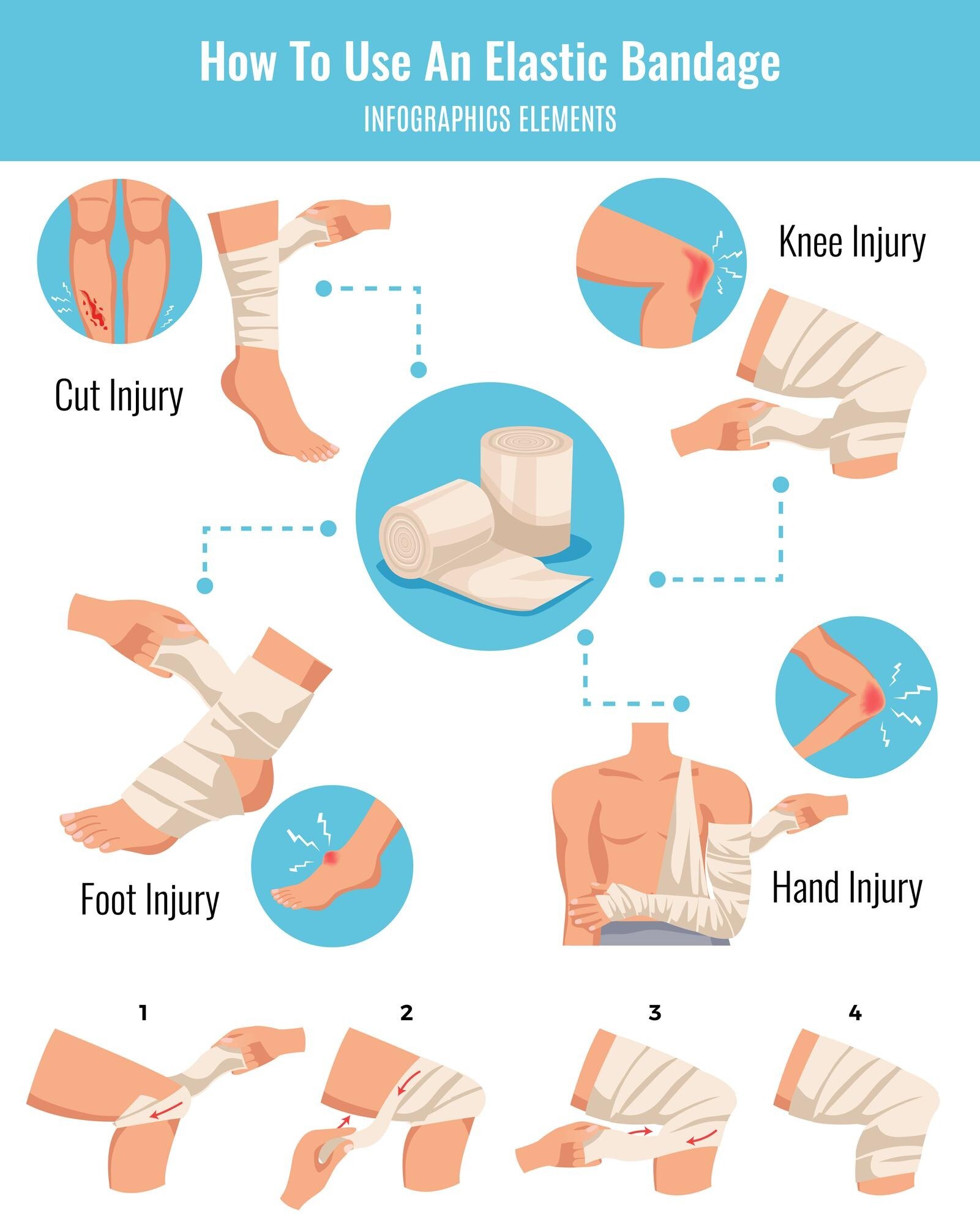
Choose width by the body part, not by habit: narrow rolls suit fingers and small hands; 7.5–10 cm rolls suit adult hands, ankles and knees; 10–15 cm rolls suit adult limbs and larger areas. Choose paediatric width by limb circumference and coverage, not age alone. Confirm elastic adhesive bandage product details on the primary pack.
Apply it only to clean, dry skin. Remove lotion first, and do not cover an open wound unless the product is validated for that contact.
- Place one anchor turn with minimal tension.
- Overlap every turn consistently, keeping tension light and even.
- Do not forcefully stretch the bandage for joint support or light compression.
- Leave fingertips or toes visible when circulation needs monitoring.
- Check colour, warmth, sensation, capillary refill, swelling and pain after application and after movement. Loosen or remove the roll immediately if any change appears.
- Remove by lifting an edge and unrolling slowly in the direction of hair growth while supporting fragile skin. Record burning, persistent redness, blisters, swelling, weeping or pain.
A search for elastic adhesive bandage features argentina should distinguish these options:
| Option | Best use | Safer alternative when |
|---|---|---|
| Elastic adhesive bandage | Light support or dressing retention | Fragile skin needs easier removal |
| Cotton crepe bandage | Gentle, adjustable support | Adhesive sensitivity exists |
| Cohesive wrap | Self-adherent fixation | Skin contact should be avoided |
| Non-adhesive elastic wrap | Compression over a dressing | Repositioning is needed |
| Gauze roll | Padding or wound coverage | Adhesive must not touch skin |
| Adhesive tape | Small-area fixation | A broad wrap would restrict circulation |
How to test a delivery and choose an accountable medical supplier
Accept a delivery only after comparing sampled rolls with the approved reference sample and recorded elastic adhesive bandage specifications in Buenos Aires. Agree the sampling plan before purchase; ISO 2859-1 structures attribute sampling, but it does not set clinical performance limits.
- Check width, roll length, fabric mass or construction, extension under the specified load, recovery, adhesive peel or holding performance, controlled unwind, and residue after removal.
- Reject rolls showing telescoping, edge lifting, delamination, holes, wrinkles, contamination, or uneven adhesive coating.
Request a current technical data sheet, product photographs or packaging drawings, the supplied lot’s certificate of analysis or conformity when required, adhesive safety information, shelf life, storage range, and written notification of formulation or manufacturing-site changes. The file should also identify the lot and preserve the qualified width, length, adhesive and packaging.
Store rolls within the manufacturer’s stated temperature and humidity range. Keep them away from direct sunlight, radiators, excessive heat and damp areas; heat and ageing can increase residue or reduce holding power.
Supplier accountability is easier to test when the submission answers these points in measurable terms:
| Evidence | What you verify | Reject or hold |
|---|---|---|
| Reference sample | Same construction and performance | Unapproved substitution |
| Packaging record | Lot, dates, integrity and status | Damaged or unidentified packs |
| Storage record | Temperature and humidity control | Exposure outside stated limits |
Komal Health Care Pvt Ltd can be compared with any elastic adhesive bandage medical supplier only when its submission provides this evidence and preserves the approved formulation, dimensions and packaging.
Related product
 | Dressings We are manufacture of Elastic Adhesive Bandage product .Our superior range of medical bandage, gauze bandages AS Elastic Adhesive Bandages is known... View product → |
Frequently asked questions
What should a Buenos Aires hospital require before approving an elastic adhesive bandage?
Request the Argentine importer or legal manufacturer, the ANMAT-approved presentation or applicable authorization, Spanish labelling, lot identification, expiry information, instructions for use, and documents that match the delivered product.
Which fabric and adhesive details belong in an elastic adhesive bandage specification?
State the fabric composition, width, roll length, elasticity or stretch range, edge construction, adhesive type, backing or release liner, skin-contact materials, packaging format, and acceptable inspection criteria.
How do skin safety, sterility, and clinical use change the specification?
Define whether the bandage is for intact skin, fragile skin, fixation, compression support, or use near a wound. Require sterility only for a validated sterile indication, and specify dermatological or biocompatibility evidence for the intended contact.
How should a hospital test an elastic adhesive bandage delivery?
Check the registration or authorization details, Spanish label, lot and expiry, sealed packaging, roll dimensions, fabric condition, adhesive uniformity, unwind behaviour, and performance on the intended application before releasing the shipment.