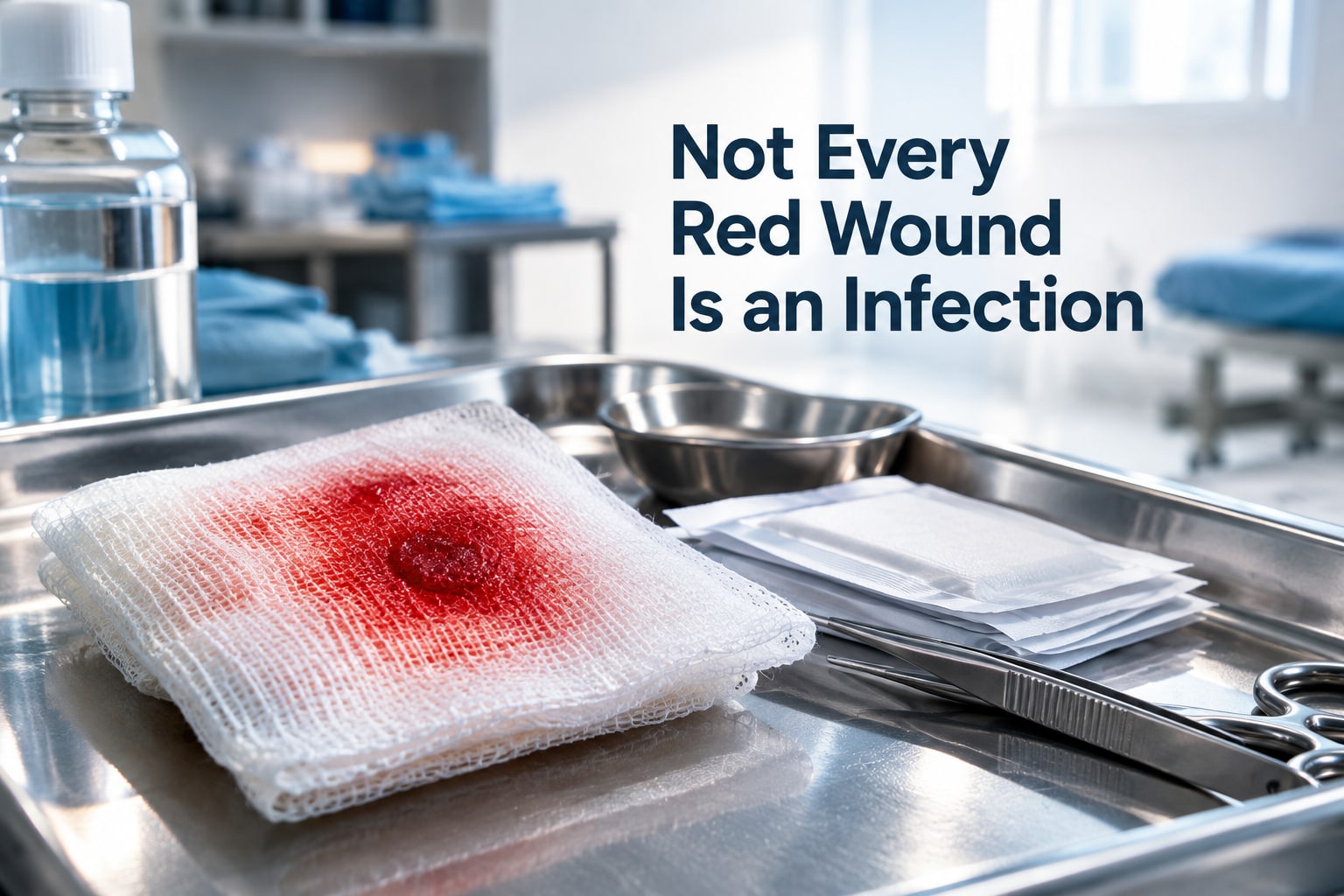
Redness, burning, blistering, drainage and pain after applying chlorhexidine gauze can indicate irritation, allergy, infection or a poor dressing choice. You will learn how to distinguish these problems, when to remove the dressing, which wounds and body sites require an alternative, and what Argentine buyers should verify before ordering.
Key takeaways
- Compare redness, pain and drainage over time before changing the dressing.
- Stop using chlorhexidine gauze when contact dermatitis or a chemical burn is suspected.
- Prevent maceration by avoiding excess antiseptic and changing wet dressings promptly.
- Verify Argentine registration, lot details, expiry date and sterile-pack integrity before buying.
How to tell a dressing reaction from infection or normal inflammation
Mild redness and tenderness confined to the immediate incision can be normal postoperative inflammation, especially soon after surgery. It should not steadily expand or worsen.
Increasing redness beyond the wound edge, spreading warmth, worsening pain, fever, purulent drainage or marked deterioration raises concern for surgical-site infection. Itching, burning, swelling, blistering, weeping, a sharply patterned rash or new fluid trapped beneath the dressing points more strongly to chlorhexidine irritation or contact dermatitis.
- Remove the dressing when a reaction is suspected, then rinse the area according to the clinical protocol. Do not reapply chlorhexidine until the treating team advises you.
- Record the product name, lot or batch number, application time and every symptom, including when it began. This information is essential when reporting chlorhexidine gauze dressing problems argentina to the clinical team or supplier.
- Contact the treating team for assessment. A dressing reaction can resemble infection, and continuing exposure while escalating antibiotics can worsen skin injury and obscure the diagnosis.
Urticaria, facial swelling, wheeze, hypotension or breathing difficulty indicates immediate hypersensitivity and requires emergency care. Facial swelling, breathing difficulty, rapidly spreading redness, fever or rapid overall decline requires urgent escalation rather than routine follow-up. A clinician must decide whether the appearance reflects superficial irritation, allergy, infection, or expected healing; do not diagnose from colour alone.
When chlorhexidine gauze is the wrong dressing choice
A CDC-supported indication for a chlorhexidine-impregnated dressing containing more than 0.5% chlorhexidine with alcohol covers certain short-term central venous catheters in adults. It does not authorise routine use on a closed orthopaedic incision; applying a catheter-site product to an operative wound is off-label unless its instructions and local regulatory status support it.
Do not choose chlorhexidine gauze when any of these conditions apply:
- Known chlorhexidine hypersensitivity or a previous reaction to the product
- Possible contact with the eye, middle ear, meninges or exposed neural tissue
- A deep, infected or heavily exuding wound
- Burns or granulating tissue, when the instructions do not permit contact
- A wound requiring a dressing with specific absorbency, drainage control or non-adherent removal
A plain non-adherent gauze dressing may reduce trauma on a clean, closed incision. A chlorhexidine-free dressing avoids unnecessary exposure, while another antimicrobial dressing may better match a documented indication. Do not treat antimicrobial activity as proof that a product is safe for every wound.
Prolonged or unvalidated exposure raises cellular-toxicity concerns because laboratory studies show concentration- and time-dependent effects on keratinocytes and fibroblasts. The result can be delayed healing, worsening granulation or painful removal, especially when gauze dries into exudate.
“Chlorhexidine gauze” is not a complete specification: antiseptic gauze dressing problems argentina begin when concentration, salt, carrier, release behaviour, labelled site and maximum wear time remain unknown.
How application errors create maceration, burns and removal pain
Apply the dressing only after wound preparation under the clinical protocol: remove blood or exudate when indicated, and let chlorhexidine preparation fluid dry completely before covering the site. Wet antiseptic trapped beneath a patient or under an occlusive secondary dressing increases exposure and can cause burning, chemical injury, maceration, edge leakage and loss of adhesion.
| Application error | Injury or failure | Safer application |
|---|---|---|
| Pooled antiseptic beneath the patient | Concentrated wet contact, burning or chemical injury | Remove excess solution and prevent pooling |
| Covering before preparation fluid dries | Maceration, leakage and poor adhesion | Wait until the skin is visibly dry |
| Heavy exudate with a non-absorbent cover | Fluid accumulation and painful removal | Choose an absorbent secondary dressing matched to exudate |
| Tight fixation or prolonged wear | Pressure injury, skin stripping and removal pain | Secure without excessive pressure and follow the labelled maximum wear time |
| Use on fragile or damaged skin | Irritation, blistering or delayed healing | Avoid unnecessary contact with intact surrounding skin and follow the product’s age and site restrictions |
Premature infants, neonates and patients with fragile skin need particular caution: adult specifications cannot be assumed suitable. Exposure time, solution pooling and occlusion matter more in these groups. These are preventable chlorhexidine gauze dressing issues, not proof that stronger antisepsis is better.
Record the application time and product name. If burning, weeping or painful removal develops, stop and seek clinical review rather than extending wear or reapplying the same product.
What persistent pain, drainage or delayed healing means
Persistent or worsening pain, drainage, or delayed healing requires clinical reassessment, not simply a longer-wearing dressing. Antimicrobial activity reduces surface contamination; it does not sterilize the wound or replace haemostasis, drainage, debridement, dead-space management, or systemic treatment when infection is present.
Escalate for assessment when you see:
- Purulent drainage or a new, persistent discharge
- Wound separation or failure to progress
- Fever or spreading erythema
- A sinus tract
- Pain that increases rather than settles
- Concern for an implant infection or retained devitalised tissue
Blood, exudate, and other organic material can reduce real-world antimicrobial performance compared with laboratory claims. Reported reduced susceptibility to chlorhexidine, including antiseptic-tolerance mechanisms such as qac genes in some organisms, is another reason not to treat it as a universal substitute for infection-prevention bundles or culture-directed therapy.
A dressing may limit surface contamination while the underlying infection continues. Repeatedly painful removal or worsening granulation calls for a different dressing plan, not extended wear time; reassess adhesion, moisture, exposure duration, tissue compatibility, and the wound’s actual cause.
What to verify before buying a chlorhexidine dressing in Argentina
“Chlorhexidine gauze” is not a complete purchasing specification. Request these details before comparing price or pack size:
- Chlorhexidine salt and concentration
- Carrier material, release profile or delivered dose
- Intended body site and labelled wear time
- Sterile-barrier design and sterility method
- Storage limits, shelf life and package-integrity evidence
- Compatibility with blood, exudate and the planned wear time
| Evidence to compare | What it tells you | Warning sign |
|---|---|---|
| Antimicrobial test method | Whether the claim reflects a defined procedure | Only a zone-of-inhibition result |
| Named challenge organisms and contact times | Whether testing resembles the intended use | No organisms, exposure time or exudate conditions |
| Labelled indication | Whether the dressing is for a catheter site, incision or another wound | Catheter-use wording applied to an operative wound |
| Delivered dose or release data | How much chlorhexidine reaches the site over time | Nominal percentage with no release information |
For Argentina, verify the ANMAT registration or applicable authorization, Spanish instructions for use, lot number, sterility statement, Argentine importer or legal-manufacturer details, and a traceable complaint and recall process. “Available in Argentina” or “exportable to Argentina” does not prove authorization for the claimed use.
Komal Health Care Pvt Ltd can be assessed as a potential chlorhexidine dressing supplier argentina only after it provides this documentation and confirms the clinical indication. Keep the decision tied to regulatory evidence, exudate handling and intended body site—not catalogue wording.
Related product
 | Dressings Chlorhexidine Gauze Dressing (Antiseptic Tulle Dressing) Chlorhexidine dressing and antiseptic tulle dressing B.P. Consists of fabric of Leno weave of cotton, which has been impregnated with white soft... View product → |
Frequently asked questions
How can you tell a chlorhexidine dressing reaction from infection or normal inflammation?
Normal inflammation stays mild and close to the incision. A reaction often follows the dressing outline and causes itching or a sharply defined rash. Infection is more concerning when redness expands, warmth increases, pain worsens, drainage becomes cloudy or foul-smelling, or fever develops.
When is chlorhexidine gauze the wrong dressing choice?
Choose another dressing when you suspect chlorhexidine sensitivity, the wound needs moisture balance that gauze cannot provide, the site is heavily exuding, or the antiseptic could damage exposed tissue. Follow the surgeon’s wound-care instructions.
How do application errors cause maceration, burns or removal pain?
Excess solution, occlusion over wet gauze and infrequent changes keep skin waterlogged. Contact with concentrated antiseptic or prolonged exposure can irritate skin. Gauze stuck to dried drainage causes painful removal; moisten it before lifting unless clinical instructions say otherwise.
What do persistent pain, drainage or delayed healing mean?
Persistent or worsening pain, expanding redness, increasing drainage, wound separation or delayed healing requires clinical assessment. These signs can indicate infection, a dressing reaction, tissue damage or another wound complication.
What should you verify before buying chlorhexidine gauze in Argentina?
Check the product name, chlorhexidine concentration, intended use, sterile status, lot number, expiry date, intact packaging, manufacturer, importer and Argentine regulatory documentation. Ask the supplier for traceability records and instructions for use.