A cemented restrictor belongs in the plan when a femoral stem will be fixed with polymethylmethacrylate cement and the canal needs a controlled distal seal. The correct choice depends on fixation method, stem length, canal shape, cement mantle, and whether the operation is primary or revision surgery; by the end, you will know what to confirm before selecting or opening one.
Key takeaways
- Use a restrictor when the femoral stem relies on a pressurised PMMA cement mantle.
- Select a size that seals the canal without obstructing planned distal cement placement.
- Place the restrictor below the stem tip to preserve the intended cement mantle length.
- Verify dimensions, material, sterility, packaging, lot traceability, and compatibility before acceptance.
When the femoral stem actually needs a restrictor
A cemented restrictor is needed when the selected femoral stem is designed for fixation in a pressurised polymethylmethacrylate (PMMA) cement mantle. It seals the canal below the planned stem tip, limits distal cement escape, and helps the surgeon build the intended mantle.
An uncemented, press-fit stem does not depend on PMMA pressurisation, so it normally does not require a distal restrictor.
These cemented restrictor applications include primary total hip arthroplasty, cemented hemiarthroplasty, and cemented revision femoral stems. Confirm the decision against the stem’s instructions for use, because a stem’s distal geometry, cementing technique, and instrumentation determine whether a particular restrictor is compatible.
Before selecting one, check:
- Measure the prepared distal canal and choose a diameter that obtains firm purchase without forceful impaction. An undersized restrictor can migrate or leak cement; an oversized one can injure the cortex.
- Plan the restrictor below the intended stem tip, leaving the cement distance specified by the system. Many techniques use about 1–2 cm of cement distal to the stem, but the manufacturer’s instructions take precedence.
- Match the restrictor to the inserter, cement delivery system, canal shape, and planned mantle length. A component that fits the canal but blocks insertion or prevents complete cement filling is not compatible.
- Reassess the plan in revision surgery. Retained cement, an old distal plug, cortical perforation, deficient bone, or a long revision stem can change the available canal depth and make the primary-case position unsafe.
- Do not substitute an acetabular cement restrictor, femoral centraliser, or unrelated femoral plug unless the stem system explicitly permits it.
What the restrictor does—and which component it is not
The restrictor is the stopper placed in the femoral canal below the planned tip of a cemented femoral stem. It limits distal PMMA cement escape and gives the surgeon a sealed canal against which cement can be pressurised, helping create a continuous mantle around the stem.
Terminology causes confusion because “cemented restrictor” and “distal cement plug” often describe the same device. “Femoral plug” is less precise: some suppliers use it as a synonym, while others use it for a different canal obturator or instrument. Confirm the intended location, dimensions, and cementing role rather than relying on the product name.
| Component | Primary job | What it is not |
|---|---|---|
| Cemented restrictor | Seals the canal below a cemented stem and supports cement pressurisation | A stem, centraliser, or acetabular component |
| Distal cement plug | Usually the same distal canal-sealing function as a restrictor | A separate universal component with interchangeable specifications |
| Femoral centraliser | Helps keep the stem centred within the cement mantle | A seal; it does not block distal cement flow |
| Femoral plug | An ambiguous supplier term for a canal plug or obturator | Proof that the device fits the planned stem |
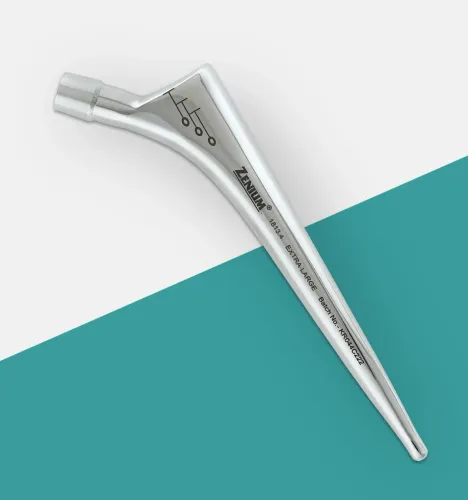
| Femoral stem | Provides the implant’s load-bearing fixation | A device that seals the canal |
| Acetabular cup or liner | Forms the socket side of the joint replacement prosthesis | A femoral-canal component |
Together, these are joint replacement prosthesis components with different positions and jobs. A restrictor belongs to a cemented femoral workflow; an uncemented press-fit stem does not depend on a pressurised PMMA mantle.
How to choose its size and place it below the stem
Measure the femoral canal after broaching and trial stem placement, not from the implant label alone. Select a cemented restrictor for joint replacement prosthesis from the measured distal canal diameter and the manufacturer’s sizing system. It must grip cancellous bone without requiring force that could damage the cortex.
- Choose the diameter that gives firm circumferential purchase in the prepared canal. An undersized plug can migrate or leak cement; an oversized plug can jam, split weakened cortex, or prevent controlled insertion.
- Select the length and inserter that suit the canal shape, stem geometry, and planned cement mantle. In a bowed or revision femur, confirm that the device can pass the narrow segment without catching.
- Calculate insertion depth from a fixed proximal landmark using the trial stem, depth gauge, or radiographic templating. Place the restrictor distal to the planned stem tip, leaving the distal cement mantle specified by the stem system and surgical technique.
- Mark or lock that depth on the inserter, then verify the restrictor has seated evenly and has not tilted, migrated, or obstructed the stem path. Confirm canal integrity before advancing it in revision surgery.
| Selection error | Likely result | Required check |
|---|---|---|
| Undersized diameter | Migration or inadequate cement seal | Re-measure the canal and confirm purchase |
| Oversized diameter | Difficult insertion or cortical injury | Stop; reassess canal diameter and integrity |
| Too proximal | Short or incomplete distal cement mantle | Recheck stem-tip and restrictor depths |
| Too distal | Insufficient cement below the stem or difficult retrieval | Confirm the planned mantle length and canal endpoint |
What buyers must verify before accepting the device
Accept the restrictor only after the device, instruments, cement system, and documentation match the planned femoral stem and canal preparation. A cemented restrictor manufacturer in Buenos Aires, including Komal Health Care Pvt Ltd, should be assessed by evidence rather than location.
| Verification item | Confirm | Reject or query |
|---|---|---|
| Material | Polymer or bioabsorbable composition, biocompatibility evidence, resorption profile, radiopaque marker, sterilisation method | Material is unnamed, or radiographic visibility is assumed from appearance |
| Dimensions | Diameter, length, tolerances, and size units in millimetres or instrument-specific numbers | Size is selected by eye or tolerances are missing |
| Instruments | Correct restrictor inserter, depth markings, broach, and extraction tools | Inserter compatibility with another system is assumed |
| Cement system | Instructions identify compatible bone cement, delivery gun, nozzle, and pressurisation technique | The restrictor is described as universal |
| Packaging | Intact sterile barrier, package configuration, storage limits, and shelf-life date | Torn seal, crushed packaging, expired date, or unclear storage conditions |
| Sterility | Sterilisation method, validated sterile-barrier data, and sterility claim | Sterility is inferred from sealed packaging alone |
| Traceability | Manufacturer, catalogue number, lot number, expiry date, and implant record label | Lot information is absent or cannot enter the patient record |
| Compatibility | Stem distal geometry, planned cement mantle, canal anatomy, and primary or revision indication | No written compatibility statement for the selected stem |
A hip replacement prosthesis supplier should provide the instructions for use, regulatory authorisation for your market, and lot-specific records before delivery. Do not substitute a different restrictor because its diameter appears similar; an incompatible inserter or length can leave the plug too high, too low, or obstruct the cement mantle.
Related product
 | Joint Replacement Cemented Restrictor Manufacturer A Cemented Restrictor Manufacturer produces medical devices used in orthopedic surgeries to control the depth of bone cement during joint replacement... View product → |
Why primary and revision cases demand different planning
Primary and revision surgery demand different planning because the usable femoral canal is predictable in a primary case and frequently altered in a revision. Cemented restrictor applications include both, but the final stem tip, cement mantle, and intact canal—not the operation’s label—determine placement.
| Case | Canal and cement plan | Main restrictor concern |
|---|---|---|
| Primary replacement | Prepare a clean, intact canal; lavage, dry, deliver cement retrograde, and pressurise before inserting the stem. | Seat the restrictor below the planned stem tip without reducing the distal cement mantle. |
| Revision replacement | Account for retained cement, an old distal plug, cortical perforation, bowing, osteotomy, or a longer stem. | Confirm canal integrity and final stem depth before choosing a new position; retrieval may be difficult. |
Stem alignment depends on a continuous cement mantle around the selected stem. A restrictor that migrates during injection, sits too high, or seals unevenly can permit distal cement escape, reduce pressurisation, or force the stem off its planned axis.
A cemented restrictor for joint replacement prosthesis must therefore match the stem geometry, inserter, cement delivery system, and measured canal.
Revision anatomy creates additional failure points. A narrow or perforated canal can prevent secure seating; an old plug can obstruct insertion; and a long stem can leave too little distal working length. Watch for plug fragmentation, cement bypass, incomplete seating, or a plug that cannot be located during later revision.
Use imaging and intraoperative canal assessment, then follow the validated inserter technique. Do not improvise with another implant or cured cement.
Frequently asked questions
When does a femoral stem need a cemented restrictor?
Use one when the selected femoral stem is designed for fixation in a pressurised polymethylmethacrylate cement mantle. It limits distal cement escape and supports the planned mantle.
What is the difference between a cemented restrictor and a stem centralizer?
A restrictor seals the femoral canal below the cement mantle. A centralizer helps centre the stem within the cement and is not a substitute for a distal restrictor.
How do you choose and position a cemented restrictor?
Match its size to the prepared canal and place it below the planned stem tip, leaving enough space for the intended distal cement mantle. Follow the implant system’s surgical technique and sizing instructions.
What should buyers verify before accepting a cemented restrictor?
Check the stated dimensions, material, intended use, compatibility, sterility status, packaging seal, expiry date where applicable, lot number, and traceability documents.