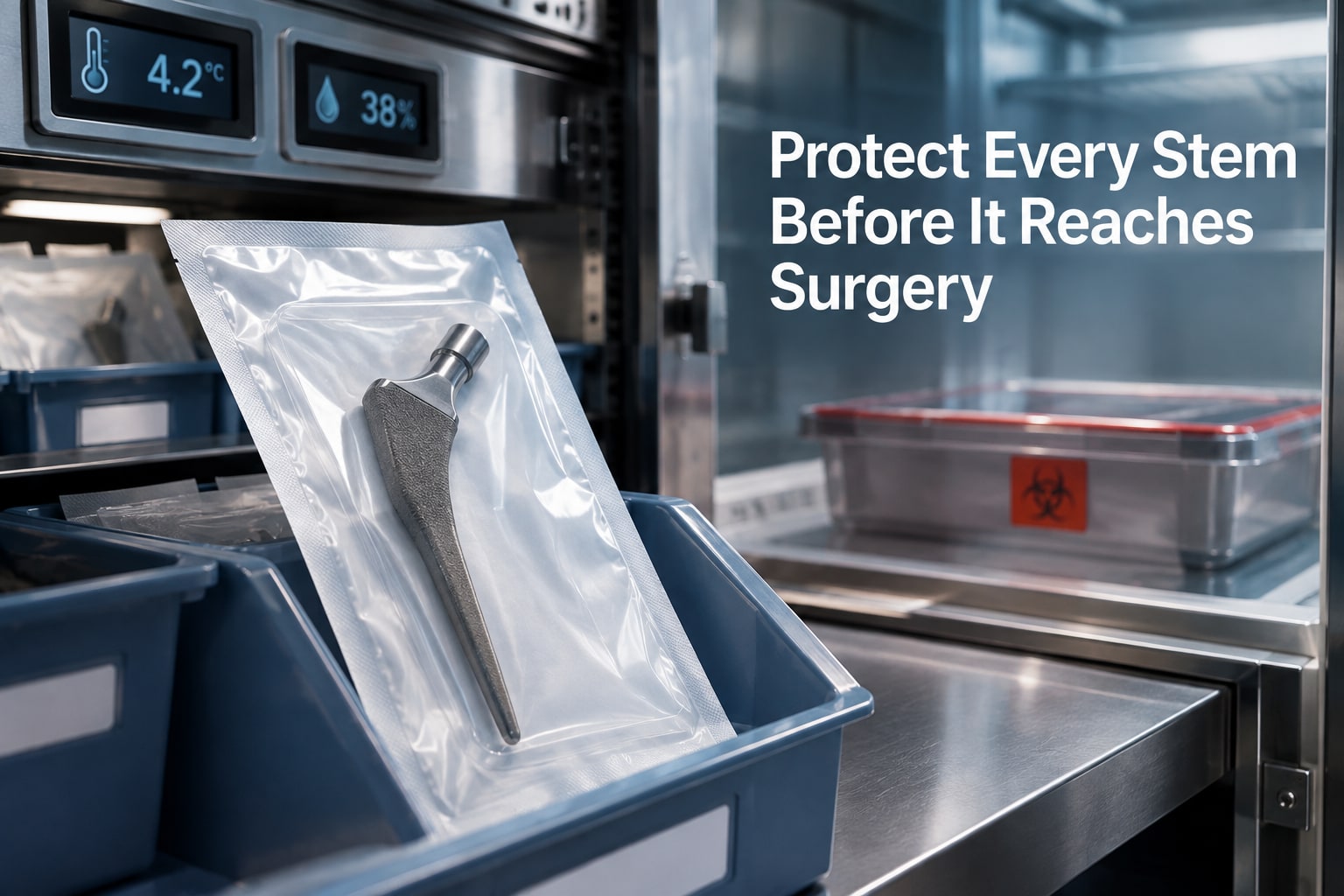
A revision stem can lose its release status before surgery if its sterile barrier is punctured, its label becomes unreadable, or its storage conditions fall outside the current manufacturer’s instructions. By following a documented path from receipt through theatre issue, hospital staff can protect the implant, preserve traceability, and isolate stock affected by heat, moisture, flooding, or handling damage.
Key takeaways
- Quarantine every delivery until lot, expiry, packaging and documents pass inspection.
- Use the current Spanish-language IFU to set temperature, humidity and light controls.
- Keep sterile barriers intact and store cartons off floors, walls and heat sources.
- Release implants only after checking expiry, compatibility, registration and theatre requirements.
Receive, inspect and quarantine every revision stem
Record the supplier, product code, lot or serial number, quantity, expiry date and condition of every revision stem on arrival. Compare the carton with the purchase order and the current Spanish-language IFU, Argentine registration and labeling. Treat the current IFU as the revision stem storage instructions; an old carton or distributor quotation cannot replace it.
Keep sterile revision stems in their original sterile barrier system and separate from trial components and reusable extraction or insertion instruments. Do not open a sterile implant carton to complete a loaner instrument set. Route reusable instruments through their own inspection, cleaning, packaging and sterilization process.
Quarantine the package immediately if you find:
- A puncture, tear, broken seal or crushed corner
- Moisture, staining, condensation or evidence of flooding
- A missing, detached or illegible product, lot or expiry label
- A mismatch between the carton, implant and receiving records
- An expired item, obsolete system generation or incompatibility with the hospital’s revision instruments
Mark quarantined stock clearly, restrict access and notify the supplier and orthopaedic team. Do not return it to the shelf because the implant inside looks intact; damaged packaging can invalidate the sterility claim. Never resterilize or repackage a single-use stem unless its labeling and an authorized, validated hospital process expressly permit it.
Release accepted stock only after the receiving record is complete.
Set the storage environment from the current IFU
Set temperature, humidity, light exposure, orientation and stacking from the current implant system’s instructions for use (IFU), not from a generic “room temperature” label. No single temperature or humidity range is safe for every revision stem: porous-coated, polymer-containing and packaged metal components can have different limits.
| Control | What to follow | What goes wrong if ignored |
|---|---|---|
| Temperature | Record the exact minimum and maximum in the current IFU; do not freeze or expose stock to prolonged heat | Freezing, heat or repeated air-conditioning changes can damage packaging or alter its protective conditions |
| Humidity | Follow the IFU’s stated limit and keep cartons dry; log readings in the storage area | Condensation and damp cartons can weaken sterile barriers and labels |
| Light | Keep implants and cartons away from direct sunlight and strong light unless the IFU permits exposure | Light can fade identification labels and degrade light-sensitive packaging materials |
| Environment | Use a clean, dry, temperature-controlled medical-device area free from dust, chemicals and water | Contamination, spills and vapour exposure can make an intact-looking carton unsuitable |
| Placement | Follow the IFU’s orientation, tray position and stacking limit; never improvise heavy loads above cartons | Crushing or shifting can damage the sterile barrier and implant surfaces |
For revision stem storage for hospitals in Buenos Aires, retain the current Spanish-language IFU and manufacturer safety notices with receiving, sterile-processing, operating-room and orthopaedic teams. Seasonal heat, humidity, power interruptions and movement between a distributor, warehouse and theatre make continuous temperature and humidity logging safer than relying on “ambient conditions.”
A distributor quotation or old carton must not override the current IFU, Argentine registration and product labelling. Quarantine stock exposed to flooding, leaks, smoke, chemicals, condensation or lost environmental control until the manufacturer or device-quality procedure authorises release.
Protect the sterile barrier, surfaces and labels on the shelf
A revision stem stays in its original sterile barrier system until preparation for surgery. Keep the pouch, tray, carton, or protective holder intact; never place an exposed stem on a shelf, in a drawer with loose instruments, or beneath heavy cartons. Impact and abrasion can damage polished tapers, porous coatings, and other functional surfaces.
Shelve cartons with labels visible and the implant supported, not leaning against sharp edges. Use clean, dry, powder-free gloves, and handle the package by its outer surfaces. Do not touch the taper, porous coating, bearing surface, or other assembly interface. Oils, fibres, moisture, and particles can compromise assembly or remain at the implant-tissue interface.
- Quarantine any package with a puncture, tear, broken seal, crushed corner, moisture, or missing or illegible label.
- Record the product name, size, lot or batch number, serial number where applicable, expiry date, and package location before moving stock.
- Keep sterile stems separate from trials, extraction tools, and reusable insertion instruments; each category follows its own cleaning, inspection, packaging, and sterilisation process.
- Isolate any stem that falls or contacts a nonsterile surface. Do not wipe it and return it to sterile stock.
- Retain the current Spanish-language IFU and manufacturer safety notices with the stock records. The phrase “revision stem care argentina” is not a substitute for those instructions or Argentine labelling.
- After flooding, condensation, smoke, chemicals, freezing, or prolonged heat, isolate the affected cartons and obtain a written quality decision before release. An intact outer carton does not prove that the sterile barrier remains acceptable.
Control expiry, compatibility and release to the operating theatre
Do not release a revision stem until its identity, expiry, compatibility and sterile-barrier condition match the scheduled procedure. For revision stem handling in Buenos Aires, use the current Spanish-language IFU, Argentine registration and label, plus current manufacturer safety notices—not an old carton or distributor quotation.
1. Select stock by FEFO: first expiry, first out. Check the expiry date, catalogue or reference number, size, lot or serial number, and system generation. Remove expired, damaged, obsolete or compatibility-flagged stock from available inventory.
2. Inspect the sealed package at issue. Quarantine any carton or sterile barrier that is crushed, wet, punctured, unsealed, stained, exposed to condensation or missing its label. Do not open a sterile implant carton to complete a loaner instrument set.
3. Match the stem to the operative plan and current system documentation. Confirm diameter and length, taper geometry, offset, body or neck option, fixation method, laterality where applicable, and compatibility with the intended head, sleeve, cone or adapter. Similar-looking components from different families or generations are not interchangeable.
4. Record the product name, reference number, size, lot or serial number, expiry date, package condition, issuing staff member, date and theatre or patient identifier. File the issue record with the implant traceability documentation.
5. Obtain the receiving theatre’s confirmation before dispatch. Keep trials, extraction tools and insertion instruments in separate stock categories, with cleaning, inspection, packaging and sterilisation records for reusable instruments.
Manage heat, flooding, transport and supplier documentation
Do not release stock after an environmental incident simply because the carton looks dry. For revision stem storage for hospitals in Buenos Aires, isolate cartons exposed to flooding, roof leaks, condensation, smoke, chemicals, freezing, excessive heat, or an unlogged loss of air-conditioning; record dates, location, duration, logger readings, photos and affected lot numbers.
- Move affected stock to a marked quarantine area without opening sterile packs.
- Stop issue and notify device quality, infection prevention and the supplier or authorised distributor.
- Request the manufacturer’s written disposition and attach it to the incident record.
- Treat wet, punctured, crushed, unsealed, stained or delaminated packaging as failed until that assessment supports release.
- During transport, use covered, clean vehicles and protect cartons from rain, direct sun, condensation and temperature extremes; document handover and logger readings.
Match the current revision stem storage instructions to the exact catalogue number, size and system generation. Keep the Spanish-language IFU, Argentine registration and labelling details, current safety notices, temperature and humidity limits, light exposure rules, orientation and stacking limits accessible to stores and theatre staff.
When Komal Health Care Pvt Ltd supplies components, ask for the applicable IFU revision and lot records rather than relying on an old carton or quotation.
Before issue, compare the product name, reference, size, lot or serial number, expiry date and package condition with the release record. Reject any mismatch.
Frequently asked questions
What must a hospital record when receiving a revision stem?
Record the supplier, product code, lot or serial number, quantity, expiry date and package condition. Compare the carton with the purchase order, current Spanish-language IFU, Argentine registration and labeling before release.
How should a hospital set storage conditions for revision stems?
Use the current product IFU as the controlling document. Set temperature, humidity, light and handling controls from the named ranges and warnings in that IFU, not from an old carton or distributor quotation.
How can staff protect revision stem packaging during storage?
Keep the sterile barrier sealed, dry and free from crushing, punctures, abrasion and label damage. Store cartons on clean shelving rather than floors, and quarantine any pack with a broken seal or unreadable identification.
When can a revision stem be released to the operating theatre?
Release it after staff confirm the expiry date, product and size compatibility, intact packaging, readable traceability details, required Argentine documentation and the theatre's requested implant configuration.
What should a hospital do after heat, flooding or transport damage?
Quarantine affected stock, record the event and inspect packaging, labels and storage records. Do not return implants to usable inventory until the supplier or manufacturer provides a documented disposition.