A combine dressing is not a uniform product category: two pads sold under the same name can differ in layers, wet strength, sterility, packaging and usable absorbency. By the end, you will have a specification, receiving checklist and supplier scorecard for comparing hospital stock safely and at a realistic delivered cost.
Key takeaways
- Use combine dressings as absorbent secondary layers over primary wound-contact dressings.
- Match pad dimensions and absorbency to exudate, wound size and change frequency.
- Request samples, lot records and packaging checks before approving a supplier.
- Compare delivered cost, lead time and stock continuity—not carton price alone.
Define the dressing before comparing suppliers
A combine dressing is a secondary absorbent pad: inner layers collect wound fluid, while an outer protective layer limits strike-through and protects clothing, bedding or fixation. Place it over a primary wound-contact dressing, not directly on tissue when the wound requires a non-adherent contact layer.
It fits exuding closed incisions or open wounds; it is unnecessary for a low-exudate wound that needs only a light cover.
1. Write the specification before requesting quotations. Name the construction—cotton, rayon/polyester nonwoven or multilayer fabric—plus dimensions, ply or basis weight, absorbent capacity, edge construction, backing, sterility status, pack format and intended contact with intact skin, closed incisions or open wounds.
Ask for biocompatibility evidence under ISO 10993 that identifies the tested material, contact type and duration; “ISO 10993 certified” alone is not enough.
2. Distinguish the product by structure and placement, not catalogue names. A gauze swab is a lighter woven or nonwoven primary dressing; an abdominal or ABD pad is a large, high-absorbency pad; a surgical sponge is intended for operative handling and counting; an absorbent roll is continuous material cut to length.
A combine dressing is a defined, layered secondary pad.
3. Reject the wrong clinical match. Do not put loose absorbent cotton on tissue when non-adherence matters, use a bulky pad on a low-exudate wound, or treat any pad as sole control for heavy bleeding or a substitute for assessment. A combine dressing buying guide should therefore specify construction and intended placement before comparing suppliers.
Match size, absorbency and change frequency to the wound
Measure the wound, then choose a combine pad that covers the primary dressing with a controlled margin on every side. Do not add unnecessary overhang: an oversized pad shifts, wets the surrounding skin and wastes stock. Never fold the pad or compress its absorbent core beneath tape, a bandage or tight fixation.
- Review the clinical record and observe strike-through at the last change.
- Classify exudate as low, moderate or heavy.
- Compare thickness, absorbent capacity per pad and fluid retention under pressure.
- Select the smallest pad that contains expected drainage without edge leakage.
- Reassess at each change for leakage, maceration, skin sensitivity and movement.
| Exudate level | Selection focus | Change trigger |
|---|---|---|
| Low | Thin pad and gentle securement | Wetting, soiling or local protocol |
| Moderate | Greater capacity and pressure retention | Saturation risk, leakage or skin deterioration |
| Heavy | High-capacity pad plus clinical reassessment | Strike-through, leakage or bleeding |
Reject “highly absorbent” as evidence. Ask for total uptake or uptake per gram, specimen size, test liquid, contact time, drained mass and test method. ISO 9073-6 provides a nonwoven liquid-absorption reference, not proof of clinical performance. If EN 13726 is cited, request the exact test and result.
Set change frequency from saturation risk, leakage, skin condition and local nursing protocol, not a catalogue interval. Use skin-compatible adhesive and securement that does not constrict the core. Handle every pad once; discard blood-contaminated pads through the facility’s infectious-waste workflow in wards, theatres and emergency departments, and give discharge packs clear single-use and disposal instructions.
Choose sterility, barrier packaging and detectable features by care setting
Sterile and non-sterile combine dressings are separate procurement products, not alternative pack sizes. Sterile stock needs validated sterilisation, a sterile-barrier system, controlled seals and lot-level release records; non-sterile bulk stock needs a defined reprocessing pathway or an approved wound-use pathway that prevents unprocessed material contacting tissue.
| Product | Evidence to request | Use decision |
|---|---|---|
| Sterile | ISO 11135 ethylene oxide or ISO 11137 radiation validation; lot release record; ISO 11607 packaging validation | Use when the dressing enters a sterile procedure or wound-care pathway requiring sterility |
| Non-sterile | Material specification; cleanliness controls; written reprocessing or wound-use instructions | Use only where the clinical protocol permits non-sterile contact |
Ask for residual-sterilant and aeration evidence for ethylene oxide, or dose validation and material or packaging-effect data for radiation. Separate the sterile barrier pack from the shipping carton and record units per inner pack, inner packs per case and usable pads per case.
Request seal-strength or leak-test results, transport simulation, storage conditions and labelled shelf life under ISO 11607.
Verify X-ray-detectable elements on the product label and specification, then include detection in the theatre count procedure. Never infer detectability from “surgical.”
At receipt and before use, inspect:
- Seals, cleanliness, odour and label accuracy
- Crushed or wet cartons, open or weak seals and mixed lots
- Lot or batch number, expiry date, sterilisation method and sterility indicator
Quarantine defective or mixed-lot packaging; do not accept it routinely.
Audit performance claims through samples and lot documents
A sample proves only what arrived in the sample box. An auditable claim links the exact lot to defined materials, packaging and test results, so a hospital wound dressing supplier must provide records rather than phrases such as “high absorbency” or “international quality standards.”
1. Request a technical data sheet, certificate of analysis or declaration of conformity for the exact lot. It must state absorbency capacity per pad, retention under pressure, strike-through resistance, lint shedding, wet strength, dimensions, layer construction, packaging cleanliness and batch consistency. Require each test method, specimen-conditioning temperature and humidity, specimen size, and acceptance limit.
2. Check the ISO 13485 certificate for the named manufacturing site, product category, certification scope and validity dates. ISO 13485 demonstrates a medical-device quality system; it does not prove clinical suitability, sterility or Argentine authorization.
3. Require traceability from the finished pack to the absorbent material, backing, packaging components and sterilisation batch. Ask for retained samples, incoming inspection records, and a written complaint, recall and replacement process. Define quarantine for open or weak seals, wet or crushed cartons, missing labels, mixed lots, abnormal odour or visible fibre shedding.
4. Evaluate samples under a written, controlled fluid-comparison protocol, never as an improvised clinical trial. Inspect construction, dimensions, labels, seals and lint, then compare measured uptake and leakage under identical conditions. Obtain nursing, infection-control and procurement sign-off before contracting; do not treat one attractive sample as proof of production consistency.
Compare Argentine suppliers by delivered reliability, not carton price
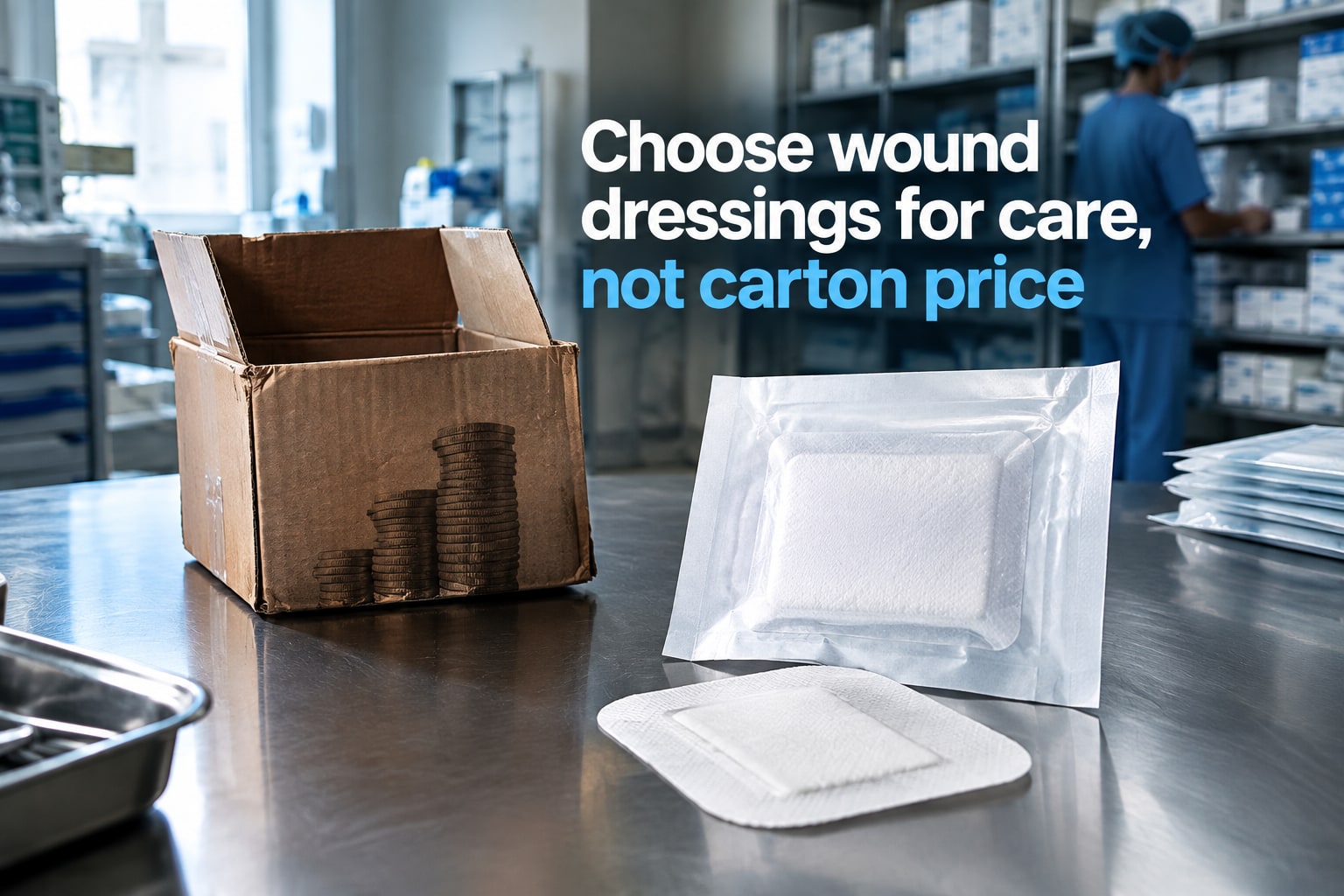
Carton price hides the real decision: compare the cost of one usable dressing delivered to the ward. For a choosing combine dressing supplier argentina review, verify the exact presentation’s classification, ANMAT registration or authorization where applicable, responsible importer or establishment, Spanish label, lot, expiry and required import documentation.
A foreign quality certificate does not establish Argentine market authorization.
| Supplier | Verify before approval | Cost and continuity test |
|---|---|---|
| Buenos Aires distributor | Holds local stock; identify legal manufacturer, importer and complaint owner | Domestic lead time, coverage beyond Buenos Aires, emergency replenishment |
| Argentine manufacturer | Confirm establishment responsibility, design-change control and technical records | MOQ, expiry on delivery, lot rotation and replacement policy |
| Imported product | Confirm authorized importer, import file, Spanish labelling and recall contact | Freight, customs clearance, currency, payment terms and import lead time |
For a combine dressing manufacturer argentina or surgical dressing distributor in buenos aires, score each candidate against the same checklist:
- Price each usable dressing after sterile-pack quantity, rejected or damaged units, freight, customs, expiry wastage and emergency orders.
- Request samples plus lot-specific certificates, technical records, complaint and adverse-event procedures, recall communication, and documentation for the exact presentation.
- Record stock physically held in Argentina, par and emergency levels, back-order substitutions, Spanish invoices and institutional-tender support.
- Put normal and emergency delivery times, minimum remaining expiry, replacement terms and recall-notification time into a written service level.
- Ask who controls design changes and supplies lot documents. Komal Health Care Pvt Ltd belongs in the comparison only after these documents, production capacity and local supply terms are verified.
Related products
 | Surgical Dressing We offer a quality range of Combination dressing pads, combine dressing pad where high absorbency is required to handle heavy drainage, promote... View product → |
 | Surgical Disposable Our organization manufactures a premium range of Gauze Dressings that includes sterilized and non-sterilized Gauze Swabs, lab sponge and gauze roll. View product → |
Frequently asked questions
What is a combine dressing used for?
A combine dressing is a secondary absorbent pad placed over a primary wound-contact dressing. It collects wound fluid and helps limit strike-through onto clothing, bedding or fixation.
How do you choose the right combine dressing size and absorbency?
Match the pad’s dimensions and absorbency to the wound area, exudate volume and planned change frequency. A larger or more absorbent pad is not automatically better if it creates bulk or delays needed changes.
Which combine dressing features matter in different care settings?
Check sterility, barrier packaging and detectable features against the care setting. Hospital operating rooms, wards, outpatient clinics and emergency services can have different handling and identification needs.
How should you compare combine dressing suppliers in Argentina?
Review samples, lot documents, packaging integrity, lead times, stock continuity and delivered cost. Compare the complete supply performance rather than relying on carton price alone.
Related products
 | Dressings Chlorhexidine Gauze Dressing (Antiseptic Tulle Dressing) Chlorhexidine dressing and antiseptic tulle dressing B.P. Consists of fabric of Leno weave of cotton, which has been impregnated with white soft... View product → |
 | Dressing Superior range of Sterilized Ward Gauze are made from B.P. & I.P. type gauze having chlorine free bleach. View product → |
 | Dressings Paraffin Gauze Dressings are used to dress denuded areas and hence these gauze are specially coated with soft paraffin jelly. View product → |
 | Surgical Dressing Our OT Gauze Swabs, cotton swabs are available in different folds and can also be customized as per client's requirement. View product → |