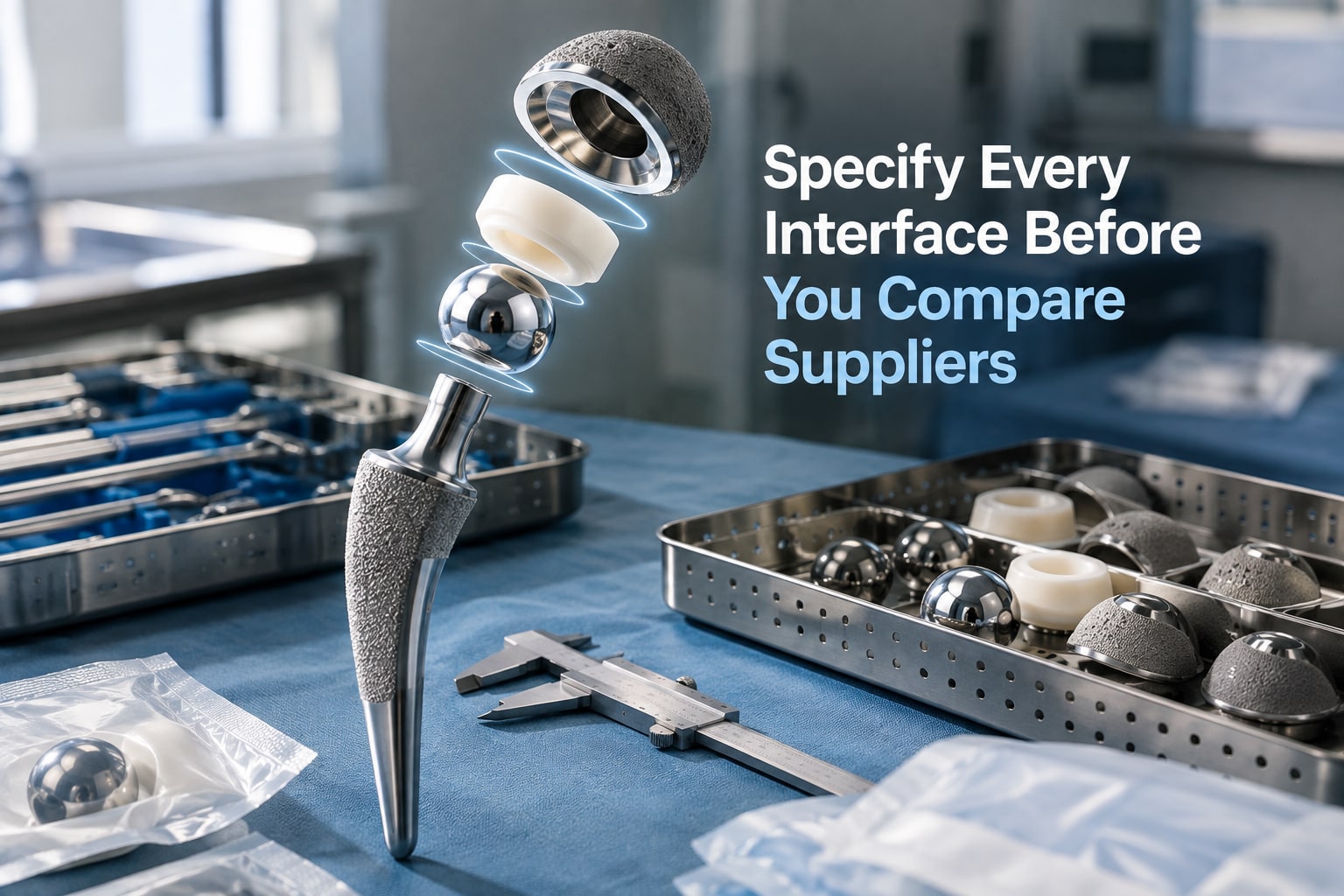
A catalogue name does not tell a hospital whether a cemented stem will fit its available heads, bipolar shells, instruments, cementing protocol or regulatory file. By the end, you will have a practical specification and verification checklist for comparing stem systems, supplier submissions and tender documents in Buenos Aires.
Key takeaways
- Request a separate dimensional row for every stem size and increment.
- Record stem material, surface finish, geometry and cementing interface.
- Approve exact head, cup and stem combinations before tender evaluation.
- Check Argentine registration, batch traceability and sterile packaging documents.
Build a dimensional schedule that removes ambiguity
A catalogue calling a stem small, medium or large cannot support canal compatibility or radiographic templating. For bipolar modular stem cemented specifications in buenos aires, require one completed row for every stem size and increment, not a range summary.
| Field | Supplier must record |
|---|---|
| Stem size | Exact meaning: stem body, canal-fill dimension or another catalogue measurement; every size and increment |
| Geometry | Overall length, proximal height and width, distal diameter, offset options, neck geometry, left/right compatibility |
| Taper | Designation, angle and dimensions; every available neck length; approved head materials |
| Bipolar dimensions | Femoral-head bearing diameter and bipolar-shell outer diameter as separate fields; “size 44” is unusable unless 44 mm is defined |
| Compatibility | Approved stem-head and head-neck combinations; every modular junction; whether the stem body is one component or contains interlocking segments |
| Control data | Dimensional tolerances, exact catalogue number, packaging configuration, sterile or non-sterile presentation |
Request cemented femoral stem product details in this format. “Modular” commonly identifies interchangeable neck or head components; it does not mean the stem body consists of multiple interlocking segments. Confirm that distinction in writing, and reject any offer that leaves the taper or junction unspecified.
List each configuration’s catalogue number beside its head, shell, neck and stem sizes. Record whether left and right versions differ, because a shared label does not prove compatibility. Pair the schedule with radiographs or templating data; nominal size alone cannot show that the stem fills the patient’s canal.
Specify the stem surface, material and cementing interface
The stem’s material and geometry determine how it moves, loads and remains supported inside the PMMA mantle. Request the exact alloy and stem-specific declared standard, such as ISO 5832-1 where claimed; do not transfer an SS 316L/LVM statement from a bipolar-prosthesis page to the stem without written confirmation.
| Feature | Record | Why it matters |
|---|---|---|
| Surface | Polished or matte | Influences stem–cement movement and fixation behaviour |
| Shape | Collar or collarless; fenestrated or solid | Changes proximal support and cement interlock |
| Taper | Tapered or parallel in each zone | Affects subsidence, load transfer and mantle stress |
| Distal geometry | Centralizing tip or canal-filling profile | Determines distal position and mantle symmetry |
Ask for collar dimensions, proximal canal-fill geometry, distal diameter, centralizer compatibility and every supplied centralizer size. State whether the stem’s design supports a planned 2–3 mm mantle; treat that figure as a planning reference, not a guarantee, because canal preparation, stem size, distal plugging and centralization control the achieved mantle.
For cemented stem specifications Argentina hospitals should request ISO 5833-compliant PMMA cement documentation covering validated hand or vacuum mixing, doughing, working and setting times, viscosity, radiopacity, storage conditions and package size. Identify which restrictor sizes fit each stem. “PMMA compatible” alone proves no combined validation.
For complete cemented hip implant specifications, request ISO 7206-4 and ISO 7206-6 reports naming the tested stem size, loading configuration and failure criteria. Record ASTM F621 evidence where declared.
Define the approved component combinations and instrument set
Treat the proposed system as a bipolar hemiarthroplasty system only when the femoral head articulates inside a mobile liner and the bipolar shell articulates with the patient’s acetabulum. The package must exclude an acetabular cup because it is not a total hip arthroplasty.
If conversion is supported, name the exact compatible acetabular cup, liner and shell components; do not assume interchangeability.
The procurement schedule must identify:
- Stem-head combinations approved by the manufacturer, taper designation and dimensions, head materials, femoral-head diameters, bipolar-shell outer diameters, liner material and every neck length.
- Written confirmation before mixing product families. Equal nominal head diameters do not prove taper fit; unapproved combinations risk poor seating, fretting, corrosion and disassembly.
- Each stem size matched to its reusable or single-use rasps, broaches, trial heads, trial shells, head impactors, centralizers, distal restrictors and extraction tools.
- Reprocessing instructions for reusable instruments, including cleaning, inspection, packaging and sterilization, plus whether vacuum-mixing equipment is supplied, required or excluded.
- Sizing radiographs or templating guidance, contraindications, cementation steps and revision or extraction instructions.
| Component | Required specification | Procurement status |
|---|---|---|
| Stem and head | Catalogue numbers, taper, neck length and approved combination | Include only when confirmed in writing |
| Shell and liner | Shell outer diameter stated separately from head bearing diameter; liner material identified | Include for hemiarthroplasty |
| Instruments | Size-specific trials, broaches, impactors, centralizers and restrictors | Include with reprocessing status |
| Cement protocol | PMMA method and equipment compatibility | State supplied, required or excluded |
These cemented hip implant specifications and cemented femoral stem product details prevent a trial component from being mismatched with the definitive implant.
Verify Argentine registration, traceability and sterile presentation
Request the current ANMAT registration certificate or applicable authorization before purchase. For cemented stem specifications Argentina buyers should verify, confirm the record through official ANMAT sources or the hospital regulatory department, and use the tender dossier as the controlling checklist.
1. Match the registration or authorization number, holder, importer, manufacturer, model designation, intended use, sterile presentation and authorized accessories to the exact stem, size range and components. If the model, holder, importer or validity status does not match, pause procurement and refer the discrepancy to regulatory staff.
2. Ask for the ISO 13485 certificate, declared implant-material standard, applicable ISO 7206-4 and ISO 7206-6 reports, certificate of conformity for every supplied configuration and tender-specific technical declarations. ISO 13485 supports quality-system review; it does not establish Argentine market authorization.
Request the tested stem size, loading configuration and failure criteria, and note ASTM F621 when declared.
3. Record each catalogue number, lot or batch number, expiry or shelf-life date and format, sterilization method, sterile-barrier configuration, packaging validation, storage limits, Spanish instructions for use and Spanish implant labels when required.
Check stems, heads, shells, liners and instruments separately: a bipolar modular stem cemented specifications in Buenos Aires submission can contain sterile and non-sterile items with different expiry dates.
4. Confirm whether reusable or single-use components have distinct reprocessing instructions and whether the offered configuration matches the authorization. A generic “ANMAT approved” statement is not enough; the documents must identify the supplied model and accessories. Keep the signed verification with the tender record.
Turn supplier responses into a comparable tender decision
A bipolar modular cemented supplier must complete one evidence-based matrix, not submit an alloy declaration and product photograph. Use the same cemented hip implant specifications fields for every bidder.
| Stem sizes and increments | Length | Offset | Neck and taper options | Material standard | Surface finish | Collar | Fenestration | Distal geometry | Centralizer and restrictor fit | Cement protocol | Head and shell combinations | Instruments | Sterility | Shelf life | Traceability | Argentine authorization evidence |
|---|---|---|---|---|---|---|---|---|---|---|---|---|---|---|---|---|
| Catalogue number, measurement definition and document | mm, tolerance and document | mm and document | Neck lengths, taper designation, dimensions and approved combinations | Exact alloy and standard, such as ISO 5832-1 | Polished or matte | Dimensions, or collarless | Fenestrated or solid | Tapered, parallel, distal diameter and canal-fill purpose | Compatible sizes, catalogue numbers and fit evidence | Cement, mixing method, working and setting times, storage and restrictor sizes | Head diameter, shell outer diameter, liner, taper and validation | Broaches, rasps, trials, impactors, centralizers, restrictors, mixing and extraction tools | Sterilization method, sterile barrier or non-sterile status | Expiry date and storage limits | Lot or serial format | ANMAT number, holder, importer, manufacturer, model and authorized accessories |
Require each supplier to return this matrix with supporting documents, not “PMMA compatible” or “ANMAT approved.” Include Komal Health Care Pvt Ltd as one bidder tested against every field.
The quotation must separate implants, cement, restrictors, centralizers, instruments, packaging and replacement items, stating inclusions for each stem size. Reject broader size claims or lower administrative effort when taper data, validated combinations or model-specific authorization is missing. Retain the signed response for receiving and pre-implantation checks.
Related product
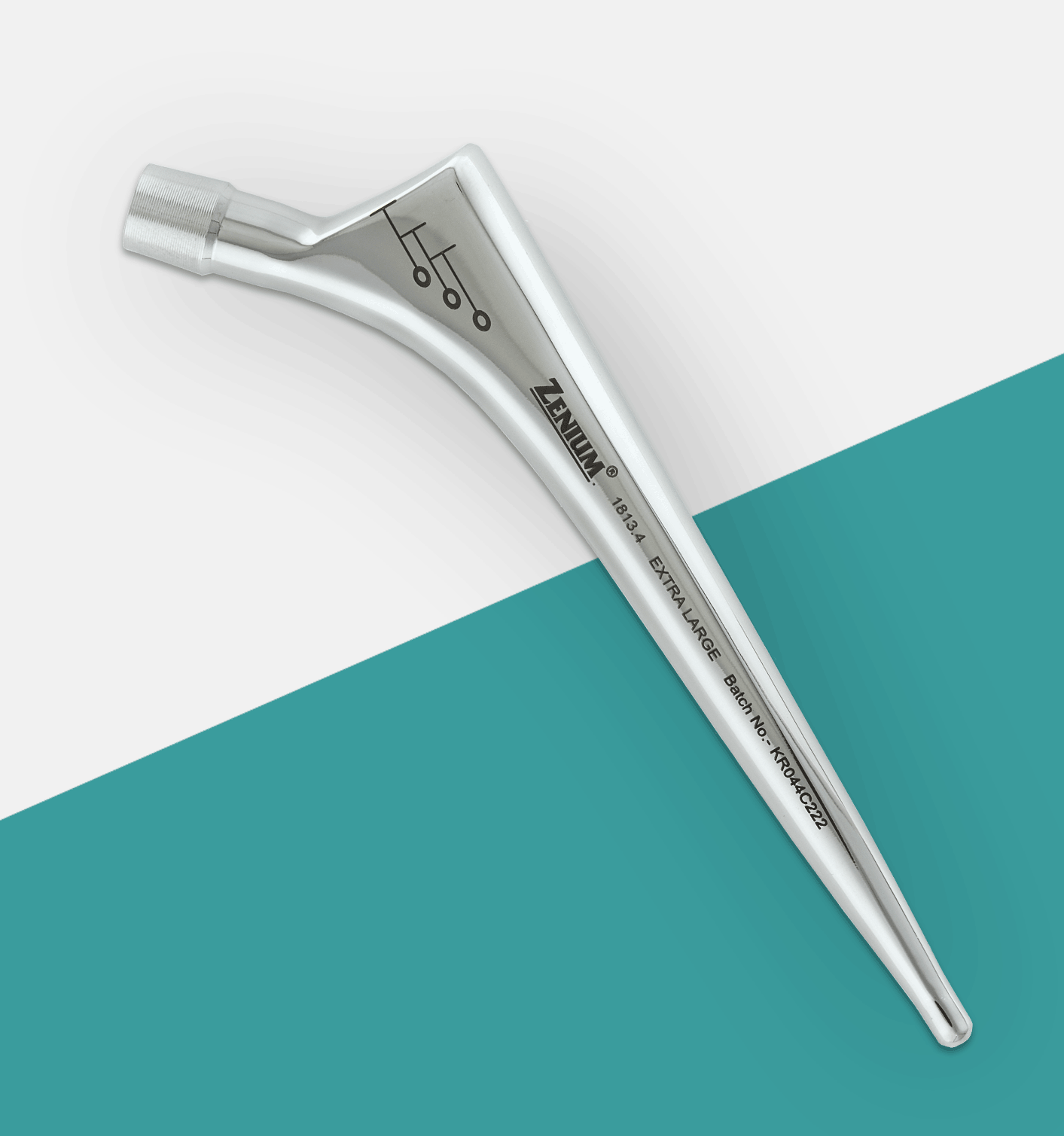 | Joint Replacement Bipolar Modular Stem (Cemented) Manufacturer The Bipolar Modular Stem (Cemented) is an orthopedic implant used in hip replacement surgeries, especially for elderly patients with fractured or... View product → |
Frequently asked questions
What dimensions belong in a bipolar modular stem cemented specification?
List every stem size and increment with dimensions needed for canal compatibility and radiographic templating, rather than using small, medium or large labels.
Which stem surface and cementing details should hospitals specify?
State the stem material, surface finish, geometry and cementing interface so suppliers cannot substitute an unreviewed design.
What component combinations and instruments should a tender approve?
Define compatible stem, femoral head and bipolar cup combinations, then request the matching trial, broach, inserter and extraction instruments.
How can hospitals verify an Argentine cemented hip implant supplier?
Check Argentine registration, manufacturer and batch identifiers, traceability records, sterile presentation, expiry information and supporting documentation.
How do you compare supplier responses for cemented bipolar stems?
Convert each response into the same dimensional, material, compatibility, instrument, registration and sterile-packaging fields before scoring the tender.